Here is a question most business owners in Dubai have never stopped to consider: what language do your customers actually search in?
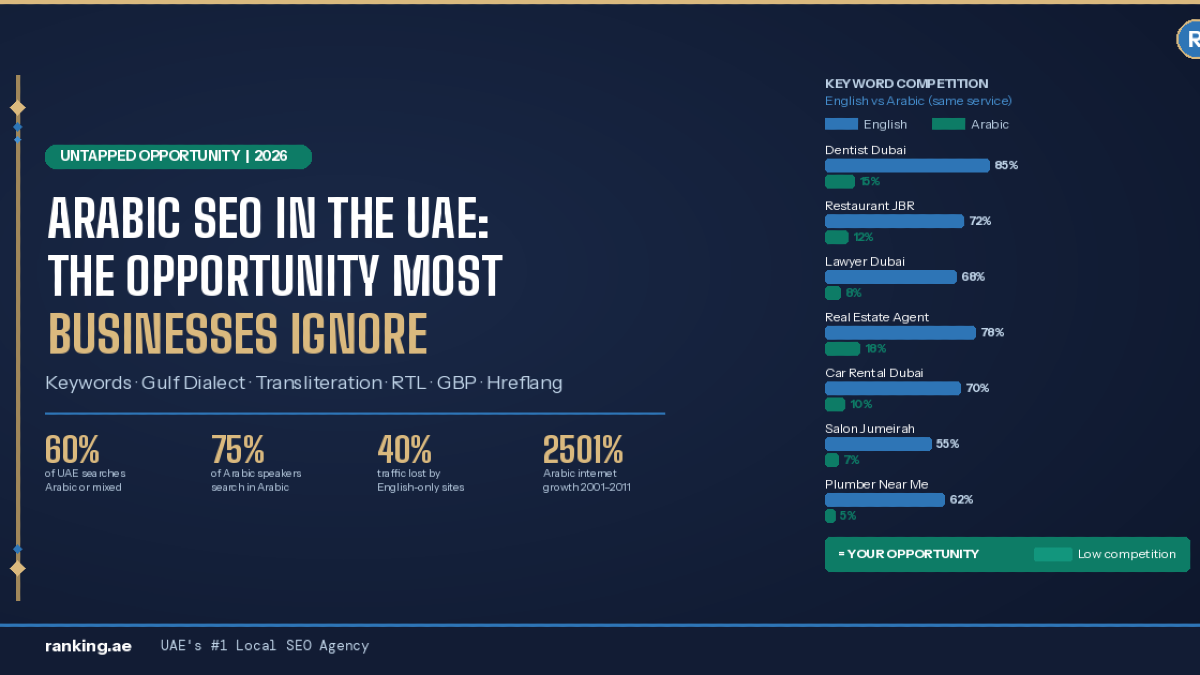
The assumption is English. And for a large share of searches in the UAE, that is correct. But the assumption that English covers the entire market is wrong, and it is costing businesses real money every day. Research from BrandStory indicates that roughly 75% of Arabic speaking users in the MENA region conduct online searches in Arabic. Vista by Lara's 2025 analysis estimates that 60% of searches originating in the UAE are either in Arabic or a mix of Arabic and English. HM Aslam's bilingual SEO research puts the cost bluntly: businesses targeting only English keywords lose 40 to 50% of potential organic traffic.
If your website, your Google Business Profile, and your content exist only in English, you are invisible to a significant and growing segment of people who are searching for exactly what you sell.
The scale of the missed opportunity becomes clear when you look at the competitive landscape. We audit local SEO for Dubai businesses almost every month, and the pattern is consistent across industries: English keywords are crowded. Dozens of optimized pages, paid ads, featured snippets, and aggressive competition for every high value English search term. Arabic keywords for the exact same services have a fraction of that competition. Sometimes there are only a handful of partially optimized pages. Sometimes there are none at all.
Arabic is the fifth most used language on the internet globally. Between 2001 and 2011, Arabic language usage online grew by 2,501%, faster than English (281%), Chinese (1,277%), or Spanish (743%). And yet, Arabic makes up only about 1 to 1.5% of online content despite being spoken by over 420 million people worldwide. That gap between the number of Arabic speakers and the amount of Arabic content online is the fundamental market inefficiency that Arabic SEO exploits.
In our Ultimate Guide to Local SEO in Dubai, we flagged Arabic SEO as an underserved opportunity. Our 10 Local SEO Mistakes post listed English only optimization as one of the most costly errors UAE businesses make. This guide is the full playbook for fixing that. It covers why Arabic SEO matters, how it differs from English SEO, the linguistic layers you need to understand, the technical requirements, the keyword research process, how to implement a practical bilingual strategy, which industries benefit most, and how to measure results.
Why Arabic SEO Is the Biggest Gap in UAE Local Search
The UAE has a population of roughly 10 million people. While expatriates make up about 85%, a substantial portion of those expats come from Arabic speaking countries: Egypt, Jordan, Lebanon, Syria, Palestine, Iraq, Morocco, Tunisia, and across North Africa. Add the Emirati national population, the Arabic speaking business travelers, and the tourists from the GCC and wider Arab world, and the Arabic speaking audience in the UAE numbers in the millions.
But the language picture is more complex than simply "Arabic speakers vs. English speakers." Many residents are bilingual or trilingual, and they switch languages depending on context. A 2017 Arab Youth Survey by PSB Insights found that in GCC countries, 56% of young adults aged 18 to 24 reported using English more than Arabic on a daily basis. That might suggest English dominance, but it misses a critical nuance: the same people often switch to Arabic for specific, high trust decisions.
Someone might casually search for a restaurant in English. But when they need a lawyer for a family matter, a doctor for a sensitive condition, a school for their child, or a government service, they frequently switch to Arabic. These are decisions where cultural familiarity, trust, and precision of language matter more than convenience. The Wick Firm's research confirms this: Arabic queries in the UAE tend to be longer, more question based, and more prevalent in industries where trust is the primary purchase driver: healthcare, legal, education, real estate, and professional services.
On the supply side, the picture is stark. Walk through the first three pages of Google results for almost any service keyword in Dubai, and count how many results are properly optimized in Arabic. For most industries, the number is close to zero. Most businesses have English only websites, English only Google Business Profiles, English only blog content, and English only meta tags. This creates a rare supply and demand imbalance: real search volume with almost no competition.
A dental clinic targeting "teeth whitening Dubai" in English competes against hundreds of optimized pages. The same clinic targeting تبييض أسنان في دبي (teeth whitening in Dubai) in Arabic may face five or fewer. The effort to rank is dramatically lower. The audience is real. And the conversion rates are often higher because Arabic searchers landing on Arabic content feel an immediate sense of trust and cultural alignment that an English page cannot provide.
Arabic SEO Is Not Translation. This Is the Most Important Thing You Will Read Here.
The single biggest misconception about Arabic SEO is that it means translating your English content into Arabic. This approach fails, and it fails consistently, for three specific reasons that every business owner needs to understand before investing a single dirham.
People Do Not Search the Way Translators Write
Arabic is not one language. It is a family of related but distinct varieties. Modern Standard Arabic (MSA) is the formal written form used in news, government, academia, and literature. It is the version taught in schools. It is also not the version most people type into Google when they want to find a plumber.
In the UAE, the spoken and searched variety is Gulf Arabic (خليجي, khaleeji). Gulf Arabic has distinct vocabulary, pronunciation, and grammar compared to MSA and compared to other major dialect groups like Egyptian Arabic, Levantine Arabic, and Maghrebi Arabic. A word that means one thing in Gulf Arabic might mean something different in Egyptian Arabic. A phrase that sounds natural in Dubai might sound foreign to someone from Cairo.
For example, the word for "car" in MSA is سيارة (sayyara). But in Gulf Arabic, people commonly say موتر (motar, from the English "motor"). The word for "key" in MSA is مفتاح (miftah). In Emirati dialect, it is often سويج (sweej, from "switch"). A keyword research strategy that only translates English terms into MSA will miss the colloquial terms that people actually type. And it is the colloquial terms that carry the lowest competition and highest local relevance.
Search Intent Differs Fundamentally Between Languages
The same service can trigger completely different search behaviors in Arabic and English. In English, someone might type a terse, transactional query: "best restaurant JBR." In Arabic, the same person might ask a more detailed, investigational question: أفضل مطعم في جي بي آر مع جلسات خارجية وأسعار معقولة (best restaurant in JBR with outdoor seating and reasonable prices).
The Wick Firm's analysis and Maps of Arabia's keyword research both confirm that Arabic search queries are generally longer, more conversational, and more likely to start with question words like كيف (how), ما هو (what is), or أين (where). This means Arabic content needs to be structured around answering questions, not just matching keywords. FAQ sections, detailed guides, and conversational content perform particularly well for Arabic queries.
Your Arabic content needs to match Arabic intent. Translating your English page's intent into Arabic does not accomplish this because the questions people ask and the information they expect differ between languages.
Machine Translated Content Damages Your Brand and Your Rankings
A machine translated page reads awkwardly to any native speaker. Sentence structures that flow naturally in English break when converted literally to Arabic. Idiomatic expressions become nonsensical. Technical terms get mistranslated. The gender system in Arabic (which affects verbs, adjectives, and pronouns) is routinely mangled by automated translation.
BUZ Agency in Dubai states it plainly: your Arabic site should not feel like a Google Translate afterthought. Each version needs to feel native. Conquerra Digital's case study found that an Arabic SaaS platform that replaced translated pages with native Arabic sales copy saw a 40% higher lead conversion rate. Another case: a Dubai retail brand that restructured category pages with dialect aware, long tail Arabic terms saw a 45% increase in organic sessions within three months.
Google's algorithms are also sophisticated enough to identify thin, unnatural, or low quality content in Arabic. A poorly translated page does not just fail to connect with users. It signals to Google that the page is low effort, which suppresses its rankings and can hurt the authority of your domain overall.
The Three Layers of Arabic Keywords
Effective Arabic keyword research requires targeting three distinct linguistic layers. Most businesses and agencies working in the UAE address at most one of these. Capturing all three is where the competitive advantage lies.
Layer 1: Modern Standard Arabic (MSA)
These are the formal Arabic terms for your services, written in standard Arabic script. طبيب أسنان (dentist), مطعم (restaurant), محامي (lawyer), مكتب عقارات (real estate office), صالون تجميل (beauty salon), سباك (plumber). Pair these with location terms: دبي (Dubai), أبوظبي (Abu Dhabi), الشارقة (Sharjah), plus neighborhood names in Arabic. MSA keywords are the foundation. They capture the formally educated searcher, the person writing as they would in a newspaper. They are also the easiest to research because standard Arabic translation tools can produce them reasonably well.
Layer 2: Gulf Arabic Colloquial Terms
This is where generic translation fails and local knowledge wins. Gulf Arabic uses different words, shorter constructions, and loanwords from English, Persian, and Hindi that MSA does not include. In Gulf Arabic, a phone is يوال (yawal) rather than the MSA هاتف (hatif). Cash is كاش (borrowed directly from English). A workshop is ورشة (warsha). Gulf Arabic also incorporates English loanwords for modern services in ways that MSA does not: بنك (bank), ليزر (laser), فايل (file).
For SEO, this matters because a Gulf Arabic speaker searching for car services might type موتر instead of سيارة. A person looking for a specific dish might use the Gulf Arabic name rather than the MSA term. Capturing these dialectal variations means your content appears for searches that a pure MSA strategy misses entirely. The competition for dialectal terms is even lower than for MSA terms because almost no one targets them deliberately.
Layer 3: Transliteration (Arabizi)
This is the most overlooked layer and often the least competitive. Arabizi is the practice of writing Arabic words using Latin (English) letters and numbers. It is widespread among younger, bilingual users who are comfortable on English keyboards but think in Arabic. The numbers replace Arabic letters that have no Latin equivalent: 3 represents ع (ain), 7 represents ح (ha), 2 represents ء (hamza).
Examples: "tabib asnan" for dentist (طبيب أسنان), "mat3am" for restaurant (مطعم), "mo7ami" for lawyer (محامي), "7alaq" for barber/salon (حلاق). These transliterated keywords appear in Google's autocomplete suggestions. They carry real search volume. And because they look like English text to most SEO tools and agencies, they are almost universally ignored. A business that creates content targeting "tabib asnan dubai" alongside the formal Arabic and English versions of that query is covering ground that no competitor even knows exists.
Arabic Keyword Research: The Process
Do not start by translating your English keyword list. Start from scratch, thinking in Arabic.
Step 1: Identify your services in all three Arabic layers. For each core service, write the MSA term, the Gulf Arabic colloquial term (if different), and the Arabizi transliteration. If you do not speak Arabic, work with a native Gulf Arabic speaker for this step. Do not rely on standard Arabic dictionaries, which default to MSA and miss dialectal and transliterated variations.
Step 2: Pair services with locations in Arabic. Your Dubai neighborhoods have Arabic names: دبي مارينا (Dubai Marina), البرشاء (Al Barsha), جميرا (Jumeirah), ديرة (Deira), مركز دبي المالي العالمي (DIFC). Some neighborhoods are commonly searched in transliteration too: "JBR," "JLT," "Business Bay" remain in English even in Arabic context searches. Build combinations: service + location in all three layers.
Step 3: Research volume and competition. Use Google Keyword Planner with location set to United Arab Emirates and language set to Arabic. Use Google Trends filtered by UAE to compare Arabic vs English volumes for the same topic. Use Semrush or Ahrefs with Arabic language settings. IstiZada's keyword research methodology emphasizes that search behavior in the MENA region is significantly different from other markets, and a simple translation of English keywords will not suffice. Check Google autocomplete in Arabic: type the beginning of your Arabic service term and see what Google suggests. Check the يسأل الناس أيضًا (People Also Ask) section in Arabic search results.
Step 4: Compare competition side by side. For every high priority keyword, run the English version and the Arabic version in a Google search and compare the results. Count how many pages on the first page are genuinely optimized. For English terms, you will typically find 8 to 10 optimized results. For Arabic terms, you might find 2 to 3, with several results being auto translated or partially relevant. That gap is your opportunity.
Technical Requirements for Arabic Websites
Arabic is a right to left (RTL) language, and supporting it properly requires specific technical work that goes beyond content creation.
Subdirectories Over Subdomains
BUZ Agency, The Wick Firm, and Monu's 2026 technical SEO guide all recommend subdirectory structures: yoursite.com/ar/ for Arabic pages alongside yoursite.com/en/ or yoursite.com/ for English. Subdirectories consolidate domain authority. Your Arabic pages benefit from the backlinks, traffic, and trust your English pages have already earned. Subdomains (ar.yoursite.com) are treated by Google as essentially separate websites, meaning your Arabic content starts from zero authority.
Hreflang Implementation
Hreflang tags are HTML attributes that tell Google which language and regional version of a page to serve to which users. For a UAE business with bilingual content, every page needs two hreflang tags in the head: hreflang="en-ae" pointing to the English version, and hreflang="ar-ae" pointing to the Arabic version. Both pages also need an x-default tag for users outside the specified regions. Without hreflang, Google may show your English page to Arabic searchers, or worse, treat your Arabic pages as duplicate content and suppress them entirely. Vista by Lara warns that stores without bilingual schema and hreflang tags are deprioritized for local UAE queries by Google's AI systems.
Right to Left CSS and Layout
Your Arabic pages need dedicated RTL styling. This means text alignment flips from left to right. Navigation menus reverse order. Sidebars move from right to left. Sliders and carousels reverse direction. Form fields and buttons mirror position. Breadcrumbs read right to left. This is not optional design polish. It is functional necessity. A page that simply swaps text to Arabic while keeping an LTR layout feels broken and unprofessional to Arabic readers. Modern CMS platforms like WordPress with RTL ready themes can handle much of this automatically, but every page needs testing across mobile and desktop devices.
Arabic URL Structures
Use transliterated Latin character slugs for Arabic pages, not Arabic script in URLs. Use: yoursite.com/ar/tabib-asnan-dubai instead of Arabic characters in the URL path. Arabic script URLs can cause encoding issues with some browsers, analytics tools, and social media platforms. The transliterated slug is universally compatible, clean, and still communicates the page topic to users and search engines.
Arabic Schema Markup
Implement LocalBusiness schema with Arabic content fields. Include your Arabic business name, Arabic service descriptions, and Arabic address details in the structured data. This feeds Google's understanding of your business for Arabic searches and positions your content for inclusion in Arabic language AI Overviews and voice search answers. You can serve different schema blocks on your /ar/ and /en/ page versions.
Google Business Profile: The Highest Impact, Lowest Effort Arabic SEO Win
If you take one action from this entire guide, let it be this: add Arabic content to your Google Business Profile. The effort is minimal. The impact is outsized. And it puts you ahead of the vast majority of competitors who have not done it.
Arabic business description. Your GBP has a 750 character description field. You can write this in Arabic to match Arabic search queries. Include your services, areas served, and languages spoken, all in Arabic. A dental clinic might write: عيادة أسنان عائلية في جميرا، دبي. نقدم طب الأسنان العام، تبييض الأسنان، تقويم الأسنان، وطب الأسنان الطارئ. فريقنا يتحدث العربية والإنجليزية. مواعيد في نفس اليوم متاحة. This signals to Google exactly what the business offers in Arabic and matches Arabic search queries directly.
Arabic service listings. List your individual services with Arabic names and Arabic descriptions in your GBP. Each service listing is an additional matching point for Arabic queries. A salon should list قص شعر (haircut), صبغ شعر (hair coloring), علاج كيراتين (keratin treatment), مانيكير (manicure), and باديكير (pedicure) as separate entries.
Arabic review responses. When a customer leaves a review in Arabic, respond in Arabic. When they write in English, respond in English. Google tracks the language of reviews and responses. A profile with reviews in multiple languages signals to Google that the business serves a multilingual community, which broadens the searches it appears for. BrandStory's guide specifically recommends making your Google Business Profile bilingual as a foundational Arabic SEO step.
Arabic Google Posts. Publish at least some of your weekly Google Posts in Arabic. Alternate between English and Arabic posts, or create bilingual posts. Share Ramadan specials, Eid offers, and National Day content in Arabic. This signals freshness and relevance to Arabic speaking searchers. Our GBP optimization playbook covers posting strategy in detail.
Building Arabic Website Content That Ranks
Once your GBP is bilingual, the next step is your website. Here is how to approach Arabic web content strategically.
Start With Your Highest Traffic Pages
Identify the three to five pages on your website that generate the most traffic or leads. These are typically your homepage, main service page, and top location pages. Create Arabic versions of these pages first. Do not translate them. Rewrite them in Arabic from scratch, targeting Arabic keywords and Arabic search intent. The structure can mirror the English version, but the language, phrasing, and keyword targeting should be independently researched and natively written.
Use Native Arabic Speakers, Not Translation Tools
Hire a professional Arabic copywriter who understands Gulf Arabic, SEO, and the UAE market. This is not a place to cut costs. A single well written Arabic page that ranks for 10 Arabic keywords will generate more traffic than 20 machine translated pages that rank for nothing. The copywriter should be briefed on the target keywords for each page, the search intent behind those keywords, and the specific audience segment you are targeting (Emiratis, Arab expats, GCC visitors, etc.).
Create Arabic Blog Content for Long Tail Keywords
Once your core pages are in place, start publishing Arabic blog content targeting long tail Arabic queries. These are the question based, informational searches where competition is essentially zero. An orthopedic clinic might publish: كيف تختار جراح عظام في دبي؟ (How to choose an orthopedic surgeon in Dubai?). A restaurant might publish: أفضل أماكن الإفطار في رمضان في دبي (Best Iftar places in Ramadan in Dubai). A law firm might publish: ما هي تكلفة تأسيس شركة في دبي؟ (What is the cost of starting a company in Dubai?). Each of these pages becomes a landing point for Arabic searchers that your English only competitors cannot intercept.
Arabic FAQ Pages
FAQ pages are particularly effective for Arabic SEO because Arabic search behavior is heavily question based. Create FAQ pages in Arabic for each major service, using the actual questions people search for in Arabic. Structure them with clear سؤال (question) and جواب (answer) formatting that Google can extract for featured snippets and AI Overviews. Implement FAQ schema in Arabic on these pages to maximize visibility in rich results.
Which Industries See the Biggest Arabic SEO Returns in the UAE
While every business serving Arabic speaking customers benefits, some industries see disproportionately large returns from Arabic optimization.
Healthcare and medical. Patients researching medical conditions, seeking specialists, and evaluating clinics overwhelmingly prefer to read in their native language when health is at stake. Trust is paramount in healthcare. An Arabic language clinic page signals cultural alignment that an English page cannot. Arabic healthcare search volumes in the UAE are high, intent is strong, and competition is almost nonexistent. A clinic targeting طبيب أطفال في دبي (pediatrician in Dubai) in Arabic will rank with a fraction of the effort required for the English equivalent. See our medical SEO approach.
Legal services. The UAE legal system operates in Arabic. Contracts, court documents, and government filings are in Arabic. People searching for legal help, particularly for family law, visa matters, contract disputes, and business formation, frequently search in Arabic because the language of their legal problem is Arabic. Law firms optimizing for Arabic legal terms face almost no competition and reach clients in their moment of highest need.
Real estate. The UAE property market serves a massive Arabic speaking buyer and renter base across GCC nationals, Arab expats, and investors from the wider region. Arabic searches for شقق للبيع في دبي مارينا (apartments for sale in Dubai Marina) or فلل للإيجار في جميرا (villas for rent in Jumeirah) represent a significant audience that English only real estate websites miss entirely. See our real estate SEO vertical.
Government, tax, and compliance. Businesses and individuals searching for UAE visa information, corporate tax filing, VAT compliance, trade license processes, and regulatory guidance frequently search in Arabic. Our client UAE Tax Filing benefited significantly from bilingual content that addressed these queries in both languages.
Food and beverage. Arabic food searches are common, specific, and deeply cultural. People search for specific dishes (مندي, مشاوي, كبسة), specific dining experiences (إفطار رمضان, سحور), and specific restaurant types in Arabic. A restaurant optimizing for both English and Arabic food terms captures two audiences simultaneously. See our restaurant SEO service.
Automotive. Car buying, servicing, and rental searches happen in Arabic at high rates in the UAE. Dealerships and rental agencies that list Arabic service descriptions, Arabic inventory pages, and Arabic GBP content access a segment their English only competitors simply forfeit.
Ramadan, Eid, and Cultural Calendar: The Seasonal Arabic SEO Advantage
One of the most powerful dimensions of Arabic SEO in the UAE is the ability to align with the Islamic and cultural calendar in ways that English content rarely does effectively.
During Ramadan, Arabic search volume surges for specific terms: إفطار (Iftar), سحور (Suhoor), مواقيت رمضان (Ramadan timings), زكاة (Zakat), عروض رمضان (Ramadan offers), هدايا العيد (Eid gifts), and dozens more. The Wick Firm's case study found that a tourism operator in Abu Dhabi who launched Arabic landing pages focused on cultural events saw a 30% increase in inquiries.
The same pattern applies during Eid al Fitr, Eid al Adha, UAE National Day (December 2 to 3), and the Islamic New Year. Arabic speakers search for gifts, events, deals, travel, restaurant specials, and services aligned with these occasions in Arabic. A business that publishes Arabic content around these moments, timed before the season begins, captures traffic that English only competitors never even see.
This extends beyond holidays. Arabic content around Dubai Shopping Festival, Dubai Summer Surprises, and GITEX can capture Arabic searchers during these major commercial events. The key is to plan your Arabic content calendar alongside your English one, ensuring bilingual coverage of every seasonal moment that matters to your audience.
Measuring Arabic SEO Results
You need separate tracking for Arabic and English performance. Without it, you cannot attribute results or identify what to optimize next.
Google Search Console: Filter by page to isolate your /ar/ pages. Review which Arabic queries drive impressions and clicks. Compare click through rates between Arabic and English pages for similar services. Track your Arabic page indexing status to ensure Google is crawling and serving your Arabic content correctly.
Google Analytics: Create a separate segment or view filtering for /ar/ URL paths. Track sessions, bounce rate, time on page, and conversions from Arabic visitors independently. The Wick Firm recommends differentiating between ar-ae and en-ae traffic to accurately attribute revenue to each language version. If your Arabic bounce rate is high, the content may not match the search intent well enough, or the RTL formatting may need work.
Google Business Profile Insights: After adding Arabic content to your GBP, monitor which search queries appear in your Insights data. You should start seeing Arabic queries within weeks. Track direction requests, calls, and website clicks that originate from Arabic searches.
Keyword ranking tools: Use Semrush or Ahrefs with UAE location and Arabic language settings to track your Arabic keyword rankings over time. Establish a 30 day baseline before launching Arabic content so you can measure improvement precisely. Track both MSA terms and transliterated terms separately.
Our Starter, Growth, and Dominate plans all include bilingual performance tracking. You always know exactly what your Arabic SEO investment is producing.
Your Arabic SEO Roadmap
Here is the prioritized action plan, from highest impact to long term investment.
Week 1: Add an Arabic business description to your Google Business Profile. List all services in Arabic. Respond to any existing Arabic reviews in Arabic.
Week 2: Conduct Arabic keyword research across all three layers (MSA, Gulf Arabic, transliteration). Identify your top 10 to 15 priority Arabic keywords with the lowest competition and highest intent.
Week 3 to 4: Create Arabic versions of your top 3 highest traffic website pages. Hire a native Gulf Arabic copywriter. Implement subdirectory structure (/ar/), hreflang tags, and RTL styling.
Month 2: Begin publishing Arabic blog content targeting long tail Arabic keywords. Create Arabic FAQ pages for your core services. Start posting bilingual Google Posts weekly.
Month 3 onward: Expand Arabic content across additional service pages and location pages. Build Arabic citations in UAE directories that support Arabic listings. Track and optimize based on performance data. Scale what works.
This is a compounding strategy. Each piece of Arabic content strengthens the others. The earlier you start, the wider the competitive moat you build before other businesses in your market realize this opportunity exists.
Find Out What Your Competitors Cannot See
If you want to know how much Arabic search traffic your business is currently missing, start with our free SEO audit. We analyze your current visibility in both English and Arabic search results, identify the specific Arabic keywords where your competitors are absent, and show you exactly what the opportunity looks like in numbers: volume, competition, and estimated traffic.
No commitment. No sales pitch. Just data showing what is there and what you are leaving on the table.
Get your free bilingual SEO audit here and see the gap for yourself.
Arabic SEO is included in all our plans, starting at AED 1,499/mo. We handle the Arabic keyword research, native Arabic content creation (Gulf Arabic speakers, not translation), bilingual GBP management, and performance tracking. Our team includes native Arabic speakers who understand how people in the UAE actually search, not how a translation algorithm thinks they should.
We have seen it with our clients. LicensePlate.ae's 480% organic growth, MobileNumber.ae's 350% growth, and MyJet24's 890% growth all included bilingual optimization as a core part of the strategy. The results are consistent and measurable.