Three businesses. Same neighborhood. Same industry. Same service. Only one of them appears when someone searches on Google Maps. The other two might as well not exist for that customer at that moment.
That is not random. Google decides who fills those three Map Pack positions using a specific set of signals that it evaluates in real time, for every search, from every location. Understanding those signals is the difference between being visible when customers are actively looking for you and being invisible while your competitors collect the phone calls.
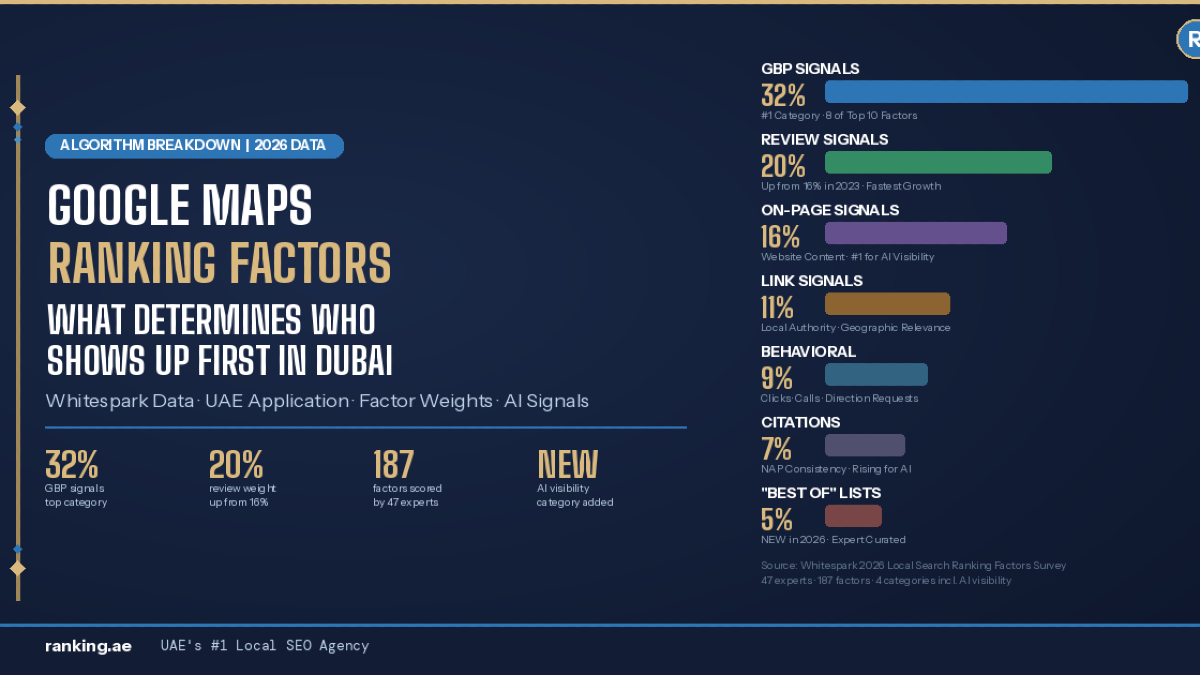
This guide breaks down every factor that influences Google Maps rankings, based on the most authoritative data source available: the Whitespark Local Search Ranking Factors survey, published in November 2025. This survey has run since 2008, and the 2026 edition drew on 47 of the world's leading local SEO experts evaluating 187 individual factors across four categories, including a brand new AI Search Visibility category added for the first time.
We are not going to list every factor and move on. For each signal group, we explain the mechanism (how Google uses the signal), the data (what the research shows about its weight), and the UAE application (how it works differently in Dubai, Abu Dhabi, and Sharjah compared to how it works in London or New York). If you operate a local business in the UAE, this is the most complete breakdown of the algorithm you will find written specifically for your market.
Google's Three Pillars: Relevance, Distance, and Prominence
Google officially confirms that Maps rankings are built on three core signals. Every individual factor we discuss below feeds into one of these pillars.
Relevance measures how well your business matches what someone searched for. If a user types "emergency plumber JBR," Google scans your business category, services list, description, website content, and even your photos to determine whether you are an emergency plumber operating in JBR. The more precisely your information matches the query, the stronger the relevance signal. A plumber who selected "General Contractor" as their primary category instead of "Plumber" is telling Google they are a general contractor. Google believes them.
Distance measures how far your business is from the searcher at the moment they search. For "near me" queries, Google needs to know your exact location to even consider you as a result. This is where Dubai creates unique challenges that we will cover in detail: vertical density (30 businesses on different floors of the same JLT tower), free zone addresses versus physical storefronts, and the proximity radius that Google applies to different query types.
Prominence measures how well-known and trusted your business is. Google assesses this through reviews (volume, recency, sentiment, and keyword content), links from other websites, mentions across the web, citation consistency, and behavioral signals like how often users click, call, or request directions. Google calls this "popularity" in its own documentation. A business with 200 reviews, links from local publications, and consistent NAP data across 50 directories sends a far stronger prominence signal than one with 8 reviews and no citations.
Now let us look at the specific signal groups that feed into these three pillars, ranked by the weight they carry.
Factor Group 1: Google Business Profile Signals (32% of Local Pack Rankings)
The Whitespark 2026 survey places GBP signals at 32% of Map Pack ranking influence, making it the single most weighted category. 8 of the top 10 individual ranking factors come directly from GBP. No other channel concentrates this much ranking power in one place. Our GBP Optimization Playbook covers the full 18-point optimization process. Here, we focus on why each element matters algorithmically.
Primary Category: The #1 Individual Ranking Factor
Whitespark's 2026 report identifies your primary category as the single most important ranking factor for the Local Pack. It is the signal Google uses most heavily to decide which searches your business is eligible to appear in. This is not a branding decision. It is an algorithmic filter.
The rule is specificity. "Pizza Restaurant" ranks for pizza queries that "Restaurant" does not. "Pediatric Dentist" outranks "Dentist" for pediatric searches. "Emergency Plumber" captures emergency intent that "Plumber" alone misses.
UAE application: Dubai's diverse business environment creates category challenges that cities with simpler economies do not face. A shawarma restaurant operating from a takeaway counter inside a mall food court is not the same category as a fine-dining Arabic restaurant in DIFC, even though both serve Arabic food. A medical center offering dermatology, dental, and general practice needs to decide which category is primary based on which service drives the most revenue and search volume, then use secondary categories for the rest. We see this mistake constantly in our audits: businesses choosing a broad category because it "covers everything" when a specific category would rank them for the searches that actually bring customers through the door.
Business Hours: The Ranking Factor Nobody Talks About
This is one of the most underappreciated findings in the 2026 survey. Joy Hawkins and multiple survey respondents confirmed that businesses listed as open at the time of a search are more likely to rank higher than businesses listed as closed. Sterling Sky's research showed rankings degrading in the final hour before a business is listed as closing. Your listed hours of operation are literally a ranking factor.
UAE application: This hits Dubai businesses harder than almost any other market because of Ramadan, Friday schedules, and public holidays. A restaurant that does not update its GBP hours for Ramadan (shifted Iftar/Suhoor hours, potential daytime closures) is telling Google it is closed when it is open and open when it is closed. That mismatch suppresses rankings during the most commercially important month of the year for F&B businesses. Friday prayer hours, UAE National Day, Eid closures, late-night Ramadan shopping hours: every one of these needs to be reflected in your GBP. Our GBP playbook covers the exact process for setting holiday hours, Ramadan hours, and the "more hours" feature for special sessions like Friday brunch or Iftar service.
Profile Completeness and Ongoing Activity
A fully completed profile performs significantly better than a partially completed one. Every empty field is information Google cannot use to match your business to a query and an answer Google cannot give about you when AI Overviews and the "Ask Maps" Gemini feature pull data from your profile. Approximately 11.1% of Google Business Profiles remain unclaimed, meaning competitors can suggest edits to your business name, hours, address, or categories without your knowledge.
Beyond completion, Google rewards ongoing activity. Behavioral and engagement signals (posts, photos, clicks, calls, direction requests, review cadence) continue to climb in importance. Profiles that show consistent activity outperform static listings. Google Posts published weekly, photos uploaded monthly, and review responses within 24 hours all signal an active, engaged business. Profiles that were set up once and abandoned signal the opposite.
UAE application: We audit GBPs across Dubai every week. The pattern is consistent: businesses set up their profile during company formation (often with the PRO or formation agent filling it out), never touch it again, and wonder why they rank behind competitors with fewer reviews. Those competitors are posting weekly offers, uploading photos of their actual space, responding to every review in both English and Arabic, and updating their profile for holidays. Activity is a ranking signal. Inactivity is a ranking penalty by omission.
Photos and Visual Content
Google's Vision AI now scans your uploaded photos to infer what your business does. A plumber who uploads photos of a tankless water heater installation can rank for "water heater repair" even without that keyword in text, because Google reads the image content. Geo-tagged photos (images with location metadata) build additional trust and local relevance. Fresh visual content signals activity. When users engage more with photo-rich profiles, Google notices.
UAE application: Two angles specific to the UAE. First, many businesses in Dubai use the same professional stock photos across multiple GBPs for different branches. Google can detect duplicate images. Each branch needs photos of its actual space, its actual team, and its actual work. A salon in Business Bay and the same brand's location in JLT should not have identical photo sets. Second, food businesses: uploading high-quality photos of your dishes can directly influence what food-related searches your restaurant appears for, because Vision AI reads the dish type from the image.
Factor Group 2: Review Signals (20% of Local Pack Rankings)
Review signals grew from 16% in 2023 to 20% in the 2026 survey, the largest increase of any signal group. This is the factor where the algorithm's direction is clearest: Google is placing more weight on reviews, not less. Our complete review generation guide covers the operational side, how to actually build a system that generates reviews consistently. Here, we focus on why each aspect of your review profile matters to the algorithm.
Review Volume and Velocity
A business with 100+ reviews typically outranks one with 15. But raw count is not the full picture. Google weighs review recency heavily, meaning 60 reviews from the last 6 months carry more ranking power than 150 reviews from 3 years ago. A steady stream of 3 to 5 new reviews per week signals active customer engagement. A business that received 50 reviews in 2022 and nothing since signals stagnation.
UAE application: Dubai's transient population creates a unique review dynamic. Customers who leave reviews may leave the country within 1 to 3 years, meaning older reviews carry less weight both algorithmically and psychologically. The businesses that win the review game in the UAE are the ones with active generation systems: WhatsApp follow-ups, QR codes at checkout, and staff trained to ask at the right moment. Our reviews guide includes specific timing windows by industry (2 hours post-dinner for restaurants, next morning for clinics, 30 minutes for home services) and a copy-paste WhatsApp template.
Review Content and Keywords
A review that says "great service" helps your star rating. A review that says "best emergency plumber in JBR, fixed our burst pipe in under an hour" helps your ranking for "emergency plumber JBR." Google reads review text and uses it as a relevance signal. The keywords customers use in their reviews directly influence which queries your business appears for. This is not manipulation. Customers who describe their experience in specific terms naturally use the keywords that other customers search for.
UAE application: Multilingual reviews carry double value in the UAE. A review in Arabic describing "أفضل شاورما في الكرامة" (best shawarma in Al Karama) creates a relevance signal for Arabic searches that an English-only review cannot. Hindi and Urdu reviews in areas like Deira and Bur Dubai serve the same function for South Asian search queries. Our Arabic SEO guide covers the three keyword layers (MSA, Gulf Arabic, and transliteration) that apply to review content as much as they apply to website content.
Review Responses
Google's own research shows businesses that respond to reviews are considered 1.7 times more trustworthy. Response speed also matters. In 2026, Google places greater weight on timely responses. A response within 24 hours signals attentive management. A response 3 weeks later signals neglect. Personalized responses outperform template replies because they create additional keyword-rich content on your profile.
UAE application: Responding to Arabic reviews in Arabic is not just good customer service. It creates Arabic-language content on your GBP that strengthens your relevance for Arabic searches. The same applies to Hindi or Urdu reviews. Most businesses in the UAE ignore non-English reviews entirely, creating an easy competitive advantage for those that respond in the customer's language.
Factor Group 3: On-Page Signals (Website Content)
Your website still matters for Google Maps rankings. The algorithm cross-references your GBP with your website content and authority to validate your listing. On-page signals dropped slightly from 19% in 2023 for Local Pack rankings, but they remain critical for local organic results and are the single most important factor for AI search visibility.
NAP Consistency Between Website and GBP
Your business name, address, and phone number on your website must match your GBP exactly. Not approximately. Not close enough. Exactly. "Suite 301, Tower A, Business Bay" on your website and "Tower A, Suite 301, Business Bay" on your GBP is a mismatch that creates confusion for the algorithm. This is one of the 10 local SEO mistakes we see most frequently in our audits, and it is one of the easiest to fix.
Location Pages with Unique Content
If your business serves multiple areas or operates multiple branches, each needs a dedicated page on your website with genuinely unique content about that location. Not the same template with the neighborhood name swapped. Google detects thin, duplicated location pages and suppresses them.
UAE application: A cleaning company serving JBR, Business Bay, and Dubai Marina needs three location pages, each describing the specific types of properties in that area (JBR: high-rise apartments with marina views; Business Bay: mixed commercial and residential towers; Dubai Marina: waterfront apartments), the specific challenges (JBR's salt air corrosion, Business Bay's construction dust, Marina's pet-friendly buildings), and genuine content about serving that neighborhood. This sends a far stronger relevance signal than a single generic "cleaning services Dubai" page.
LocalBusiness Schema Markup
Structured data (schema) helps Google understand your business information in machine-readable format. LocalBusiness schema with your NAP, opening hours, services, geo-coordinates, and accepted payment methods feeds directly into Google's knowledge systems. For AI search visibility, having a dedicated page for each service is a key priority because both AI Overviews and tools like ChatGPT and Perplexity pull from structured, well-organized website content.
UAE application: Include service-specific schema (MedicalClinic, Restaurant, RealEstateAgent, etc.) rather than just generic LocalBusiness when applicable. Include the acceptedPaymentMethod property for Apple Pay, Samsung Pay, and local payment methods that UAE customers search for. Include the areaServed property listing the specific Emirates and neighborhoods you cover.
Factor Group 4: Link Signals
Link signals continue to drop in importance for Local Pack rankings, but they remain significant for local organic results and for building the kind of authority that supports all other ranking factors. The key shift in 2026: geographic relevance of the linking domain now matters more than raw domain authority for local rankings.
What this means for UAE businesses: A single link from Gulf News, Khaleej Times, Arabian Business, or The National carries more local ranking weight than ten links from international directories. A link from a .ae domain sends a geographic relevance signal that a .com link cannot. Sponsoring a Dubai charity event, being featured in a UAE business publication, or receiving a link from the Dubai Chamber of Commerce website: these move local rankings more than any generic link-building campaign.
Our pillar guide covers the specific link building strategies that work in the UAE market, and our pricing guide explains why the cost of link building varies so significantly based on whether an agency targets local authority links versus generic international directories.
Factor Group 5: Citation Signals (And Why They Matter More Than You Think in 2026)
There is a narrative in the SEO industry that citations are dying. The 2026 Whitespark data tells a different story. Citation signals remain steady for Local Pack rankings and have actually gained significant importance for AI search visibility. Three of the top five factors for AI visibility are citation-related. The quality of unstructured citations ranks as the fourth most important factor for appearing in AI tools like ChatGPT, Perplexity, and Claude.
Structured Citations: Your Digital Identity
Structured citations are your business listings on directories: Google, Bing, Apple Maps, Yelp, Facebook, and industry-specific platforms. Whitespark's analysis shows that 10 citations from authoritative sources provide more ranking benefit than 50 from low-quality directories. Quality over quantity. Your NAP must be identical across every listing. Every inconsistency introduces doubt.
UAE-specific directories that carry weight: Bayut, Property Finder, and Dubizzle (for relevant industries), Yellow Pages UAE, Dubai Chamber member listings, DTCM (Department of Tourism), DHA (Dubai Health Authority for medical businesses), KHDA (for education), and industry-specific platforms like Eat App, TripAdvisor, and Zomato for F&B. These are the directories Google cross-references when validating UAE businesses.
Unstructured Citations: The AI Visibility Factor
Unstructured citations are mentions of your business on news sites, blogs, industry publications, and editorial content where your business is named but not necessarily linked. The 2026 survey identifies these as a critical factor for AI search visibility. When ChatGPT or Perplexity answers a query like "best dental clinics in Dubai," they draw from the same web data that unstructured citations exist in. Being mentioned by name in Gulf News, Time Out Dubai, or an industry association site builds the kind of documented presence that AI models reference.
UAE application: Getting featured in Time Out Dubai's "Best of" lists, Lovin Dubai, What's On Dubai, Dubai Eye radio segments, or local charity event coverage creates unstructured citations that serve double duty: they build authority for Google Maps and they train AI models to include your business in their recommendations. This is a new factor in 2026 and most UAE businesses have not adjusted to it yet.
Factor Group 6: "Best Of" Lists and Expert-Curated Content (New for 2026)
A brand new finding in the 2026 survey: being included in expert-curated "best of" or "top local" lists for your category now has a measurable impact on rankings in both traditional search and AI results. Google is also now surfacing curated "Local Gems," "Trending," and "Top List" categories directly within Google Maps results, appearing around position four in traditional Map Pack results.
UAE application: This changes the value calculation for being featured in Time Out Dubai's awards, Esquire Middle East's dining lists, What's On Dubai's "best of" compilations, Bayut's top agent lists, and similar editorial rankings. These are no longer just marketing wins. They are ranking factors. If you operate in a competitive industry in Dubai, getting onto these lists should be part of your SEO strategy, not just your PR strategy.
Factor Group 7: Behavioral Signals (The Fastest-Growing Category)
Behavioral signals saw the largest increase from the 2023 survey. These are the actions users take when they interact with your business listing: click-through rate, time spent on your profile, calls made from the listing, direction requests, messaging engagement, and whether users return to search results after visiting your listing (a negative signal called pogo-sticking).
You cannot fake behavioral signals. But you can influence them by making your listing more useful, more complete, and more engaging than competitors. Better photos increase clicks. Clear service menus reduce bounce. Strong review responses build trust. Accurate hours prevent bad experiences. Each improvement increases the probability of positive user engagement, and engagement nudges visibility upward.
UAE application: The direction request metric carries particular weight in Dubai because of the city's geography. Businesses in locations that are difficult to navigate (inside malls, in towers without clear street-level signage, in areas undergoing construction) should add detailed directions in their GBP description and use the "located in" feature to specify the building or mall. When users can find you without frustration, they request directions and follow through. When they cannot, they pogo-stick back to results and Google interprets that as a negative signal about your listing.
The Proximity Factor and Why It Works Differently in Dubai
Proximity is not a factor you optimize directly. You cannot move your business closer to every potential customer. But understanding how proximity works in the algorithm helps you understand why your rankings vary from location to location and what you can control.
The Vicinity update made the searcher's physical location one of the most dominant ranking factors. But the 2026 survey notes that distance has become less dominant relative to relevance and prominence. A business with outstanding relevance and prominence signals can outrank one that is physically closer but has a weaker profile.
Dubai's vertical density problem: Unlike most Western cities where businesses are spread horizontally across streets, Dubai stacks businesses vertically. A single tower in JLT might contain a dental clinic on floor 3, an accounting firm on floor 14, and a marketing agency on floor 22. All three share nearly identical GPS coordinates. Google differentiates through the combination of GBP pin accuracy, floor/suite information in the address, and the strength of other signals. If your pin is placed at the tower entrance but your business is on the 22nd floor, Google may not precisely understand your location relative to searchers inside the same building or adjacent towers. Verify your pin placement at the exact building entrance and include floor information.
Free zone versus physical storefront: Many Dubai businesses are registered in free zones (DMCC, DAFZA, IFZA) but serve customers across the city. Your GBP address should reflect where customers visit you, not your registration address, unless they are the same. A marketing agency registered in DMCC but meeting clients at a co-working space in Business Bay needs to decide which address to list based on where the customer interaction happens.
Service area businesses: Businesses that go to customers (plumbers, electricians, cleaners, mobile car washes) rather than receiving them at a location face a different proximity equation. Google allows service area configuration, but Whitespark's research has long documented the negative ranking impact of hiding addresses as Google's guidelines require for service area businesses. If you operate from a physical location where customers can visit but also serve a wider area, you may benefit from listing your address rather than hiding it.
The New Category: AI Search Visibility Factors
The 2026 Whitespark survey added AI search visibility as a category for the first time. This matters because AI tools like Google's AI Overviews, ChatGPT, Perplexity, and Claude are increasingly how people discover local businesses. The factors that drive AI visibility overlap with but are not identical to Map Pack factors.
On-page signals are the most important group for AI search visibility. Having a dedicated page for each service, with structured content, clear headings, and comprehensive information, is what AI models extract answers from. Citation signals rank third for AI visibility, higher than their Map Pack ranking. Three of the top five AI factors are citation-related. The quality of unstructured citations (mentions on news sites, blogs, industry publications) is the fourth most important individual AI visibility factor.
What this means practically: If you want to appear in AI-generated local recommendations, your website needs to be well-structured and informative (not thin), your business needs to be mentioned on authoritative third-party sites (not just directories), and your citation data needs to be consistent. The businesses that rank well in the Map Pack and also appear in AI recommendations are the ones that have invested in all three. Our pillar guide covers the foundational strategy, and our Arabic SEO guide covers the bilingual dimension that becomes even more important when AI tools need to answer queries in Arabic.
What Hurts Your Rankings: Negative Factors
The 2026 survey also identifies factors that actively hurt your rankings.
Keyword stuffing in your business name. Adding keywords to your GBP business name that are not part of your legal business name (e.g., "Ahmed's Plumbing - Best Plumber Dubai Emergency 24/7") violates Google's guidelines and increases suspension risk. Enforcement is getting stricter in 2026. Long-term trust beats short-term tricks.
Fake reviews. Google's August 2025 spam update specifically targeted fake review patterns. Google actively penalizes fake engagement. Getting caught results in review removal (sometimes of legitimate reviews too), profile penalties, and potential suspension.
NAP inconsistencies. Different phone numbers, addresses, or business names across directories send conflicting signals that reduce Google's confidence in your data. Audit your citations at least twice per year.
Stale profiles. A profile with no posts since 2023, no new photos, and no review responses tells Google the business may not be actively operating. In a market like Dubai where business turnover is high, Google is especially sensitive to signals of active operation.
The Priority Sequence: What to Fix First
If you can only work on five things this month, do these in order. This sequence is based on the factor weights from the 2026 survey, starting with the highest-impact items.
1. Verify your primary category is specific and accurate. This is the #1 individual factor. If it is wrong, nothing else matters as much. Check it against your actual core service, not what feels broadest. Reference our GBP playbook section on categories.
2. Update your hours (including Ramadan, holiday, and special hours). Businesses listed as open when users search rank higher. Inaccurate hours hurt you twice: algorithmically and through bad customer experiences that generate negative reviews.
3. Start generating reviews consistently. Reviews grew from 16% to 20% of ranking influence. Set up the WhatsApp and QR code system from our reviews guide. Respond to every review within 24 hours, in the language it was written.
4. Audit your NAP consistency across the web. Search your business name on Google. Check the top 10 directories where you appear. Fix every inconsistency. Mismatched data reduces Google's confidence in your listing.
5. Publish a Google Post this week and upload 3 to 5 new photos. Activity signals are rising in importance. A single post and a few photos take 15 minutes and signal that your business is alive and engaged.
For the full optimization process beyond these five priorities, our GBP Playbook walks through every step. For the strategic picture of how all these factors fit together, our pillar guide to local SEO in Dubai covers the framework. And for understanding what it costs to have all of this managed professionally, our SEO pricing guide breaks down every tier in the UAE market.
Find Out Where Your Business Stands
Every factor in this guide is something we audit, track, and optimize for our clients across all 91+ UAE areas we cover. Our free SEO audit evaluates your Google Business Profile against every ranking factor discussed here, analyzes your review profile, checks your citation consistency, reviews your website's on-page signals, and shows you exactly where you stand relative to the businesses currently occupying the Map Pack positions you want.
Get your free audit here and see which factors are holding your business back. Or explore our plans starting at AED 1,499/mo to see what professional optimization includes at each tier.
We have applied these exact principles to grow LicensePlate.ae by 480%, MyJet24 by 890%, MobileNumber.ae by 350%, and UAE Tax Filing by 275%. The ranking factors are the same for every local business. The application is what makes the difference.