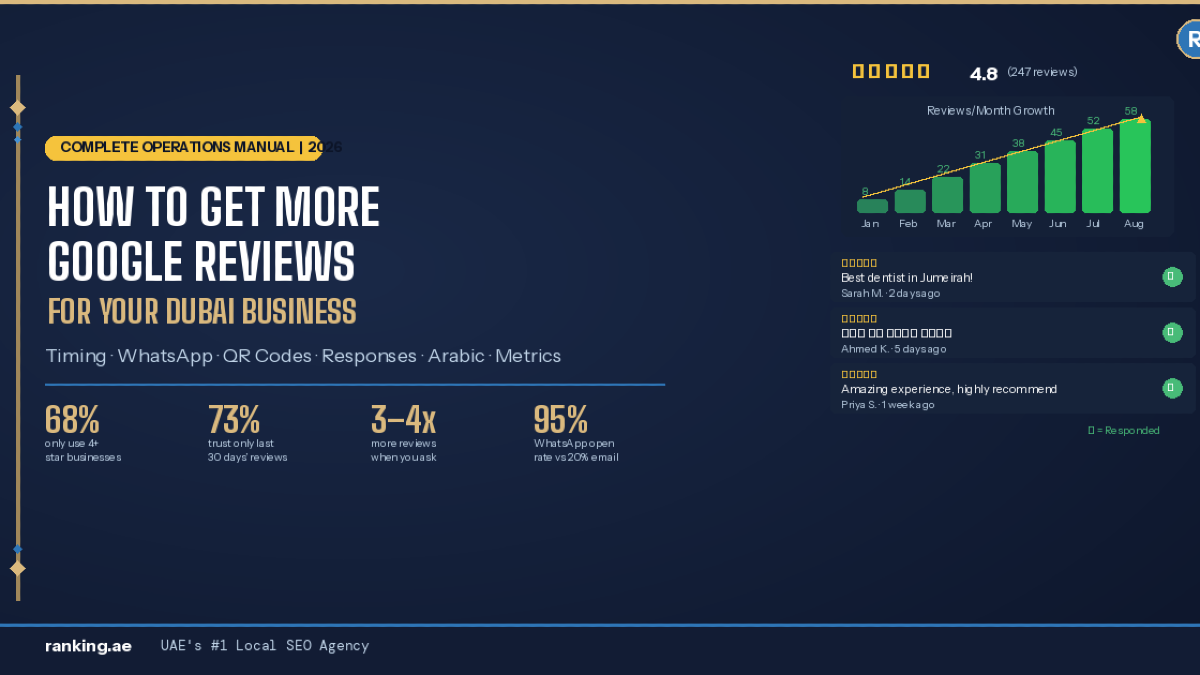
A dental clinic in Jumeirah has 14 Google reviews. The clinic down the street has 187. Both offer similar services, similar pricing, and similar quality of care. But when someone in Jumeirah searches for a dentist, the clinic with 187 reviews appears in the Map Pack with a 4.7 star rating, fresh reviews from the last week, and a response to every piece of feedback. The clinic with 14 reviews sits somewhere below the fold, invisible to the vast majority of searchers.
The difference is not luck. It is a system. The clinic with 187 reviews asks every patient. The one with 14 does not.
The data backs this up with uncomfortable clarity. BrightLocal's 2026 Local Consumer Review Survey, the most comprehensive annual study on review behavior, found that 41% of consumers now "always" read reviews when browsing for businesses, a massive jump from 29% the year prior. In 2026, 68% of consumers will only use a business with 4 or more stars, up from 55% in 2025. And 31% will only consider businesses rated 4.5 stars or higher, nearly double the 17% from the previous year.
Google hosts roughly 73% of all online business reviews and 83% of consumers use Google specifically to read reviews before visiting a local business. Review signals now account for approximately 20% of local pack ranking factors, up from 16% just two years ago, making reviews the second most important ranking factor after Google Business Profile signals. In a 2025 analysis of roughly 3,200 Google Business Profiles, researchers found that in the top 10 positions, review count accounted for 26% of ranking variability and review text relevance accounted for 22%.
Reviews are not a nice to have. They are a ranking factor, a trust signal, a conversion driver, and a competitive moat. And most businesses in Dubai are not generating them systematically.
This guide is the operations manual. Not theory. Not suggestions. A step-by-step system you can implement this week that will generate a steady flow of Google reviews, manage your reputation actively, and turn reviews into a measurable business asset. If you have read our GBP optimization playbook or our 10 Local SEO Mistakes post, both flagged reviews as critical. This is the post that gives you the complete playbook for actually doing it.
Why Reviews Have Become the Second Most Important Local Ranking Factor
Google's local algorithm has shifted meaningfully toward reviews over the past three years. The Whitespark Local Search Ranking Factors survey tracked review signals rising from roughly 16% of the local pack algorithm to about 20%. Whitespark's Darren Shaw recommends getting reviews on prominent review sites in your industry, not just Google, and ensuring you have a testimonials page on your own website linked in the main navigation.
The reason for this shift is that reviews are the most reliable signal of actual business quality that Google can measure at scale. A business can optimize its GBP description, build citations, and create content. But reviews come from real customers sharing real experiences, and Google's algorithms have become increasingly sophisticated at evaluating review quality, sentiment, keyword content, velocity, and recency.
A 2025 analysis of 3,200 Google Business Profiles quantified something important: while proximity is the dominant ranking factor overall (55% of variability), in the top 10 results where proximity is similar, review count jumps to 26% of variability and review text relevance accounts for 22%. The researchers concluded: if you cannot change your location, focus on the inputs you can control, meaning reviews.
Beyond rankings, reviews directly drive conversion. LocaliQ research found that consumers are willing to pay 22% more for a business with a good online reputation, and 31% more if reviews are "excellent." 92% of consumers choose a local business with at least a 4-star rating. One negative review can convince 94% of consumers not to contact a business, and four negative reviews can cause a loss of up to 70% of potential clients.
In the UAE, where 76% of local searchers visit a business within 24 hours and decision-making happens fast, reviews are often the final filter between your business and a competitor. They determine whether that 24-hour visit happens at your location or someone else's.
Step 1: Set Up Your Review Infrastructure
Before you ask a single customer for a review, set up the tools that make leaving one effortless.
Generate Your Google Review Short Link
Sign into your Google Business Profile dashboard. Select your business. Click "Ask for reviews" or "Get more reviews." Google will provide a short URL that takes the customer directly to the review writing interface. This is your master review link. Copy it. Save it. You will use it everywhere.
Create a QR Code
Use any QR code generator (QR Code Generator, QR Code Monkey, or Canva) to turn your review link into a scannable code. Print this QR code on table cards for restaurants, counter displays for retail and salons, appointment cards for clinics, business cards, receipts, and delivery packaging. Every physical touchpoint with a customer is a review opportunity. A customer scanning a QR code at their table while waiting for the bill can leave a review in under 60 seconds.
Set Up a WhatsApp Business Template
In the UAE, WhatsApp is the dominant messaging platform. WhatsApp achieves 95% open rates compared to 20% for email and 35 to 50% response rates for review requests versus 5 to 15% for email. Create a WhatsApp Business message template that you and your team can send after every successful service:
"Hi [Name], thank you for visiting [Business Name] today! We hope you had a great experience. If you have a moment, a quick Google review would mean a lot to us: [review link]. Thank you!"
Keep it under 4 sentences. Include the customer's name. Include the direct review link. Do not add conditions, lengthy explanations, or multiple requests. One message. One link. One tap. Relvio's research shows that businesses actively asking for reviews get 3 to 4 times more than those that wait. The difference is asking.
Add the Review Link to Every Digital Touchpoint
Your email signature (every employee). Your invoice footer. Your booking confirmation email. Your post-appointment SMS. Your website's footer and contact page. Your social media bios. The more places this link appears, the more paths customers have to leave a review. Each placement costs nothing and works 24/7.
Step 2: Master the Timing
When you ask matters as much as whether you ask. The optimal timing window varies by industry, and getting it right can double your response rate.
Restaurants and cafes: Ask within 2 hours of the meal. The experience is vivid. Emotions are high. A WhatsApp message sent at 9pm after a 7pm dinner catches the customer while they are still thinking about the food. In the restaurant itself, a QR code on the table or the bill folder catches them before they leave. For Ramadan Iftar and Suhoor experiences, the timing is even more specific: send the review request 30 minutes after the meal ends.
Medical and dental clinics: Ask the next morning. Patients are often still processing during or immediately after an appointment. A WhatsApp message at 10am the day after a procedure feels considerate, not pushy. For cosmetic procedures where results develop over days, wait 3 to 5 days and ask when the patient is seeing results.
Salons and spas: Ask the same day, within 1 to 2 hours of the appointment. The customer has just seen the result in the mirror. They feel good. They are showing friends. This is the peak emotional moment. A WhatsApp message with "Hope you love the new look! A quick Google review would really help us out" lands when they are most likely to respond.
Home services (plumbers, electricians, AC repair, cleaning): Ask within 30 minutes of completing the job. The customer is standing in their newly repaired kitchen or freshly cleaned apartment. The problem is solved. Relief is high. The technician can ask in person (highest conversion method) or send a WhatsApp message immediately after leaving.
Real estate: Ask within 48 hours of a successful transaction: a signed lease, a completed sale, a handed-over key. The closing moment is emotionally charged and the client is most likely to attribute their satisfaction to the agent.
Hotels and hospitality: Ask on checkout day, ideally 2 to 4 hours after checkout. The guest has had time to reflect on the full experience but has not yet mentally moved on to their next activity.
Legal and professional services: Ask when a case is successfully resolved or a project milestone is achieved. The client feels relief and gratitude. A generic monthly email will not work here. The ask needs to be tied to a specific successful outcome.
BrightLocal's 2026 data confirms that 80% of consumers were prompted by a business to leave a review in 2025, and 69% actually did when asked. Without asking, the rate drops to 5 to 10%. The ask itself is the single biggest variable.
Step 3: Train Your Team to Ask
The highest-converting review request method is not email, not SMS, not WhatsApp. It is an in-person ask from the person who delivered the service. In-person requests have the highest conversion rate of all methods, especially when the ask comes from someone the customer has a personal connection with.
Train every customer-facing team member on when and how to ask. The language should be natural, brief, and genuine. Not scripted and robotic. Something like:
"If you were happy with how everything went today, it would really help us if you left a Google review. It only takes a minute, and it makes a huge difference for a small business like ours."
The key elements: acknowledge the positive experience first. Frame the ask as a favor, not a demand. Mention that it is quick. And make it immediately actionable: "I can send you the link right now on WhatsApp if you would like."
For restaurants, the server can ask when presenting the bill. For clinics, the receptionist can ask as the patient checks out. For salons, the stylist can ask while the customer is admiring the result. For home services, the technician can ask before walking out the door. Each of these moments is a natural conversation point, not an awkward interruption.
Hold a 15-minute team briefing. Explain why reviews matter to the business. Show them the review link. Demonstrate how to send the WhatsApp template. Set a team goal: X new reviews per week. Celebrate when you hit it. The businesses we work with that treat review generation as a team effort rather than a marketing task consistently outperform those that leave it to one person.
Step 4: Respond to Every Review Within 24 Hours
BrightLocal's 2026 survey found that 19% of consumers now expect a response to their review on the same day they post it, tripling from 6% the year before. 32% expect a response by the next day. 81% expect to hear back within a week. Response speed has become a trust signal in its own right.
SQ Magazine data shows that negative reviews responded to within 24 hours are 33% more likely to be updated positively by the customer, and that businesses responding promptly see 17% more click-throughs from their profile. 88% of consumers say they are likely to use a business that responds to all reviews, both positive and negative.
Every review response is written for two audiences: the person who left the review, and the hundreds of future customers who will read your response before deciding whether to call you. This dual audience principle should guide every response you write.
For Positive Reviews
Thank the customer by name. Reference something specific about their visit: the service they received, the dish they ordered, the treatment they had. This shows you actually read the review and remember them. Keep it warm, brief, and genuine.
"Thank you, Sarah! We are glad you enjoyed the keratin treatment. Looking forward to seeing you for your next appointment."
For Negative Reviews
Acknowledge the concern specifically. Apologize where appropriate. Do not argue, deflect, or make excuses. Invite them to resolve the issue offline by providing a direct contact (phone or email). Keep your tone professional and empathetic.
"Thank you for your feedback, Ahmed. We are sorry to hear the wait time was longer than expected. This is not the standard we aim for. We would like to make this right. Please call us directly at [number] so we can discuss how to improve your experience."
Never argue publicly. Never copy and paste the same response on every review. BrightLocal specifically warns that generic or templated responses have a negative impact on consumer trust. Personalize every response, even if it takes an extra 30 seconds.
For Arabic Language Reviews
Respond in Arabic. Always. When a customer takes the time to write a review in Arabic, a response in English feels dismissive, even if unintentionally. A response in Arabic signals that your business genuinely serves and values the Arabic-speaking community. In the UAE, where a significant portion of the population searches and communicates in Arabic, this is not optional. It is a competitive advantage. Our Arabic SEO guide covers why this matters beyond just reviews.
Step 5: Build Review Velocity
A one-time review campaign that generates 20 reviews in a week and then nothing for months is less effective than a steady flow of 3 to 5 reviews per week. Google values recency and consistency, not just total count.
73% of consumers only trust reviews from the last 30 days. Listings with a consistent flow of at least one new review per week rank 25% higher. Top-ranking businesses on Google average 47 reviews, but it is the velocity, the rate at which new reviews arrive, that matters more than the raw total.
To build sustainable velocity, embed the ask into your daily operations, not your monthly marketing calendar. Every customer interaction should have a review touchpoint. If you serve 20 customers per day and 10% leave a review (which is the low end when you actively ask), that is 2 reviews per day, 14 per week, 60 per month. In 6 months, you have 360 reviews. In a year, over 700. That is a competitive moat that a new competitor cannot replicate quickly.
Automating the review request process increases volume by 40 to 70% within the first 60 days. Set up automatic WhatsApp messages triggered by appointment completion, invoice payment, or booking confirmation. The system sends the ask without requiring any team member to remember. The team's in-person ask still adds to this, but the automation ensures no customer falls through the cracks.
Step 6: Use Reviews as Content and Social Proof
Reviews are not just for your Google profile. They are content assets you should distribute across your marketing.
Website testimonials page. Create a dedicated page on your website featuring your best reviews, linked in your main navigation. Whitespark specifically recommends this. Screenshot the reviews or quote them with attribution. This page builds trust for visitors who arrive from organic search.
Social media content. Turn your best reviews into Instagram Stories, LinkedIn posts, and Facebook updates. A simple graphic with the review text, the customer's first name, and the star rating makes compelling social content. Share one per week.
Google Posts. Feature positive reviews in your weekly Google Posts. "This week, Sarah said our keratin treatment was the best she has ever had. Thank you, Sarah! Book yours at [link]." This puts social proof directly in front of people viewing your GBP.
Print materials. For physical businesses, print your best review quotes on wall displays, menu inserts, waiting room cards, or window decals. "Rated 4.8 stars on Google with 200+ reviews" is a powerful trust signal for walk-in traffic.
Step 7: Handle Fake and Competitor Reviews
BrightLocal's data shows that 40% of consumers believe they have spotted fake reviews on Google. Approximately 11% of Google reviews may be fraudulent. In competitive Dubai markets like restaurants, clinics, and salons, fake reviews from competitors are a real threat.
Signs of a fake review: the reviewer has no profile photo and no other reviews; the review is extremely generic or extremely hostile with no specific details about a visit; multiple negative reviews appear within a short timeframe, especially from accounts created recently; the review describes a service you do not offer or references a staff member who does not exist.
How to report: Flag the review through your Google Business Profile dashboard. Select the policy violation category (spam, fake content, off-topic, conflict of interest). Google's review moderation team will evaluate. This process can take days to weeks. In the meantime, respond professionally to the review so future readers see that you are aware and engaged.
How to drown it: The most effective defense against fake or negative reviews is volume of genuine positive ones. A business with 200 authentic reviews and one suspicious negative review is barely affected. A business with 10 reviews and one fake one-star is devastated. Volume is your shield.
Do not buy reviews. Do not ask employees to leave reviews. Do not offer discounts or incentives in exchange for reviews. All of these violate Google's review policies and can result in review removal, profile suspension, or ranking penalties. The only sustainable strategy is earning genuine reviews from real customers through excellent service and consistent asking.
Step 8: Track the Metrics That Matter
You need to track five specific review metrics monthly.
Total review count. Your cumulative number of Google reviews. Top-ranking businesses average 47, but in competitive Dubai markets like restaurants and clinics, the leaders often have 200 to 500+. Set a target based on your top competitor's count plus 20%.
Average star rating. Your overall rating out of 5. In 2026, 68% of consumers will only use a business with 4+ stars and 31% require 4.5+. If you are below 4.2, focus on service quality improvements alongside review generation. Conversion rates peak at 4.9 stars, and a perfect 5.0 can actually reduce trust because consumers find it suspicious.
Review velocity. New reviews per week. Target at least 1 per week as a minimum floor (the threshold linked to 25% higher rankings). For competitive industries, aim for 3 to 5 per week. Track this on a rolling 30-day basis.
Review recency. The date of your most recent review. 73% of consumers only trust reviews from the last 30 days. If your most recent review is more than 2 weeks old, your generation process needs attention.
Response rate and speed. The percentage of reviews you have responded to and the average time to response. Target 100% response rate with same-day response for all reviews. 81% of consumers expect a response within one week and 19% expect same-day.
Track these in a simple spreadsheet or use tools like BrightLocal, Birdeye, or Podium. Check the numbers monthly. If velocity drops, diagnose why: did the team stop asking? Did the WhatsApp automation break? Did you have a slow service week? The metric tells you where to look.
The UAE-Specific Review Playbook
Generating reviews in the UAE has specific nuances that global guides miss entirely.
WhatsApp is the primary channel. Not email. Not SMS. WhatsApp. It is the dominant messaging platform in the UAE across all demographics and nationalities. Every review request template, every post-service follow-up, and every automated message should go through WhatsApp first, email second.
Ramadan and Eid timing. During Ramadan, dining patterns shift dramatically. Iftar experiences are highly emotional and social, making them prime review moments. Send review requests 30 to 60 minutes after Iftar service ends. For Eid, ask within 24 hours of any Eid-related service (gifts, catering, special events, salon appointments). These seasonal reviews also include Arabic keywords naturally, which strengthens your Arabic search visibility.
Multilingual reviews strengthen your profile. Encourage Arabic-speaking customers to leave reviews in Arabic. Respond in Arabic. Encourage Hindi and Urdu-speaking customers to review in their language if they prefer. A profile with reviews in multiple languages signals to Google that your business serves a diverse, multilingual community, which broadens the queries your profile appears for. Our Arabic SEO guide covers why this matters for rankings.
Cultural sensitivity in responses. When responding to reviews in the UAE, be mindful of cultural norms. Use respectful, warm language. Acknowledge specific cultural moments: "Thank you for joining us for Iftar," or "We hope your Eid celebration was wonderful." Avoid overly casual tone for professional services. Match the formality level of the reviewer.
Friday and weekend patterns. Many UAE customers dine out, visit salons, and attend appointments on Fridays and Saturdays (the UAE weekend). Review requests sent on Friday evening and Saturday morning tend to catch customers when they have time to respond. Sunday morning is also effective as people settle into the new work week.
Tourist and visitor reviews. Dubai attracts millions of visitors who use Google to find restaurants, attractions, and services. A tourist who leaves a review adds to your total count and often includes location keywords naturally: "Amazing experience at this restaurant in Dubai Marina." If your business serves tourists, train your team to ask international visitors specifically, as their reviews carry additional geographic signals.
Your Complete Review Operations Checklist
Here is every action in one place, prioritized for immediate implementation.
1. Generate your Google review short link from your GBP dashboard.
2. Create a QR code from the link and print it on table cards, counter displays, receipts, and appointment cards.
3. Write a WhatsApp message template (under 4 sentences, personalized, with the review link).
4. Add the review link to every email signature, invoice footer, booking confirmation, and social media bio.
5. Brief your team: explain why reviews matter, demonstrate how to ask, practice the in-person ask, distribute the WhatsApp template.
6. Set a team target: minimum 1 review per week, ideally 3 to 5 for competitive industries.
7. Automate review requests via WhatsApp Business or a CRM tool triggered by service completion.
8. Respond to every existing review you have not yet responded to, starting today.
9. Commit to responding to every new review within 24 hours, in the language it was written in.
10. Track monthly: total count, average rating, velocity, recency, and response rate.
11. Review the metrics monthly and diagnose any drop in velocity immediately.
12. Repurpose your best reviews as website testimonials, social media content, and Google Posts.
Want Us to Build This System for You?
Review generation and management is a core part of every ranking.ae plan. We do not just tell you to "get more reviews." We build the infrastructure: the WhatsApp templates, the automation sequences, the QR codes, the response protocols, the Arabic language review strategy, and the monthly tracking that ensures your review count grows steadily and your rating stays strong.
If you want to see where your review profile stands right now, start with our free SEO audit. We will analyze your current review count, rating, velocity, recency, response rate, and how you compare to the top 3 competitors in your Map Pack. Then we will show you exactly what it will take to close the gap.
Get your free review and SEO audit here and see the numbers for yourself.
Plans start at AED 1,499/mo and include GBP management, review strategy, content creation, citation building, and monthly reporting. We have helped over 500 businesses across 91+ UAE areas build review profiles that drive rankings and revenue. LicensePlate.ae grew 480%. MobileNumber.ae grew 350%. MyJet24 grew 890%. Reviews were a core part of every one of those outcomes.