A dental clinic in Jumeirah hired an agency for AED 5,000 a month to "do SEO." After 8 months, organic traffic had grown by about 25%. The agency's reports showed keyword rankings improving, backlinks being built, and blog posts driving steady impressions. On paper, progress. In practice, the phone was not ringing any more than before. Walk-ins had not increased. The Google Business Profile still had 14 reviews from 2023 and no posts. The Map Pack, where 3 out of 4 new patients actually come from, still showed three competitors above the clinic in every local search.
The agency had delivered competent traditional SEO. The clinic needed local SEO. The traffic growth came from people reading blog posts about dental health, not from patients in Jumeirah searching for a dentist right now. The metrics looked positive in a quarterly report. The business outcome was zero.
We see this exact scenario at least twice a month. The inverse happens too: an e-commerce store selling luxury watches across the GCC hires a local SEO agency that optimizes a Google Business Profile and builds citations. The store has no physical showroom. Its customers buy online. The GBP generates a few hundred profile views but zero conversions because nobody is searching for this brand locally. Meanwhile, its product pages sit on page 4 for high-intent purchase keywords because the traditional SEO work, the content, backlinks, and technical optimization that would actually drive revenue, was never done.
Local SEO and traditional (regular) SEO are not the same discipline. They target different algorithms, optimize for different ranking factors, produce different types of results, operate on different timelines, and serve different business models. As Miriam Ellis writes at Search Engine Land, local SEO includes everything involved in traditional organic SEO but adds an entire layer of local search marketing on top of it. Choosing the wrong one wastes months and thousands of dirhams. Choosing the right one, or understanding when you need both, is one of the most consequential marketing decisions a Dubai business owner can make.
This guide explains exactly how each type works at a mechanical level, what Google's algorithms actually do differently for local versus non-local queries, what each costs in the UAE market, what results look like on realistic timelines, and most importantly, gives you a framework you can apply in 60 seconds to determine which type your specific business needs. If you have read our Ultimate Guide to Local SEO in Dubai, you already know the full local SEO playbook. This post puts that knowledge in context alongside traditional SEO so you can make an informed investment decision.
Google Does Not Use One Algorithm. This Changes Everything.
This is the concept that most business owners and many marketers miss entirely. Google does not run a single algorithm for every search. It determines the type of query first, identifies the user's intent, and then selects the appropriate ranking system to evaluate and display results.
When someone in Dubai types "how to file corporate tax in the UAE," Google detects informational intent with no geographic component. It runs its standard organic ranking algorithm, evaluating content quality, backlink authority, E-E-A-T (Experience, Expertise, Authoritativeness, Trustworthiness), technical page health, and user engagement signals. The results page shows standard blue links. No map. No business profiles. Just web pages ranked by who answered the query best.
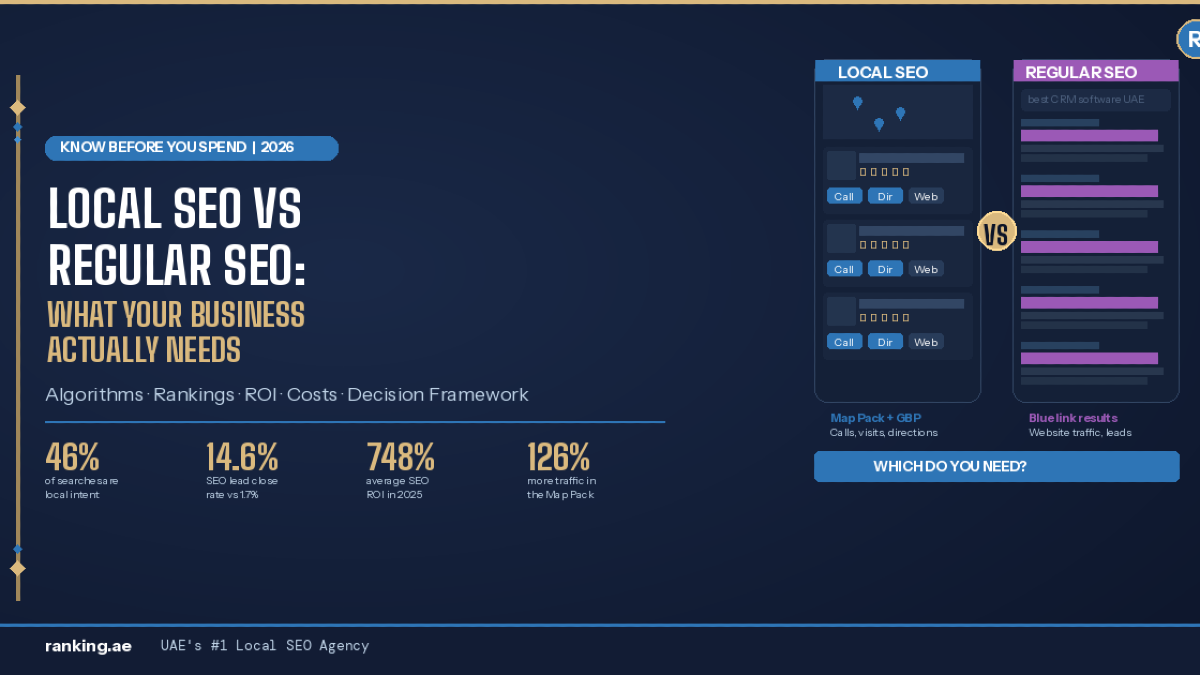
When the same person types "tax consultant near me" or "tax accountant Dubai Marina," Google detects local intent. A completely separate ranking system activates alongside the organic one. The search results page transforms: a Map Pack appears at the top showing three Google Business Profiles with star ratings, hours, photos, and action buttons (Call, Directions, Website). Below the Map Pack, organic results appear, but they are now filtered for local relevance. Google is simultaneously running two algorithms, each with different ranking factors, producing two sets of results on the same page.
The Whitespark Local Search Ranking Factors survey, conducted annually with input from 44 to 47 of the world's leading local SEO practitioners, has tracked these ranking factors for over a decade. The most recent data shows the local pack algorithm weights its factors roughly as follows: GBP signals (categories, completeness, activity) carry the most weight, followed by on-page signals (NAP, local keywords, schema), review signals (volume, velocity, sentiment, responses), link signals (local link authority), behavioral signals (click-to-call, profile engagement, dwell time), citation signals (directory consistency), and personalization (user location, search history).
The traditional organic algorithm weighs factors completely differently: content quality and relevance, backlink authority and diversity, technical SEO health (Core Web Vitals, crawlability, mobile-friendliness), E-E-A-T signals, and user engagement metrics. There is overlap between the two systems, but the emphasis is fundamentally different.
This is why "doing SEO" without specifying which type is like saying "I need medicine" without specifying the condition. If your business needs Map Pack visibility and your agency is only building backlinks and writing blog posts, you will never appear where your customers are actually looking. The algorithms are different. The strategies must be different.
Sterling Sky's 2023 research documented something even more specific: local rankings begin to degrade in the final hour that a business is listed as open each day. The Whitespark survey found that chosen hours of operation rank as more influential than additional GBP categories, quantity of reviews, and even proper map pin placement. These are ranking factors that traditional SEO does not even acknowledge exist.
What Traditional SEO Actually Involves and Delivers
Traditional SEO, also called organic SEO or regular SEO, is the process of optimizing your website to rank higher in Google's standard organic search results. These are the blue link results that appear below ads and below the Map Pack (if one is shown). The goal is to increase visibility for a broad, often national or international audience.
The Core Work
On-page optimization. Every page on your website is tuned for its target keyword: title tags, meta descriptions, header hierarchy, content depth, keyword placement, internal linking, image optimization, and page speed. In the UAE context, this includes optimizing for both English and Arabic queries where relevant.
Content creation at scale. Blog posts, guides, resource hubs, comparison pages, and landing pages designed to capture search traffic for informational and commercial queries. The content targets keywords based on relevance and search volume without geographic modifiers. An e-commerce store might target "best running shoes for flat feet" rather than "running shoes Dubai." Research from BrightEdge shows that SEO drives over 1,000% more traffic than organic social media, making content the engine of organic visibility.
Technical SEO. Site speed, mobile responsiveness, crawlability, indexation, Core Web Vitals, structured data, HTTPS, XML sitemaps, canonical tags, clean URL architecture, and hreflang for multilingual sites. These are the foundational factors that determine whether Google can efficiently access, understand, and rank your pages. Data from DWI shows that improving site speed by just 1 second can increase conversion rates by 7%.
Link building. Earning backlinks from authoritative websites to build domain authority. In traditional SEO, the focus is on the quality, relevance, and authority of the linking domain, not necessarily its geographic location. A backlink from a high authority tech publication or international news site is valuable regardless of where that publication is based. DWI's research found that acquiring high quality backlinks can increase ROI by up to 500% over 12 months.
E-E-A-T signals. Demonstrating Experience, Expertise, Authoritativeness, and Trustworthiness through author credentials, original research, real-world case studies, and content that genuinely helps the reader. In 2026, E-E-A-T is critical as Google uses it to differentiate genuine expertise from the flood of AI-generated content. 97% of mature SEO programmes reported that SEO improved their business goals in 2024.
The Results Traditional SEO Produces
Traditional SEO generates organic traffic from standard search results. This traffic tends to be high quality: SEO-generated leads close at 14.6% compared to 1.7% for outbound leads. The average ROI of SEO is approximately 748%, with leaders in industries like real estate reaching 1,389% and financial services reaching 1,031% according to FirstPageSage analysis. SEO outperforms PPC in long-term ROI with an average return of 8x compared to PPC's 4x based on data from 119 companies.
However, traditional SEO takes time. Backlinko's research found that the average page ranking in Google's top 10 is about 2.6 years old. Most businesses see positive ROI between 6 and 12 months, with peak performance in years 2 to 3. This is a compounding investment: results build on each other over time and become increasingly difficult for competitors to displace.
Who Needs Traditional SEO
E-commerce stores selling products online without requiring a physical visit. SaaS companies. Online publishers and media sites. Consulting firms that serve clients remotely. Any business where the customer does not need to walk through a physical door. In the UAE context: a Dubai-based e-commerce store selling perfumes across the GCC, a fintech startup serving the MENA region, a travel booking platform, a free zone business formation consultancy working entirely over Zoom. If the customer interacts with you purely through a screen, traditional SEO is likely your primary need.
What Local SEO Actually Involves and Delivers
Local SEO is the process of optimizing your online presence so your business appears in location-based search results: the Google Map Pack, Google Maps listings, the Local Finder (the expanded list behind "More places"), and local organic results. The goal is to be visible to people who are nearby, searching for what you offer, and ready to act now.
46% of all Google searches carry local intent. In the UAE, where 99% of the population is online and 76% of local mobile searchers visit a business within 24 hours, local SEO connects your business to people who are ready to spend money today, not next month.
The Core Work
Google Business Profile optimization. The single most important ranking factor for the Map Pack. Categories, descriptions, photos, hours (including Ramadan, Eid, Friday, and UAE National Day adjustments), services, products, weekly Google Posts, messaging, booking links, and attributes. GBP signals carry the most weight in determining Map Pack rankings according to Whitespark's survey of 47 experts. Verified, fully completed profiles surface 80% more often in search and generate 4x more website visits. Our complete GBP optimization playbook covers every step in detail.
Citation building and NAP consistency. Getting listed on UAE directories (Yellow Pages UAE, Bayut, Zomato, TripAdvisor, Dubai Chamber, Foursquare, and industry-specific platforms) with identical business name, address, and phone number everywhere. Businesses with consistent NAP receive 70% more calls than those with inconsistencies. Even small variations, like "Al Noor Dental Clinic" on Google and "Al-Noor Dental" on Yelp, weaken your local authority.
Review generation and management. Building a systematic process for earning reviews and responding to every one. 83% of consumers check Google reviews before visiting a local business. Review signals account for roughly 15% of local ranking factors, up from 11% just a few years ago. Listings with at least one new review per week rank 25% higher. 97% of consumers now read reviews for local businesses. In the UAE, WhatsApp is the dominant review solicitation channel.
Location pages and local content. Dedicated pages for each area served, with unique content, local keywords, embedded maps, and area-specific details. A plumber serving 6 Dubai neighborhoods needs 6 individually optimized location pages, each targeting the specific way people in that area search. We manage over 1,000 location pages across 91+ UAE areas for our clients.
Local link building. Earning backlinks from geographically relevant sources: UAE news outlets like Khaleej Times and Gulf News, Dubai Chamber directories, local charity sponsorships, community organizations, and .ae domains. Google views .ae domain links as particularly authoritative for UAE search results. A single link from a respected UAE publication can move local rankings more than ten links from generic international directories.
Arabic and multilingual optimization. In the UAE, a local SEO strategy that ignores Arabic leaves 40 to 50% of the market unaddressed. Bilingual GBP descriptions, Arabic service listings, Arabic review responses, and Arabic website content capture audiences that English-only competitors miss entirely. Our Arabic SEO guide covers the full approach including Gulf Arabic dialect targeting and transliteration strategies.
Everything traditional SEO includes. Local SEO does not replace on-page optimization, technical health, and content quality. It adds to them. Your website still needs fast load times, mobile responsiveness, clean code, proper schema markup (LocalBusiness, FAQ, Service), and quality content. As Search Engine Land notes, local SEO includes everything in traditional organic SEO but layers the local search work on top.
The Results Local SEO Produces
Local SEO generates Map Pack visibility, phone calls, direction requests, walk-ins, and bookings from people in your geographic area who are ready to act. Conversion rates for local intent keywords are 15 to 30% higher than general search terms according to Marketing LTB's analysis of industry data. Businesses in the Google 3-pack receive 126% more traffic and 93% more actions than businesses ranked 4 to 10 according to SOCi.
Local SEO produces faster initial results than traditional SEO because the competitive pool is geographically bounded. A dental clinic in Jumeirah competes against other dental clinics within a few kilometers, not every dental website in the country. GBP optimization, citation cleanup, and review generation can produce visible improvements in 1 to 3 months. Strong rankings for competitive local terms typically require 6 to 12 months of sustained effort.
In the UAE, where SMEs account for over 90% of businesses and the vast majority of those SMEs serve customers locally, local SEO is the highest ROI marketing channel available to most businesses.
Who Needs Local SEO
Any business that serves customers face to face. This includes restaurants, cafes, clinics, dental practices, hospitals, salons, spas, barbershops, gyms, yoga studios, law firms, accounting firms, real estate agencies, car dealerships, car rental companies, hotels, co-working spaces, retail stores, pharmacies, optical shops, pet clinics, nurseries, schools, construction companies, interior designers, and every home service provider: plumbers, electricians, cleaners, movers, AC technicians, pest control, and painters. If people walk through your door, come to your location, or you go to theirs, local SEO is your priority.
How These Two Systems Differ: The Details That Matter for Your Investment
Here is where the comparison gets specific enough to act on.
Different Ranking Factors with Different Weights
The Whitespark survey breaks down local pack ranking factors into seven signal groups: GBP signals carry the most weight, followed by on-page signals, review signals, link signals, behavioral signals, citation signals, and personalization. Rio SEO's analysis of the same data highlighted a notable shift: on-page and behavioral signals have risen in importance while link and GBP signals dipped slightly, reflecting Google's growing ability to measure real user engagement.
Traditional organic SEO factors are weighted differently. Content quality and relevance dominate. Backlink authority and diversity are the second strongest signal. Technical health (Core Web Vitals, crawlability, mobile experience) forms the third pillar. E-E-A-T and brand signals round out the top factors. There is no direct equivalent to GBP signals, citation signals, or review signals in the organic algorithm. They simply do not exist there.
This means a business can have a technically perfect, content-rich, well-linked website and still be invisible in the Map Pack if it has not optimized its Google Business Profile. Conversely, a business with a thin website but an excellent GBP, strong reviews, and consistent citations can dominate the Map Pack while being nowhere in organic results. The systems are genuinely independent, even though they appear on the same search results page.
Different Screen Real Estate, Different User Behavior
On a mobile device in Dubai, a local search shows the Map Pack filling nearly the entire screen above the fold. The first organic result often requires scrolling. The Map Pack shows photos, star ratings, hours, distance, and one-tap action buttons (Call, Directions, Website). SOCi's data shows that businesses in the Map Pack's top 3 receive 126% more traffic and 93% more actions than businesses ranked 4 to 10 in the local finder. If your business appears third in organic results but is absent from the Map Pack, you are likely getting less visibility than the third-place Map Pack business.
For traditional organic results, the position hierarchy follows a steeper click curve. Research shows that the first organic result on mobile gets about 22.4% of clicks, dropping to 13% for second position and 10% for third. By position ten, you are down to 2.3%. There is no equivalent of the Map Pack's action buttons in organic results. Users must click through to the website first.
Different Keywords and Search Patterns
Traditional SEO targets keywords without location modifiers: "corporate tax guide UAE," "best CRM software," "how to register a business," "luxury watch brands." These are informational or commercial queries where geography is irrelevant to the answer.
Local SEO targets keywords with explicit or implicit geographic intent: "dentist near me," "restaurant Dubai Marina," "plumber JLT," "lawyer DIFC," "car rental Deira." It also targets implicit local queries where Google infers geographic intent: "dentist open now," "brunch today," "emergency plumber." Google's Vicinity update made the searcher's physical location at the moment of search one of the most influential ranking factors. Someone standing in JBR searching "coffee shop" will see entirely different Map Pack results than someone in Business Bay searching the same phrase.
In Dubai, this distinction matters enormously because the city is a collection of distinct neighborhoods, each with its own character, demographics, and search patterns. Someone in Deira searching for a restaurant has different expectations from someone in DIFC. The keyword strategy for each area must reflect this. Our pillar guide covers neighborhood-level keyword research for the UAE market.
Different Timelines and ROI Curves
Traditional SEO is a longer-arc investment. Most businesses see positive ROI between 6 and 12 months, with peak performance in years 2 to 3. For competitive national or international keywords, meaningful rankings can take 12 to 18 months. The payoff is compounding: once you rank, the traffic is essentially free and sustainable, and each piece of content builds the authority of the next. 88% of marketers who invest in SEO intend to maintain or increase that investment because of this long-term compounding effect.
Local SEO has a faster initial return. GBP optimization, citation cleanup, and review generation can produce visible improvements within 1 to 3 months. 70% of businesses see significant improvements within 6 months of starting SEO. For local businesses specifically, the competitive pool is smaller (you are competing against businesses within a few kilometers, not a few thousand websites), which means results can appear sooner. That said, competitive local keywords in a dense market like Dubai still require 6 to 12 months of sustained work for dominant rankings.
Different Costs in the UAE Market
The cost composition differs because the work is different. Local SEO retainers in the UAE typically include GBP management, citation building and monitoring, review strategy, local content creation, location pages, and local link building. For a single-location SMB, this ranges from about AED 1,500 to 5,000 per month depending on the competitiveness of the industry and the scope of work.
Traditional SEO retainers include content production at scale (blog posts, landing pages, resource hubs), technical audits and fixes, broad link building campaigns, and ongoing optimization. Because the content demands are higher and the competitive landscape is wider, traditional SEO often costs more: AED 3,000 to 15,000+ per month depending on industry and ambition.
Our Starter plan at AED 1,499/mo is built around local SEO fundamentals. Our Growth plan at AED 2,999/mo adds content and traditional SEO elements. Our Dominate plan at AED 4,999/mo combines both at full intensity with weekly reporting. The sequencing is built into the plan structure: local SEO first for immediate ROI, traditional SEO layered on for long-term authority.
The Decision Framework: Which One Does Your Dubai Business Need?
Here is the practical framework. It takes 60 seconds to apply.
The 10-Second Map Pack Test
Open Google on your phone right now. Search for your main service keyword plus "Dubai" or your specific neighborhood. Look at the results. If a Map Pack appears (a map with 3 business listings showing star ratings, photos, and Call/Directions buttons), Google considers this a local query. You need local SEO. If only standard blue link results appear with no map, Google considers this a non-local query. You need traditional SEO. If both appear (Map Pack plus significant organic results below), you likely need both. This single test tells you more about your SEO needs than most agency proposals.
You Need Local SEO If:
1. Customers physically visit your location: shop, clinic, restaurant, office, salon, gym, showroom, school.
2. You provide services at the customer's location: plumbing, cleaning, moving, home maintenance, mobile car wash, pest control, AC repair.
3. Your target customer is within a specific geographic area: a neighborhood, a city, an emirate.
4. A Map Pack appears when you search your core service keyword + Dubai (or your area name).
5. Your competitors have Google Business Profiles with reviews, photos, and active listings.
6. Your primary conversions are phone calls, walk-ins, direction requests, WhatsApp inquiries, and local bookings.
If three or more apply, local SEO is your primary investment. In Dubai, this covers restaurants, clinics, dental practices, salons, spas, barbershops, gyms, law firms, accounting firms, real estate agencies, car dealerships and rental companies, hotels, retail stores, construction companies, home service providers, schools, nurseries, pet clinics, and pharmacies.
You Need Traditional SEO If:
1. Customers buy from you online without visiting a physical location.
2. Your audience is spread across the UAE, the GCC, or internationally.
3. Revenue comes from website transactions: e-commerce purchases, software signups, lead form submissions, content monetization.
4. No Map Pack appears when you search your main keyword.
5. Your competitors win with content: comprehensive guides, product pages, comparison articles, and resource hubs.
If three or more apply, traditional SEO is your priority. In the UAE, this typically includes e-commerce stores, SaaS companies, online publishers, remote consulting firms, fintech platforms, EdTech businesses, and digital service providers.
You Need Both If:
1. You have a physical location AND serve customers online. A bookstore with a shop in Al Quoz and an e-commerce site. A clinic with a physical practice and telehealth consultations.
2. You operate multiple locations across Emirates. A restaurant chain in Dubai, Abu Dhabi, and Sharjah needs local SEO for each branch and traditional SEO for brand-level queries like "best Thai restaurant UAE."
3. You compete against both local businesses and national platforms. A real estate agency competing in the Map Pack against local agents while also competing organically against Bayut and Property Finder.
4. Your customers research online before visiting. They read your blog or comparisons (traditional SEO captures them), then search for your specific location when ready to act (local SEO captures them). This applies to most considered purchases: healthcare, legal, education, automotive, real estate, and financial services.
Most Dubai businesses with physical locations fall into this combined category. The strategy is not 50/50. It is local SEO first as the foundation (because that drives immediate, high-converting leads) supplemented by traditional SEO for broader visibility, content authority, and brand building.
Five Dubai Scenarios: Applying the Framework to Real Businesses
Scenario 1: A Single-Location Dental Clinic in Jumeirah
Patients visit the clinic. They search for "dentist Jumeirah," "teeth whitening near me," "emergency dentist Dubai," "طبيب أسنان في جميرا." A Map Pack dominates every one of these results.
Diagnosis: Local SEO, with Arabic SEO as a critical additional layer. Full GBP optimization with Arabic descriptions and services. Location page for Jumeirah with unique content. Review generation via WhatsApp after every appointment. Citations on healthcare directories (DHA, Bayut Health, UAE Medical Directory). Arabic content targeting Arabic dental queries. Responses to Arabic reviews in Arabic.
Traditional SEO role: Secondary. Blog content about dental health topics builds domain authority and supports the local pages, but the patient leads come from Map Pack visibility. A blog post about "how to prevent cavities" drives awareness; the GBP and location page drive appointments.
Expected timeline: GBP improvements visible in 4 to 8 weeks. First ranking lifts in 2 to 3 months. Competitive Map Pack positions in 6 to 9 months. Our medical SEO approach addresses this model.
Scenario 2: An E-Commerce Perfume Store Shipping Across the GCC
No physical showroom. Customers order online and receive shipments. They search for "buy oud perfume online," "Arabian fragrance gift set," "best perfume brands UAE." No Map Pack appears for any of these queries.
Diagnosis: Traditional SEO. Product page optimization targeting high-intent purchase keywords. Category pages for fragrance types. Blog content about perfume culture, ingredients, and gifting guides. Backlinks from beauty, lifestyle, and luxury publications in the MENA region. Technical SEO ensuring fast load times, mobile responsiveness, and proper product schema for rich results.
Local SEO role: Minimal. A Google Business Profile can be set up for brand credibility, but it will not drive meaningful revenue without a physical location customers visit.
Expected timeline: First ranking improvements in 3 to 6 months. Meaningful traffic growth in 6 to 12 months. Competitive product rankings in 12 to 18 months.
Scenario 3: A Multi-Branch Restaurant Group With 5 Locations
Each branch serves walk-in diners in a different neighborhood: JBR, Business Bay, DIFC, Al Karama, and Dubai Marina. Customers search for "best Thai restaurant JBR," "Thai food delivery Business Bay," "Thai restaurant near DIFC," "مطعم تايلاندي في دبي مارينا."
Diagnosis: Aggressive local SEO for each location plus traditional SEO for brand queries. 5 separate Google Business Profiles, each fully optimized with location-specific photos, menus, hours (including Ramadan Iftar/Suhoor hours and Friday brunch hours), and review generation at every branch. 5 location pages on the website with unique content for each neighborhood. Arabic descriptions and menu items on every GBP. Traditional SEO adds a blog about Thai cuisine, cooking culture, ingredient guides, and dining trends that builds domain authority and sends ranking signals to all 5 location pages.
Expected timeline: GBP optimizations visible quickly (weeks). Individual branch rankings improve over 3 to 6 months. Full Map Pack dominance across all 5 areas in 9 to 12 months. Our restaurant SEO approach covers multi-branch strategy.
Scenario 4: A DIFC-Based Law Firm Serving the Entire UAE
Clients meet at the DIFC office for consultations, but the firm handles cases across all 7 Emirates. Some clients are local, some are international corporations. Searches include "corporate lawyer DIFC," "employment law Dubai," "محامي شركات في دبي," "UAE contract dispute lawyer."
Diagnosis: Both, with equal priority. Local SEO for the DIFC location captures clients searching for nearby legal help: GBP optimization, reviews from satisfied clients, citations on legal directories. Traditional SEO for broader legal queries captures clients across the UAE: in-depth legal guides, case analysis content, landing pages for each practice area. Arabic SEO is essential because the UAE legal system operates in Arabic and many clients search for legal help in their native language.
Expected timeline: Local visibility improves in 2 to 4 months. Organic rankings for competitive legal terms in 6 to 12 months. Legal services have the highest SEO conversion rates at 7.5% according to FirstPageSage, making the investment particularly worthwhile.
Scenario 5: A Free Zone Consultancy Working Entirely Remotely
No client ever visits the office. All meetings are virtual. The firm serves startups across the MENA region. Searches include "business setup consultant UAE," "DMCC free zone company formation," "UAE corporate tax advisor." No Map Pack appears because these queries do not carry walk-in intent.
Diagnosis: Traditional SEO. Authoritative content about UAE business formation, free zone comparisons, tax compliance, visa processes, and regulatory changes. Backlinks from business publications, startup ecosystems, and free zone directories. A Google Business Profile can exist for credibility, but it is not the primary driver.
Expected timeline: Content-driven rankings begin appearing in 4 to 6 months. Competitive positioning for high-value business formation keywords in 9 to 15 months.
The Costly Mistake: Buying the Wrong Type of SEO
We opened this guide with the dental clinic scenario because it is not hypothetical. It is the most common marketing waste we see in the UAE. The pattern is consistent: a local business hires an agency that delivers traditional SEO work. Traffic grows, reports look positive, but the business does not grow because the traffic is informational, not local. The people reading blog posts are not the people picking up the phone to book an appointment.
The numbers make the waste tangible. If a restaurant spends AED 5,000 per month for 8 months on traditional SEO instead of local SEO, that is AED 40,000 invested in work that produced blog readers instead of diners. Had that same AED 40,000 been allocated to local SEO, GBP optimization, review generation, location pages, citation building, and local link building, the restaurant would likely be ranking in the Map Pack, receiving more calls, and filling more tables by month 4 or 5.
The reverse is equally wasteful. An e-commerce brand spending AED 3,000 per month on local SEO for 6 months (AED 18,000) when it has no physical location is buying visibility in a channel its customers do not use. That money invested in product page optimization, content marketing, and link building would have moved the needle on actual revenue.
Both agencies in these scenarios may have delivered competent work. The problem was not execution. It was diagnosis. The wrong treatment was prescribed because no one asked the right questions at the start.
This is why our free SEO audit begins with understanding your business model before recommending any strategy. We do not sell "SEO" as a generic package. We determine which type of SEO your business actually needs, then build the plan around that diagnosis.
If You Need Both, Here Is the Priority Sequence
For the majority of Dubai businesses with a physical presence, the sequencing is: local SEO first, traditional SEO second.
Months 1 to 3: Local SEO foundation. Claim and fully optimize your Google Business Profile. Clean up citation inconsistencies across all directories. Launch a review generation process. Create location pages for each area you serve. Fix any mobile speed or technical issues that affect local landing pages. Set up bilingual (English and Arabic) GBP content. This phase targets the highest-intent, fastest-converting traffic.
Months 3 to 6: Layering in traditional SEO. Begin publishing blog content targeting informational keywords in your industry. Build backlinks from UAE publications and industry sources. Implement comprehensive schema markup. This content builds domain authority that lifts your local pages too, because Google considers your overall website quality when evaluating local results.
Months 6 to 12: Full combined execution. Both systems running simultaneously and reinforcing each other. Local SEO drives the immediate phone calls and walk-ins. Traditional SEO builds the content moat and brand authority that makes your local rankings harder to displace. Arabic content across both tracks captures the audience competitors miss.
The mistake is doing this in reverse: spending 6 months on blog content and link building before even claiming your Google Business Profile. For a local business, that is 6 months of missed Map Pack visibility and missed leads from people searching in your neighborhood right now.
How to Know if Your Current Agency Is Doing the Right Type
If you are already working with an SEO agency, these diagnostic questions will tell you whether the strategy matches your business model.
Is your Google Business Profile being actively managed? If you are a local business and the answer is no, your agency is not doing local SEO regardless of what they call their service. Active management means weekly posts, monthly photo uploads, review monitoring and responses, and seasonal hour updates. Our GBP playbook defines what active management looks like.
What keywords are they tracking? Ask to see the keyword tracking report. If none of the tracked keywords include location modifiers ("dentist Jumeirah," "plumber JLT," "salon Dubai Marina"), the strategy is not targeting local search. Local SEO requires location-specific keyword tracking at the neighborhood level.
Has your review count grown? If your review count has not increased since the agency started, they are not implementing a review generation strategy. Review growth does not happen passively. It requires systems, processes, tools, and active management.
Are they building local links? Ask where your backlinks are coming from. If they are all from generic international directories or blog comments, the link building is traditional, not local. Local link building targets UAE publications, .ae domains, Dubai business directories, and community organizations.
Are they creating location pages? If your website has one service page but no dedicated pages for the areas you serve, local SEO is not being prioritized. A business serving 5 neighborhoods needs 5 location pages. Our 10 Local SEO Mistakes post covers why this matters.
Are they optimizing in Arabic? In the UAE, a local SEO strategy that ignores Arabic is incomplete. Our Arabic SEO guide explains the scale of the missed opportunity and how to capture it.
If you answered "no" to most of these and your business serves local customers, you are paying for the wrong type of SEO. That does not mean your agency is incompetent. It means the strategy was built for the wrong business model. The diagnosis was wrong, and the treatment followed the wrong diagnosis.
Making the Right Decision
Here is the simplified decision path.
If customers come to you or you go to them within a geographic area: local SEO first. Layer traditional SEO as budget and timeline allow.
If customers interact with you entirely online and geography does not matter: traditional SEO.
If you serve customers both locally and online: local SEO first for immediate ROI, traditional SEO second for long-term authority. Run them in parallel if budget permits.
If you are unsure: run the Map Pack test. Search your main service on Google. If a map appears, you need local SEO. If only blue links appear, you need traditional SEO. If both appear, you need both.
The test takes 10 seconds. The answer it gives you is worth more than most generic agency proposals.
Not Sure Which Type of SEO Your Business Needs?
That is exactly what our free SEO audit answers. We analyze your business model, your current search visibility in both Map Pack and organic results, your Google Business Profile (if you have one), your website's technical health, your citation consistency, your review profile, and your competitive landscape in both English and Arabic search results. Then we tell you: here is which type of SEO you need, here are the specific opportunities in front of your business, and here is what it will take to capture them.
No commitment. No generic recommendations. A strategy built around how your business actually operates and where your customers actually search.
Get your free SEO audit here and find out exactly where your marketing budget should go.
Our plans start at AED 1,499/mo for local SEO and scale based on what your business specifically requires. Every plan includes the type of SEO your business model demands. We have helped over 500 businesses across 91+ UAE areas determine the right approach and execute it. LicensePlate.ae grew 480%. MobileNumber.ae grew 350%. MyJet24 grew 890%. Each started with the right diagnosis.