A patient sitting in their apartment in Dubai Marina opens Google on their phone and types "dentist near me." Three clinics appear in the Map Pack. One of them gets the call. The other 70 dental practices within a 2-kilometer radius do not exist for that patient at that moment.
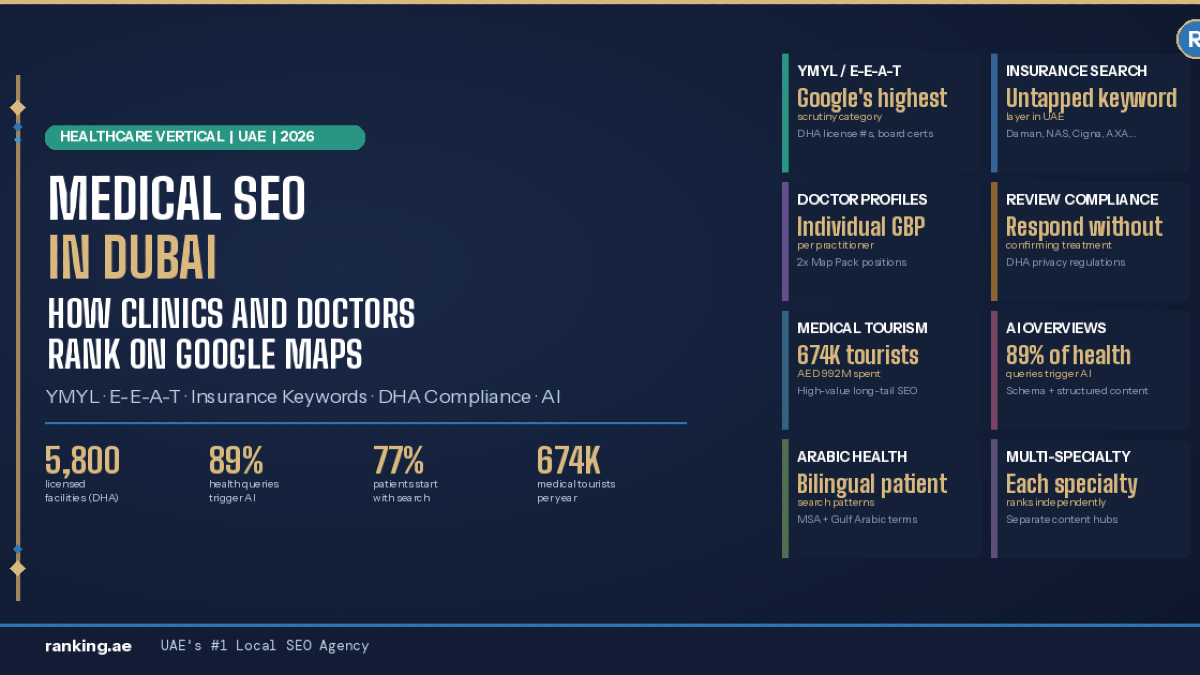
That scenario plays out thousands of times per day across Dubai. 77% of patients start their healthcare journey with a search engine. 72% read online reviews before choosing a provider. And 89% of healthcare queries now trigger AI Overviews at the top of Google results, meaning even the first organic result sits below an AI-generated answer.
Dubai now has approximately 5,800 licensed healthcare facilities, up 8% from 5,340 in 2024 according to the Dubai Health Authority. That includes 55 hospitals, 70 general dental clinics, 126 general medical clinics, 68 specialised clinics, and over 69,400 healthcare professionals. Dubai also attracted 674,000 medical tourists in 2022 spending AED 992 million, a number that has grown since. The competition for patient attention is fierce, growing, and increasingly decided by Google.
This guide is written specifically for clinics, dental practices, medical centers, and healthcare providers operating in Dubai and the UAE. Not a generic medical SEO guide with Dubai examples inserted. Every section addresses the specific challenges and opportunities of healthcare marketing in the UAE: DHA regulations, mandatory health insurance search patterns, multilingual patient populations, Ramadan scheduling, and the YMYL content standards that make medical SEO fundamentally different from any other industry.
Why Medical SEO Is Fundamentally Different from Every Other Industry
YMYL: Google Holds Healthcare to a Higher Standard
Google classifies healthcare content as YMYL (Your Money or Your Life), its highest-scrutiny category. Content that could affect a person's health, safety, or financial wellbeing receives stricter evaluation for accuracy, authority, and trustworthiness. A plumber's blog post about pipe maintenance can rank with decent on-page optimization. A clinic's page about diabetes treatment must demonstrate genuine medical expertise or Google will suppress it regardless of how well the page is technically optimized.
This is where E-E-A-T (Experience, Expertise, Authoritativeness, Trustworthiness) becomes a ranking factor you cannot bypass. Medical SEO sits inside Google's highest-risk category. A clinic page that names its doctors with their verifiable credentials (DHA license number, specialty board certification, years of practice, institutions trained at) ranks higher than one that says "our experienced team of specialists." The first demonstrates expertise. The second claims it without evidence. Google and AI models both know the difference.
Patient Lifetime Value Makes the ROI Math Overwhelmingly Favorable
A dental patient who comes for a cleaning and stays for orthodontic work, whitening, and family referrals may be worth AED 10,000 to 50,000 over their relationship with the practice. A dermatology patient starting with a consultation and progressing to ongoing treatments can exceed AED 20,000 in lifetime value. An IVF patient represents AED 30,000 to 80,000 per treatment cycle.
Compare those numbers to a monthly SEO investment of AED 1,499 to 4,999 from our pricing guide. If SEO generates even 5 new patients per month with an average lifetime value of AED 10,000, that is AED 50,000 in patient value from a AED 3,000 monthly investment. No other industry that ranking.ae serves has this kind of ROI math working in its favor.
The Insurance Search Layer That Most Clinics Ignore
Health insurance is mandatory in Dubai under Law No. 11 of 2013. Every resident must have coverage. This creates a massive search behavior pattern that most clinics completely ignore: patients searching by insurance provider rather than by clinic name or specialty.
"Dentist Dubai that accepts Daman." "Dermatologist Cigna network JLT." "Pediatrician near Business Bay Aman insurance." "Eye doctor Dubai Marina NAS coverage." These are high-intent, bottom-of-funnel searches from patients who have already decided they need care and are now filtering by whether their insurance covers it. Clinics that list their accepted insurance networks on their website, GBP, and structured data capture this entire keyword layer. Clinics that do not list insurance information lose these patients to competitors who do, even if the competitor is further away or has fewer reviews.
The major insurance providers to target in your content: Daman (the largest, covering most government employees), NAS, Oman Insurance, AXA, Orient, Cigna, MetLife, Bupa, Allianz, and Dubai Insurance Company. Each insurer has a provider network, and patients search for doctors within their specific network. A single page titled "Dental Clinic in JBR Accepting Daman Insurance" targets an insurance-specific long-tail keyword with zero competition from clinics that have not optimized for insurance search.
Google Business Profile Optimization for Healthcare Providers
Our GBP Optimization Playbook covers the 18-point general process. For healthcare, several points require specific attention.
Primary Category: The Decision That Determines Your Visibility
Our Maps Ranking Factors guide identifies primary category as the #1 individual ranking factor. For healthcare, this decision is more consequential than in any other industry because the category options are granular and each one triggers different search queries.
"Medical Center" is a trap. It is broad and matches weakly against specific searches like "dentist near me" or "dermatologist JLT." A dental practice should select "Dental Clinic" or "Dentist" as its primary category, not "Medical Center." A dermatology clinic should choose "Dermatologist." A pediatric practice should choose "Pediatrician." A multi-specialty clinic with dermatology, dental, and general practice must decide which service drives the most patients and revenue, use that as the primary category, and add the others as secondary categories.
This is not a branding decision. It is an algorithmic filter. A clinic listed as "Medical Center" will not appear for "dentist near me" searches even if it has a full dental department. Google takes your primary category at face value.
Doctor Profiles Within GBP
Google now allows healthcare providers to create individual practitioner profiles linked to the practice's main GBP. Each doctor profile includes their name, specialty, credentials, and patient reviews specific to that practitioner. This creates additional ranking opportunities: Dr. Sarah Ahmed, listed as a Dermatologist at your clinic, can rank independently for "dermatologist JLT" while the clinic's main profile ranks for "skin clinic JLT." Two Map Pack positions from one practice.
Include DHA license numbers in doctor descriptions. This is a verifiable credential that feeds E-E-A-T signals. "Dr. Sarah Ahmed, DHA License #XXXX-XXXX, Board-Certified Dermatologist, 12 years of practice" gives Google and AI models a concrete expertise signal that "Dr. Sarah, our experienced skin specialist" does not.
Appointment Booking Integration
GBP supports direct booking links. For healthcare in the UAE, this connects to platforms like Vezeeta, Practo, the DHA's own Dubai Health app, or the clinic's own booking system. A "Book Appointment" button directly in the Map Pack result removes friction. A patient who would have called (or abandoned the search) can book in two taps. This also creates a behavioral signal: booking actions tell Google the listing is converting users, which positively influences rankings.
Hours, Ramadan, and Emergency Availability
Our Maps Ranking Factors post explains that businesses listed as open at the time of search rank higher. For healthcare, this has specific implications. Clinics with extended evening hours (common in Dubai to serve working professionals) should list those hours precisely. Ramadan hours must be updated: many clinics adjust to split schedules. Emergency and after-hours availability should use the "more hours" feature. A clinic that is open until 10 PM ranks for evening searches when competitors listed as closing at 6 PM do not.
Review Generation for Healthcare: The Compliance-Sensitive Approach
Our complete review generation guide covers the system. For healthcare, the approach requires adjustment for patient privacy and DHA regulations.
When and How to Ask
The optimal ask timing for healthcare differs from other industries. The best moment is at checkout, immediately after a positive interaction with the practitioner. The front desk staff hands the patient a card with a QR code and says, "We would really appreciate it if you could share your experience. It helps other patients find us." The WhatsApp follow-up goes out the next morning, not 2 hours later (healthcare is not the same as a restaurant; patients need time to process).
For dental procedures with visible results (whitening, aligners, veneers), the ask can happen at the reveal moment when the patient sees the outcome for the first time. That emotional peak produces the most detailed, enthusiastic reviews.
How to Respond Without Violating Patient Privacy
In the UAE, DHA regulations govern patient confidentiality. When responding to a review that mentions a specific treatment, the clinic must not confirm that the patient received that treatment. The correct approach:
Patient review: "Dr. Ahmed did an amazing job with my teeth whitening. Went from shade A3 to B1 in one session."
Wrong response: "Thank you! We are glad your whitening treatment went well. Your shade improvement was excellent."
Right response: "Thank you for taking the time to share your experience. We are glad you had a positive visit and appreciate your kind words about Dr. Ahmed. We look forward to seeing you again."
The right response acknowledges the review without confirming any clinical details. This protects the clinic legally while still responding promptly (which is a ranking signal, as covered in our Maps Ranking Factors guide).
Multilingual Patient Reviews
Dubai's patient population searches in Arabic, English, Hindi, Urdu, and Tagalog. A review in Arabic from a patient describing their experience at your JLT clinic creates a relevance signal for Arabic healthcare searches. A review in Hindi from a patient in Deira does the same for Hindi queries. Encouraging multilingual reviews is not just good patient relations. It builds multilingual search visibility. Our Arabic SEO guide explains why this applies to every touchpoint, including reviews.
Website Content That Satisfies YMYL Standards and Ranks
Service Pages That Answer Patient Questions Directly
A page titled "Teeth Whitening in Dubai Marina" that opens with "Professional teeth whitening at our Dubai Marina clinic takes 60 to 90 minutes, uses Philips Zoom or BEYOND technology, and costs AED 1,200 to 2,500 depending on the method" gives patients and AI systems exactly the specific, extractable information they need. A page titled "Our Cosmetic Dentistry Services" with 400 words of marketing language about "your smile journey" ranks for nothing because there is nothing concrete to extract.
Each service page should include: the procedure name with location, what the procedure involves in plain language, typical duration, realistic cost range in AED, the technology or method used, who performs it (named doctor with credentials), recovery expectations, and insurance coverage information. This format satisfies E-E-A-T, answers patient questions, feeds AI Overviews, and targets location-specific keywords simultaneously. Our AEO/GEO guide explains why this structured format is critical for appearing in AI-generated answers.
Doctor Profile Pages With Verifiable Credentials
Each practitioner should have a dedicated page listing: full name, specialty, DHA license number, board certifications, medical school and residency (with years), areas of special interest, languages spoken, published research or conference presentations (if applicable), and a professional photo. This is E-E-A-T in its purest form. AI models evaluating whether to recommend your clinic for a specific condition check whether your team includes a credentialed specialist in that area. A page that says "our team has decades of experience" fails this check. A page listing Dr. Fatima Al-Rashid's DHA license, her board certification in pediatric dentistry, and her 15 years of practice passes it.
Insurance Network Pages
Create a page for each major insurance provider your clinic accepts. "Dental Clinic in JLT Accepting Daman Insurance" is a page that targets a specific keyword cluster with near-zero competition. Include: which services are covered under that insurer's network, any co-pay information you can share, the process for claiming (direct billing vs reimbursement), and a list of your doctors within that network. These pages capture the insurance-specific search intent that most clinics ignore entirely.
Condition and Treatment Content With Medical Authority
Blog posts about common conditions ("What Causes Gum Recession?" "When Should You See a Dermatologist for a Mole?") build topical authority and capture informational search intent. But healthcare content must cite medical sources. Reference DHA guidelines, WHO recommendations, published studies, or established medical references. AI models prefer content that references authoritative sources and meet YMYL standards. A blog post that cites a PubMed study ranks higher and gets cited by AI more frequently than one that states unsourced claims.
Schema Markup: The Technical Layer That Feeds AI
Healthcare has specific schema types that general business sites do not use. Implementing these gives AI systems pre-organized, machine-readable data about your practice.
MedicalOrganization schema: Your clinic's name, address, phone, opening hours, accepted insurance, and medical specialties in structured format.
Physician schema: Each doctor's name, credentials, specialty, affiliated organization, and available service.
MedicalProcedure schema: For specific treatments you offer, including preparation, procedure type, and follow-up.
FAQPage schema: Your FAQ content marked up for rich results. Healthcare FAQs frequently appear in featured snippets and AI Overviews.
These schema types feed the AI visibility signals we covered in our AEO/GEO guide. When ChatGPT, Perplexity, or Google's AI Mode answers "best pediatric dentist in Dubai," they draw from structured data. Clinics with schema give AI systems clean, organized data to cite. Clinics without it force AI to guess from unstructured content.
Multi-Location Clinics and Multi-Specialty Practices
A healthcare group with branches in Dubai Marina, Jumeirah, and DIFC needs a separate GBP for each location with unique photos (the actual reception desk, waiting area, and treatment rooms at each branch), unique reviews (patients reviewing the specific branch they visited), and a dedicated location page on the website with content specific to that neighborhood's patient demographics.
The Whitespark 2026 survey confirms that each specialty can rank independently while reinforcing the broader medical entity. A multi-specialty clinic should structure its website so dermatology, dental, and general practice each have their own content hub, their own doctor profiles, and their own service pages, all clearly connected to the parent clinic's brand. This prevents specialties from competing with each other and ensures each one can rank for its own keyword set.
Our pillar guide to local SEO in Dubai covers the general multi-location strategy. For healthcare, the additional requirement is that each branch must have its own hours, its own accepted insurance information, and its own appointment booking link.
Capturing Medical Tourist Search Traffic
Dubai attracted 674,000 medical tourists in 2022 spending AED 992 million. These patients search from outside the UAE before arriving, using queries like "best IVF clinic Dubai," "dental implants cost Dubai," "hair transplant Dubai reviews," and "LASIK surgery Dubai." They are comparing options internationally and will choose the clinic that appears most credible, most reviewed, and most informative in search results.
Medical tourism SEO requires content that addresses the travel patient's specific concerns: visa requirements for medical treatment, airport proximity, recovery accommodation, treatment timelines that fit a travel schedule, cost comparisons with their home country, and international accreditation (JCI, for example). These pages target long-tail keywords with high conversion value and relatively low competition from clinics only optimizing for local patients.
Our AEO/GEO guide is particularly relevant here: medical tourists increasingly ask AI tools for recommendations before booking. "ChatGPT, where should I go for dental implants in Dubai?" is a real query. The clinics that appear in those AI-generated answers capture patients worth tens of thousands of dirhams each.
The Seven Medical SEO Mistakes We See in Every Audit
Based on our audits of healthcare GBPs across Dubai, these are the errors that suppress visibility most frequently. Our 10 Local SEO Mistakes guide covers the general errors. These are healthcare-specific.
1. Primary category set to "Medical Center" instead of the specific specialty. This is the most common and most damaging mistake. It costs the clinic visibility for every specialty-specific search.
2. No insurance information anywhere. Not on the website, not in the GBP description, not in structured data. This surrenders the entire insurance search layer to competitors.
3. Doctor pages without verifiable credentials. "Our experienced team" is not E-E-A-T. Names, DHA license numbers, and board certifications are.
4. Identical content across multiple branches. The same "About Our Clinic" text copied to 4 location pages. Google suppresses all of them.
5. No review response strategy. Reviews mentioned specific treatments in responses, creating privacy concerns. Or reviews simply went unanswered for months.
6. Ramadan and holiday hours never updated. Clinics listed as open on Fridays from 8 AM when they actually open at 4 PM. Patients arrive, find the door locked, and leave negative reviews. The clinic loses rankings and reputation simultaneously.
7. Zero Arabic content. In a city where a significant portion of patients search in Arabic, having an English-only website and English-only GBP descriptions surrenders Arabic search visibility entirely. Our Arabic SEO guide covers the three keyword layers that apply to healthcare as much as to any industry.
Find Out How Your Clinic Ranks Against the Competition
Our free SEO audit for healthcare providers evaluates your Google Business Profile, website, citations, reviews, insurance content, doctor profiles, and schema markup against every factor discussed in this guide. We show you exactly where you stand relative to the clinics currently occupying the Map Pack positions you want and what it would take to displace them.
Get your free healthcare SEO audit here. Or explore our plans starting at AED 1,499/mo to see what medical SEO includes at each tier. We have applied these principles across healthcare, dental, and specialty practices throughout the UAE. The same methodology that grew LicensePlate.ae by 480%, MyJet24 by 890%, and UAE Tax Filing by 275% applies to healthcare with the additional E-E-A-T and compliance layer that medical SEO demands.