Someone in JBR is hungry. They pull out their phone and type "best biryani near me." Three restaurants appear in the Map Pack. One of them gets a customer who spends AED 80 to 150 tonight and potentially returns twice a month for the next two years. The other 40 biryani restaurants within walking distance do not exist for that person at that moment.
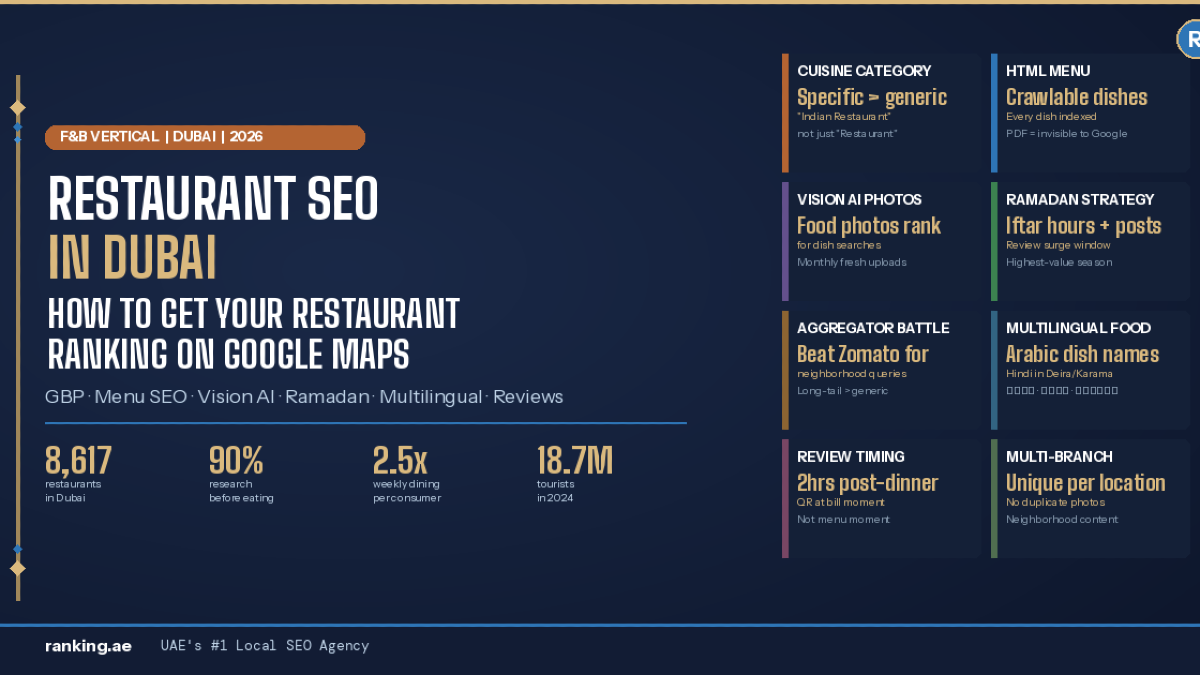
90% of consumers research restaurants before choosing where to eat. 64% specifically Google restaurants before visiting. In Dubai, those numbers carry even more weight because the city's dining population is overwhelmingly transient. New residents arrive monthly and immediately need to find places to eat. 18.72 million international tourists visited Dubai in 2024, each one discovering restaurants through search. The average Dubai consumer eats out 2.5 times per week.
The competition is staggering. Dubai Municipality data shows 8,617 restaurants and over 5,240 coffee shops and cafeterias in the city. Nearly 1,200 new restaurant licenses were issued in 2024 alone. Every one of those restaurants competes for the same three Map Pack positions when a hungry customer searches.
This guide is not a generic SEO guide with restaurant examples inserted. It covers the specific tactics, challenges, and opportunities that apply only to F&B businesses in the UAE: food photography that Google's Vision AI reads, Ramadan and Friday scheduling, competing with Zomato and Talabat, multilingual food search patterns, and the review generation timing that works for dining but not for any other industry.
Google Business Profile Optimization for Restaurants
Our GBP Optimization Playbook covers the 18-point general process. Our Maps Ranking Factors guide explains why GBP signals account for 32% of Local Pack rankings and why primary category is the #1 individual factor. For restaurants, several elements require F&B-specific treatment.
Primary Category: Specificity Wins
"Restaurant" is a trap. It is too broad. Google offers granular food categories: "Indian Restaurant," "Italian Restaurant," "Seafood Restaurant," "Pizza Restaurant," "Shawarma Restaurant," "Sushi Restaurant," "Steakhouse," and dozens more. The more specific your primary category, the stronger your relevance signal for cuisine-specific searches. A biryani place listed as "Indian Restaurant" ranks for "Indian restaurant near me" while a competitor listed as just "Restaurant" does not.
If your restaurant serves multiple cuisines (common in Dubai with its multicultural dining scene), choose the primary category that represents your core identity and highest-volume search potential. Add the others as secondary categories. A Lebanese restaurant that also serves grills and seafood should pick "Lebanese Restaurant" as primary and add "Seafood Restaurant" and "Barbecue Restaurant" as secondary.
Your Menu: HTML, Not PDF
PDF-only menus limit crawlable content. Google cannot reliably read and index a PDF menu the way it reads HTML text. An HTML menu page on your website, with each dish listed as text (not embedded in an image), makes every dish name, ingredient, and price searchable. When someone searches "lamb mandi near Dubai Marina," a restaurant with "Lamb Mandi" listed in HTML text on its menu page has a relevance signal. A restaurant with the same dish buried inside a PDF or photographed image does not.
Include on your HTML menu: dish names (in English and Arabic where applicable), key ingredients, prices in AED, dietary indicators (halal certification, vegan options, gluten-free dishes), and portion descriptions. Each of these details is a potential keyword match for specific food searches. AI systems increasingly reference structured menus, meaning this content feeds both Google and the AI recommendation engines covered in our AEO/GEO guide.
Food Photography That Ranks You for Dishes
Google's Vision AI reads the content of your uploaded photos. This is the same principle from our Maps Ranking Factors guide: a plumber uploading a water heater photo ranks for water heater searches. For restaurants, this means a high-quality photo of your lamb mandi can help you rank for "mandi" searches even without that keyword in your text, because Google reads the dish from the image.
Photos influence restaurant SEO more than almost any other industry. Upload photos of signature dishes (shot with good lighting, overhead or 45-degree angle, on a clean background), your interior ambiance (natural light preferred), outdoor seating areas (critical in Dubai's cooler months), kitchen preparation (builds trust), and seasonal offerings (Ramadan Iftar spreads, Friday brunch displays). Google tracks engagement on photos; more engagement means stronger visibility. Upload fresh photos monthly. Stale photo sets signal an inactive business.
Hours: Ramadan, Friday Brunch, Late Night, and Seasonal Shifts
Our Maps Ranking Factors post established that businesses listed as open at the time of search rank higher. For restaurants in Dubai, hours are more complex than any other industry.
Ramadan hours: During Ramadan, many restaurants shift to Iftar and Suhoor service with different hours than the rest of the year. Some close during daytime. Others open only after sunset. These must be updated on GBP before Ramadan starts and reverted when it ends. A restaurant listed as open at 12 PM during Ramadan when it actually opens at sunset will frustrate customers and generate negative reviews. Use the "special hours" feature for Ramadan dates.
Friday brunch: Dubai's Friday brunch culture is a massive search category. Restaurants offering Friday brunch should use the "more hours" feature to list brunch as a separate session (e.g., 12 PM to 4 PM). Google Posts promoting this week's brunch with a "Get Offer" or "Book" CTA capture Friday brunch searches directly from the Map Pack.
Late-night dining: Restaurants open until 2 AM or later capture "food open now" searches after midnight, a significant search volume in a city with active nightlife. Extending your listed hours (if accurate) literally extends the window during which you rank.
Attributes That Diners Search For
GBP offers restaurant-specific attributes: outdoor seating, wheelchair accessible, family-friendly, live music, shisha available, private dining, delivery available, dine-in, takeaway, and halal certified. Add every attribute that applies. When a user searches "restaurant with outdoor seating JBR" or "halal restaurant Dubai Marina," these attributes function as filters. Restaurants with the matching attribute appear. Those without it do not.
Competing with Zomato, TripAdvisor, Talabat, and Google's Own Features
For generic food searches ("restaurants in Dubai Marina," "best restaurants near me"), aggregator platforms dominate. Zomato, TripAdvisor, and Google's own curated lists occupy the top organic positions. You are not going to outrank Zomato for "restaurants in Dubai Marina" with a single restaurant's website. That is not the fight to pick.
The fight you win is the specific, neighborhood-level, cuisine-specific search where the aggregator's page is a generic category listing but your optimized page is precisely relevant. "Best biryani Al Karama" is beatable because your page is exclusively about your biryani in Al Karama, with reviews mentioning Al Karama, photos of your Al Karama location, and content describing your specific preparation. Zomato's page lists 50 restaurants with two-line descriptions. Your page goes deep on one.
Claim and optimize your aggregator listings as citation sources. Your Zomato, TripAdvisor, Talabat, and Google Maps listings are structured citations. Consistent NAP across all of them strengthens your Map Pack ranking. Accurate menus, updated photos, and active review responses on these platforms feed the AI visibility signals from our AEO/GEO guide. When ChatGPT recommends "best shawarma in Deira," it draws from exactly these aggregator profiles plus your own web presence. Inconsistency across them weakens AI confidence in recommending you.
Build direct website authority to reduce dependency. Every customer who orders directly through your website instead of through Talabat or Deliveroo saves you the 15 to 30% commission that delivery apps charge. A well-optimized website with online ordering, an HTML menu, and strong local SEO creates a direct channel that aggregators cannot tax. Your Google Business Profile can link directly to your website's ordering page, bypassing aggregators entirely for customers who find you through search.
Review Generation for Restaurants: Timing Is Everything
Our complete review generation guide covers the system. For restaurants, the when and how of asking requires F&B-specific calibration.
The Bill Moment, Not the Menu Moment
The optimal time to prompt a review is when the customer is settling the bill, not when they are reading the menu. At the menu stage, they have not eaten yet. At the bill stage, they have just finished a meal they enjoyed (or did not), and the experience is fresh. Place a small card or table tent with a QR code next to the bill folder. The text is simple: "Enjoyed your meal? A quick review helps other food lovers find us." The QR code links directly to your Google review page.
The WhatsApp Follow-Up: 2 Hours, Not 24
For restaurants with a reservation system (Eat App, SevenRooms, or a simple WhatsApp booking), send a follow-up message 2 hours after the reservation time. Not the next morning. Two hours is when the meal memory is vivid and emotional. "Hi [name], thank you for dining with us tonight. If you enjoyed your experience, we would love a quick review: [link]. It makes a real difference for us." This timing produces reviews that mention specific dishes, describe the atmosphere, and reference the neighborhood. All of that text is keyword-rich content that feeds your ranking for food-specific, location-specific searches.
Ramadan Review Strategy
Iftar is the single most powerful review generation opportunity in the Dubai F&B calendar. Guests arrive for Iftar with anticipation, break their fast in a communal setting, and leave feeling emotionally fulfilled. The reviews they write after Iftar are consistently the longest, most detailed, and most keyword-rich of the year. They describe the atmosphere, the dishes, the timing, the service, and the value. Prompt Iftar guests specifically: "Thank you for sharing Iftar with us. Your experience matters to us and to the community: [review link]." These reviews rank you for "Iftar restaurant [neighborhood]" searches during Ramadan, the highest-value seasonal search period in UAE dining.
Responding to Food Criticism
A negative review about food is different from a negative review about a late delivery or a rude interaction. Taste is subjective. Acknowledge that. Never argue about whether a dish was good or bad. The correct structure: thank the guest for their feedback, acknowledge that taste preferences vary, express genuine interest in getting it right for them next time, and offer a specific gesture ("We would love to have you back to try our new preparation. Your next visit is on us."). This response shows future readers that the restaurant takes feedback seriously without becoming defensive.
Multilingual Food Search: The Keyword Layer Most Dubai Restaurants Miss
Dubai's dining population searches in English, Arabic, Hindi, Urdu, and Tagalog. Each language represents a different customer segment with different search patterns. Our Arabic SEO guide covers the three keyword layers. For restaurants, the application is specific.
Arabic dish names with real search volume: مندي (mandi), كبسة (kabsa), شاورما (shawarma), مشاوي (mashawi/grills), كنافة (kunafa), مجبوس (machboos), فتوش (fattoush). These terms get searched in Arabic on Google.ae. A restaurant with Arabic menu content, Arabic GBP descriptions, and Arabic reviews mentioning these dishes ranks for these queries. An English-only restaurant does not.
Transliterated terms: "shawarma near me," "mandi Dubai," "kunafa delivery," "kabsa JBR," "fattoush Business Bay." These are English-alphabet searches for Arabic dishes, common among expats who know the food but search in English. Including these transliterated terms in your English menu page and GBP description captures this cross-language search intent.
Hindi and Urdu food searches in specific neighborhoods: Deira, Al Karama, Bur Dubai, and parts of Sharjah have concentrated South Asian populations who search for food in Hindi and Urdu. "बिरयानी दुबई" (biryani Dubai), "नान केबाब" (naan kebab), "देसी खाना" (desi food). Restaurants in these areas that include Hindi keywords in their content and encourage Hindi-language reviews capture a customer segment that competitors with English-only optimization miss entirely.
Multi-Branch Restaurant Strategy
A restaurant chain with locations in JBR, DIFC, Al Karama, Deira, and Dubai Marina needs a separate GBP for each branch. But separate profiles with identical content across all five is worse than having one profile. Google detects duplicate content and suppresses it.
Unique photos per branch. The JBR location's interior looks different from the Deira location's interior. Upload real photos of each branch's actual space, actual team, and actual plating. Do not use the same set of professional stock photos across five profiles.
Unique location pages on your website. Each branch needs its own page with content specific to that neighborhood. The JBR page talks about waterfront dining, tourist foot traffic, and the Friday brunch scene. The Al Karama page talks about the street food culture, the diverse community, and the value-oriented dining crowd. The DIFC page talks about the business lunch audience, the corporate event catering capacity, and the proximity to the Gate. This is not just different addresses pasted into the same template. It is genuinely different content that reflects each branch's distinct market.
Unique review profiles. Encourage guests to review the specific branch they visited. A review mentioning "the JBR location" or "our dinner in Al Karama" creates location-specific relevance that a generic brand review does not. Each branch's review profile should grow independently.
Schema Markup: Restaurant, Menu, and LocalBusiness
Restaurant schema gives Google structured data about your cuisine type, price range, opening hours, address, accepted payment methods, and whether you offer delivery, takeaway, or dine-in. Menu schema lists individual dishes with names, descriptions, and prices in machine-readable format. This is the technical layer that feeds AI systems with organized data they can cite. Our AEO/GEO guide explains why structured data is critical for AI visibility.
Include the servesCuisine property ("Lebanese," "Indian," "Japanese"), the priceRange property ("AED 50-150"), and the hasMenu property linking to your HTML menu page. For multi-branch restaurants, each location gets its own LocalBusiness schema with unique geo-coordinates, unique opening hours, and a unique telephone number.
Getting Recommended When Someone Asks AI Where to Eat
"ChatGPT, where should I get shawarma in Dubai Marina?" "Perplexity, best brunch spots in JBR." "Gemini, recommend a family-friendly restaurant in Business Bay." These are real queries that real customers ask every day. Our AEO/GEO guide covers the mechanics. For restaurants specifically:
Being featured in "best of" lists on Time Out Dubai, What's On, Lovin Dubai, and similar publications is now a measurable ranking factor for both traditional search and AI recommendations. These editorial mentions function as the unstructured citations that AI models draw from. Getting onto Time Out's "best biryani in Dubai" list is no longer just a PR win. It directly feeds the AI engine that recommends you when a tourist asks ChatGPT the same question.
Review content matters even more for AI. When 20 reviews mention "amazing Iftar experience in JBR with a view of the water and the best lamb mandi I have had in Dubai," AI models have specific, keyword-rich, sentiment-positive claims to reference when generating a recommendation. Volume plus keyword specificity plus positive sentiment equals AI citation.
The Six Restaurant SEO Mistakes We See in Every Audit
Our 10 Local SEO Mistakes guide covers the general errors. These are F&B-specific.
1. Primary category set to "Restaurant" instead of the specific cuisine. Costs you visibility for every cuisine-specific search.
2. Menu only available as a PDF or embedded image. Google cannot read it. Every dish name is invisible to search.
3. Ramadan and Friday brunch hours never updated. Customers arrive to a closed restaurant, leave negative reviews, and your rankings drop simultaneously.
4. Identical content across multiple branches. Same photos, same descriptions, same menu text on 4 different GBPs. Google suppresses all of them.
5. No Arabic menu content. In a city where Arabic dish searches have significant volume, having an English-only menu surrenders this entire keyword layer.
6. No review generation system. Relying on organic reviews produces 1 to 2 per month. A systematic approach (QR codes, WhatsApp follow-ups, trained staff) produces 15 to 30. The velocity difference is a ranking factor.
Find Out How Your Restaurant Ranks Against Local Competitors
Our free SEO audit for restaurants evaluates your Google Business Profile, menu indexability, photo quality, review velocity, citation consistency, aggregator presence, and multilingual content against every factor in this guide. We show you where you stand relative to the restaurants currently holding the Map Pack positions you want.
Get your free restaurant SEO audit here. Or explore our plans starting at AED 1,499/mo. Our SEO pricing guide breaks down what each tier delivers. We have applied these principles across F&B, healthcare, and professional services throughout the UAE. The same methodology that grew LicensePlate.ae by 480% and MyJet24 by 890% applies to restaurants with the F&B-specific layer this guide covers.