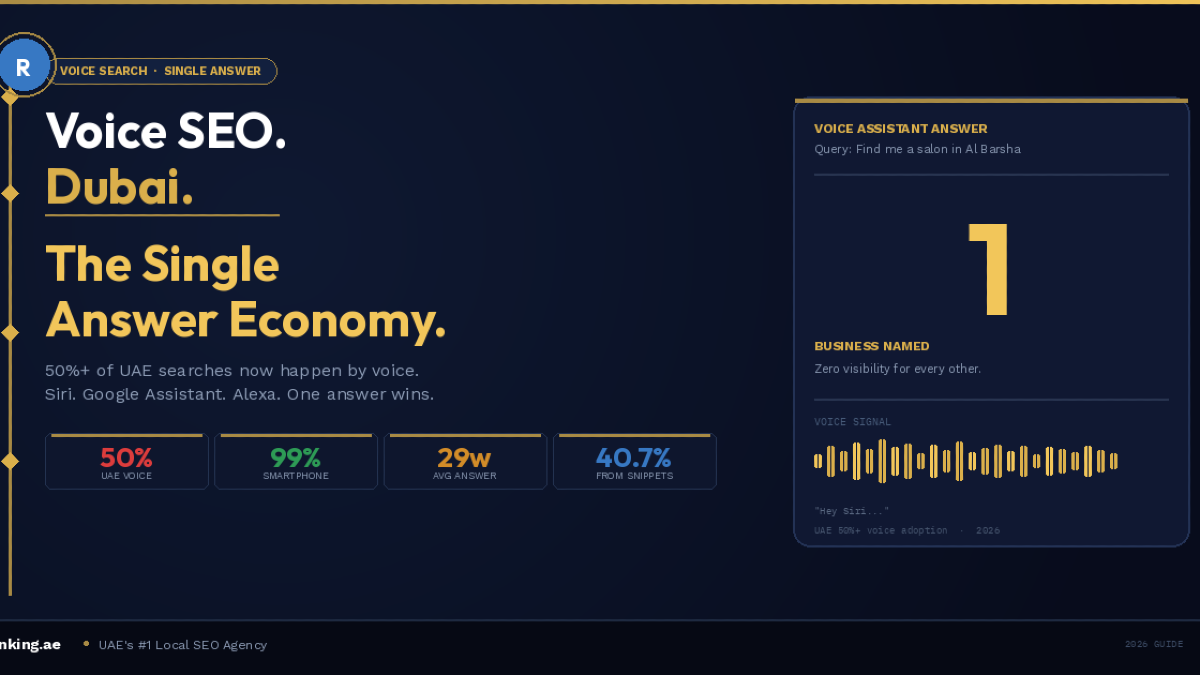
A driver on Sheikh Zayed Road at 3pm on a Wednesday in March 2026 hit heavy traffic near the Mall of the Emirates interchange. She pressed the voice button on her BMW steering wheel and said: "Hey Siri, find me a salon in Al Barsha with walk-ins available." Her car's infotainment system read back a single business name, address, and estimated arrival time. She tapped the wheel to start navigation.
She does not know what other salons existed in Al Barsha at that moment. She does not know how many were closer to her route, how many had higher ratings, or how many would have accepted her walk-in. She knows the one business Siri told her about. That business captured a new client. Every other salon within a three-kilometer radius captured nothing.
This is the Single Answer Economy, and over 50 percent of UAE searches now happen in this format. The UAE ranks among the highest-adoption voice search markets globally, helped by smartphone penetration exceeding 99 percent and smart home device adoption that has made Alexa and Google Home standard fixtures in luxury developments from Dubai Marina to Ras Al Khaimah. The driver on Sheikh Zayed Road is not unusual. She is the median UAE consumer making a local business discovery decision in 2026.
Voice search returns exactly one answer. Not ten blue links. Not a Map Pack with three options. Not a ChatGPT response naming four or five candidates. One business name, one address, one phone number, read aloud and often tapped directly into navigation without any visual confirmation. Position two does not exist in voice. Being second is functionally the same as being invisible. This article covers why the voice search landscape is structured this way, what Siri, Google Assistant, and Alexa actually read when they select that single answer, and the sixty-day operational sprint that makes a Dubai business the one business spoken aloud.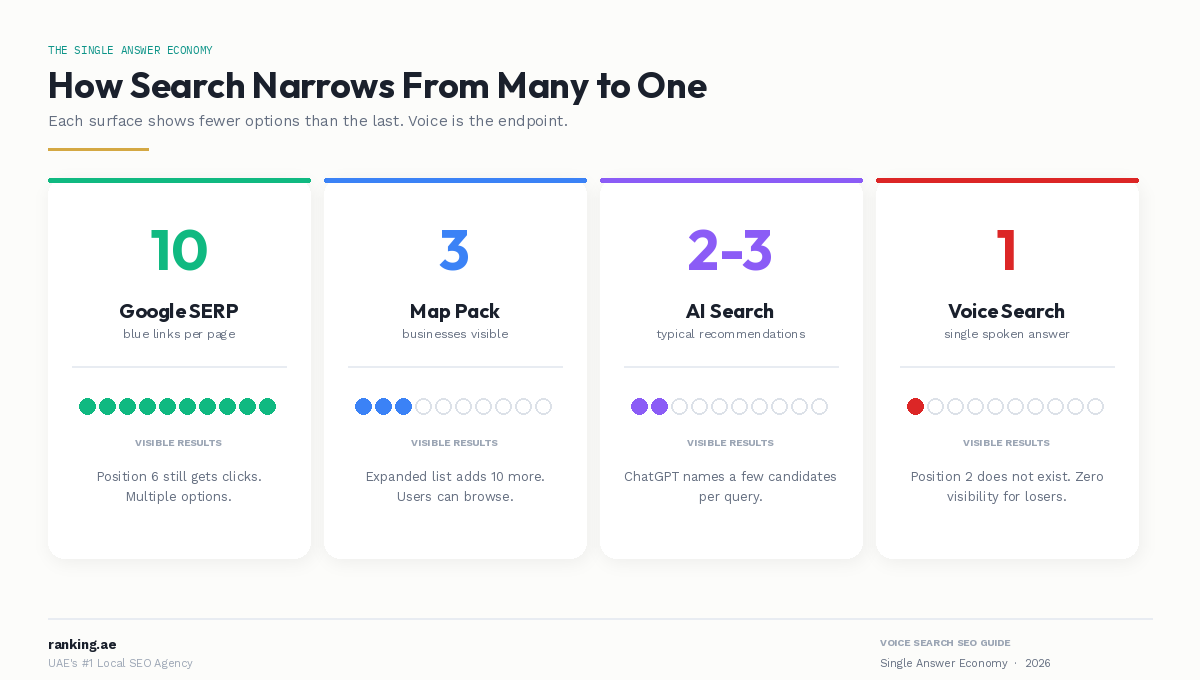
1. The Single Answer Economy: Why Voice Is the Harshest Ranking Surface in Search
Traditional search surfaces show multiple results and let the user choose. Voice search surfaces show one. The practical ranking implications compound harshly as the answer format narrows.
Google's ten blue links show ten options per page. A business ranking at position six or seven still gets visible placement and some share of clicks. The Map Pack shows three Map results plus the expanded list of ten, so a business ranking at position four or five still appears when users click "More places." In AI search, SOCi's 2026 Local Visibility Index found that ChatGPT recommends only 1.2 percent of locations, but even that response typically names two or three businesses when users ask for options. Voice search ends the pattern. The assistant picks one.
The math gets worse when you look at where voice answers come from. Backlinko's voice search research found that 40.7 percent of voice search answers are pulled directly from featured snippets, the "position zero" result that appears above the standard ten blue links. Another 40 percent or more come from the top three organic results based on Google Assistant behavior. The businesses that win voice search are almost always the ones that already own position zero or positions one through three for the query. Voice does not create a new competitive landscape. It ruthlessly filters the existing one down to the single strongest page.
The average voice search result is 29 words long. That is the hard constraint on what gets read aloud. A Dubai business whose service pages open with a three-paragraph company history before reaching the actual service description cannot compete in voice, because by word 29 the assistant has reached the end of its allotted response and the page has not yet said what it actually does. The businesses that win voice are the ones that deliver a complete, self-contained answer in 40 to 60 words immediately under each heading, giving the assistant exactly what it needs to extract and speak.
"Voice assistants give exactly one answer. Not ten blue links. Not a map pack with three options. One. The business that wins the voice result gets the customer."
— Search Scale AI, "Voice Search Optimization," 2026
2. Three Voice Contexts in the UAE: Mobile, Smart Speaker, In-Vehicle
Voice search in the UAE is not one behavior. It is three distinct contexts, each with its own query patterns, optimization implications, and commercial value. Dubai businesses that treat voice as a single category miss the fact that the driver on Sheikh Zayed Road, the expatriate asking Alexa in a Palm Jumeirah villa, and the mall visitor using Siri on her iPhone are three different customers with three different needs.
Mobile voice: Siri and Google Assistant
The highest-volume context. UAE consumers use Siri and Google Assistant throughout the day for local discovery, quick comparisons, and directions while doing other things. Siri commands 36 percent of the global voice assistant market with over 500 million active devices globally and a particularly strong footprint in the UAE's large Apple user base. Google Assistant has an equal 36 percent share and pulls directly from Google Business Profile data, which makes every GBP optimization decision a voice search decision by extension. Queries in this context are conversational, often location-anchored ("salons near me," "pharmacies open now in JLT," "the closest mechanic"), and the user typically acts on the answer within minutes.
Smart speaker voice: Alexa and Google Home
A growing context in the UAE, particularly in luxury residential developments. Alexa and Google Home devices are now standard features in developments from Dubai Marina to Emaar Beachfront to Mina Al Arab in Ras Al Khaimah, where residents query home assistants for local services, food delivery, and recommendations from their living rooms with no screen involved. Smart speaker queries skew toward lifestyle and household categories: restaurant recommendations, delivery services, home maintenance providers, grocery delivery, and personal services. The user is typically at home, not moving, and has slightly more patience for multi-turn conversations than mobile users. Alexa pulls from Bing, Yext, and its own skill ecosystem rather than from Google, which means optimizing for Alexa is a distinct technical exercise from optimizing for Google Assistant.
In-vehicle voice: Apple CarPlay and Android Auto
The UAE's car-first culture and long inter-emirate commutes make in-vehicle voice commercially significant in ways that do not apply in most markets. A Sheikh Zayed Road commuter spending 90 minutes in traffic during rush hour is the single most valuable voice search user in the country. The query is high-intent (she needs something, not browsing), proximate to a purchase decision (navigation starts immediately after the answer), and occurs in a context where visual alternatives are impossible (hands on the wheel, eyes on the road). Hospitality, F&B, fuel stations, pharmacies, and automotive services receive the bulk of in-vehicle voice queries on Dubai's high-traffic routes. 62 percent of iPhone users reported using Siri while driving, which in the UAE translates to hundreds of thousands of daily in-vehicle queries specifically.
3. What Siri, Google Assistant, and Alexa Actually Read
Each voice assistant pulls its single spoken answer from specific data sources. Understanding which sources each platform relies on determines where optimization effort should concentrate.
Google Assistant
The most straightforward. Google Assistant pulls voice answers directly from Google's search index, with heavy weighting toward featured snippets (40.7 percent of answers) and the top three organic results. For local queries, Google Assistant reads from Google Business Profile data, which makes the GBP optimization playbook effectively a voice search optimization playbook. Every GBP field that gets optimized for Map Pack ranking becomes voice-ready by extension: categories, services, attributes, opening hours, Q&A, and Posts. An incomplete GBP is the fastest way to lose a voice answer to a competitor whose profile is complete.
Siri
Siri's data sourcing is more opaque and has evolved multiple times. For factual queries, Siri uses a combination of Apple's own knowledge graph and results from whichever search engine the user has configured (Google by default for most UAE users). For local business queries, Siri pulls heavily from Apple Maps, Yelp where available, and increasingly from the user's own contacts and prior app usage. Dubai businesses frequently neglect Apple Maps entirely, which is a mistake. The claim-your-business process on Apple Business Connect takes approximately 20 minutes and opens Siri as a discovery channel. Without a claimed Apple Maps listing, a business is functionally invisible to the UAE's large iPhone population for voice queries.
Amazon Alexa
Alexa pulls from a combination of Bing's web index, Yext's data network, and Alexa's own Skills ecosystem. Amazon's partnership with Yext means that businesses listed accurately on Yext often appear in Alexa responses without additional optimization. Bing Places is separately important; Bing's webmaster tools let Dubai businesses submit sitemaps and monitor indexing in a way that most UAE businesses never bother with. Alexa voice commerce also supports custom Skills, which large retailers and service brands can build to appear in specific query categories. For most small and mid-sized Dubai businesses, the practical priority is Bing Places claim and Yext consistency rather than custom Skills.
What all three have in common
Voice assistants favor content that directly answers conversational questions. FAQ sections marked up with FAQPage schema become answer sources for any voice query that matches the question. Structured data (LocalBusiness, FAQ, Service) provides machine-readable context. Fast-loading mobile-first pages load quicker into voice responses. Pages that win voice are 52 percent faster on average than non-voice-winning pages. The shared foundation across all three platforms is clean, structured, question-answer content on fast-loading pages with accurate local business data.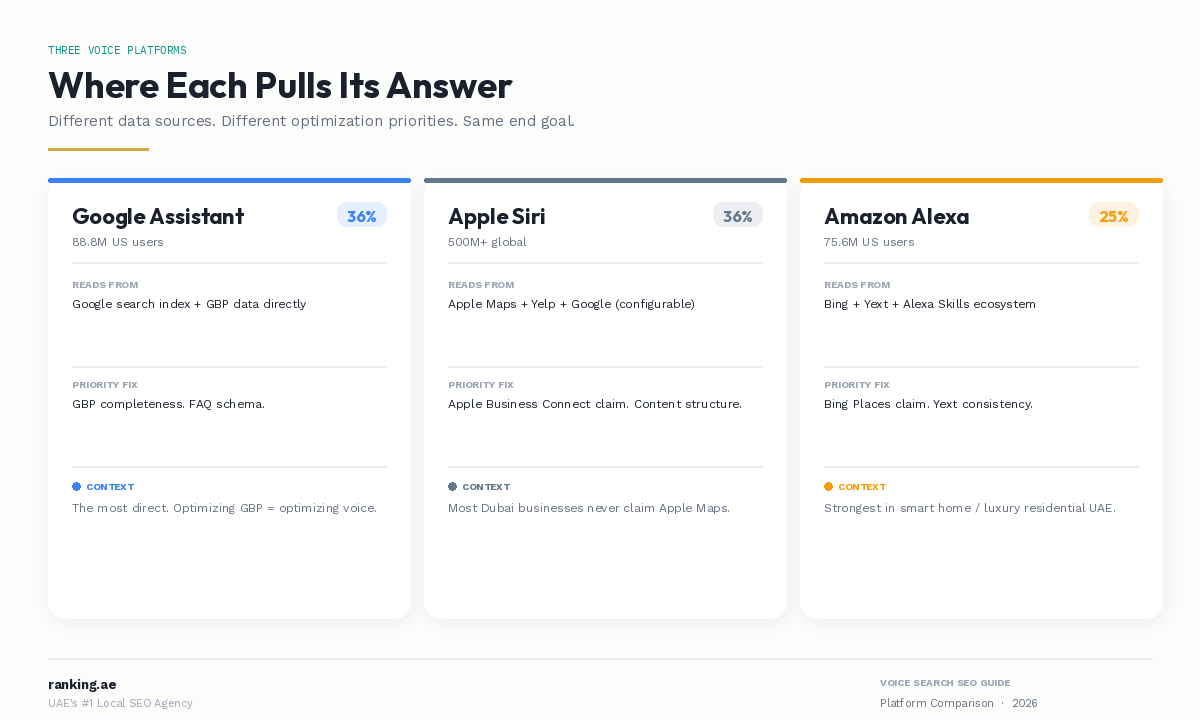
4. Arabic Voice Search: The UAE's Untapped Bilingual Advantage
Every statistic cited so far is weighted toward English-language voice search, because that is where the public research is concentrated. The UAE market is bilingual. Roughly 40 to 60 percent of voice queries in Dubai originate in Arabic depending on the category, and the number rises significantly in Deira, Al Qusais, Sharjah, and cross-emirate queries that serve Arabic-speaking expatriate and local populations.
The asymmetry creates opportunity. Our Arabic SEO guide documented that Arabic competition runs 40 to 50 percent below English competition for most categories in the UAE. That gap widens for voice specifically. A Dubai restaurant with a complete Arabic-language FAQ section marked up with FAQPage schema and an Arabic-language GBP description will appear in Arabic Siri and Google Assistant responses that English-only competitors cannot reach. The English-only competitor is not merely underperforming. It is completely invisible to the segment of the market searching in Arabic.
The technical implementation is straightforward but frequently skipped. An Arabic content strategy for voice requires three components. First, an Arabic version of the GBP description, services, and Q&A. Second, Arabic FAQ sections on service pages matching the conversational phrasing Arabic speakers actually use (which differs significantly from literal translations of English queries). Third, hreflang markup on location pages to tell Google that the Arabic and English versions of the page serve different audiences. The investment required is roughly 20 to 40 hours of Arabic content production for a small Dubai business, and the market return is access to a channel where competition is dramatically thinner than in English.
Google supports Arabic voice queries with high accuracy. Siri supports Arabic as one of its core languages. Alexa added Arabic support in 2024 with steady accuracy improvements since then. The bilingual voice opportunity is not a future consideration for Dubai businesses. It is a present gap that will close as competitors catch up.
5. The 40-60 Word Answer Pattern That Wins Featured Snippets and Voice Results
Featured snippets are the single most important ranking surface for voice search. They account for 40.7 percent of voice answers. Winning them requires a specific content structure that most Dubai business websites do not currently use.
The pattern is the answer capsule. A heading phrased as a question. A direct, complete answer in 40 to 60 words immediately below the heading, before any background context. The heading becomes the prompt the assistant matches to the user's voice query. The 40 to 60 word paragraph becomes the spoken answer, read aloud verbatim or lightly edited for flow. Background, supporting detail, and elaboration follow after the answer capsule, not before it. The page that opens each section with two paragraphs of scene-setting before reaching the answer loses every voice query to the page that delivers the answer first and elaborates second.
Example: a Dubai dental clinic
Wrong structure: H2 "Dental Implants." First paragraph: "Dental implants have become one of the most advanced and reliable solutions in modern dentistry, offering patients a permanent alternative to dentures and bridges. At our clinic, we have been placing implants for over a decade and have seen remarkable outcomes across thousands of cases..."
Right structure: H2 "How Much Do Dental Implants Cost in Dubai?" First paragraph: "Dental implants in Dubai cost between AED 4,500 and AED 12,000 per tooth depending on the implant brand, bone grafting requirements, and the crown material. A standard titanium implant with a porcelain crown typically costs AED 6,500 to AED 8,500. Premium zirconia implants cost AED 9,000 to AED 12,000. Treatment requires three to six months from surgery to final crown placement."
The second version is 52 words. It answers the question completely. A voice assistant can read the entire paragraph aloud as the answer. The first version buries the answer behind marketing language that neither the user nor the assistant can extract. Every service page on a Dubai business website needs the second pattern applied consistently under every H2 and H3.
6. FAQ Schema and Speakable Markup: Technical Implementation for Dubai Businesses
Content structure is half the work. The other half is structured data that tells voice assistants which content is formatted for voice delivery.
FAQPage schema
Every service page should have an FAQ section at the bottom answering 6 to 10 questions customers actually ask, marked up with FAQPage schema. The markup tells Google (and by extension Google Assistant) that the content is structured as question-answer pairs, making each Q&A pair independently extractable as a voice answer. Without the schema, the same FAQ content is still useful but significantly less likely to be identified as a structured answer source. Implementation takes approximately two hours across a typical service business website. The return is a meaningful increase in featured snippet win rates and therefore voice answer frequency. We covered the foundational schema implementation approach in our AI visibility guide, and the FAQ schema work is the single highest-leverage technical change for voice specifically.
Speakable schema
Google's Speakable structured data identifies specific sections of a page as formatted for audio delivery. The markup is currently supported for news publishers in limited regions, but the format is documented and increasingly adopted by non-news businesses. Speakable marks a specific paragraph or section as "read this aloud." For a Dubai business, the highest-value use case is marking up the opening 40-60 word answer capsule under each H2 with Speakable schema, signaling to voice assistants that this specific paragraph is the intended spoken response. The implementation is a single JSON-LD block added to each service page.
LocalBusiness schema
Foundational for both voice and traditional local search. At minimum: business name, address, phone, opening hours, price range, geo coordinates, service area, payment methods. For Dubai businesses, include the emirate explicitly (Dubai, Abu Dhabi, Sharjah) in the address schema. Voice assistants that cannot access Google Maps directly (Siri for non-Maps queries, Alexa entirely) rely on this markup to correctly locate the business. The GBP playbook covers the parallel work on the Google Business Profile side; the LocalBusiness schema on the website should match the GBP data exactly.
Page speed and mobile-first
Voice search results load 52 percent faster than non-voice-winning pages. The average voice-winning page loads in 4.6 seconds on mobile. Pages slower than 5 seconds are systematically excluded from voice responses even when their content would otherwise qualify. Google's PageSpeed Insights provides the diagnostic. Core Web Vitals must be in the "Good" range (green) for voice candidacy. For most Dubai business sites, the fixes are image compression, unused JavaScript removal, and moving third-party scripts to defer loading.
7. The 60-Day Voice Optimization Sprint for Dubai Businesses
Voice optimization is executed in a specific sequence. Each phase builds on the previous. The full sprint takes approximately 60 days and produces measurable changes in voice search visibility within 90 days.
Days 1-10: Baseline audit and claim the missing platforms
Search your business name on Siri, Google Assistant, and Alexa. Ask contextual questions a real customer might ask ("best [your category] in [your neighborhood]," "open [your category] near me," "[your specific service] Dubai"). Document which queries surface your business and which surface competitors. Claim Apple Business Connect if not already claimed. Claim Bing Places. Verify Yext consistency. Submit sitemaps to Bing Webmaster Tools. This is the platform foundation that many Dubai businesses have never completed.
Days 10-20: FAQ schema implementation
Identify the 6 to 10 questions that customers actually ask about each service. Write each answer in exactly 40 to 60 words in natural language. Mark up each FAQ section with FAQPage JSON-LD schema. Test implementation with Google's Rich Results Test. Deploy to every service page across the site. This is the highest-impact technical change and should be completed before any other content restructuring.
Days 20-35: Content restructuring for answer capsules
Audit every H2 and H3 on the website. Where headings are statements ("Our Dental Services"), rewrite them as questions ("What Dental Services Do We Offer in Dubai?"). Where the first paragraph under each heading is background, rewrite it as a 40 to 60 word direct answer. Move background content to follow the answer capsule, not precede it. This is the content work that determines whether pages win featured snippets, which determines whether they win voice answers. Expect this phase to require 15 to 25 pages of rewriting for a typical service business.
Days 35-45: Arabic content deployment
Produce Arabic versions of the highest-priority pages and FAQ sections. Use natural conversational Arabic phrasing matching how Dubai customers actually ask questions, not literal translations. Deploy hreflang markup linking English and Arabic versions. Update the GBP with Arabic description, services, and Q&A. This unlocks the 40 to 60 percent of voice queries originating in Arabic that competitors without Arabic content cannot reach.
Days 45-55: Schema completion and page speed
Deploy LocalBusiness schema on every location page. Deploy Service schema for each distinct service. Add Speakable markup to the highest-value answer capsules. Run PageSpeed Insights on every service page. Fix Core Web Vitals failures. Compress images. Defer third-party scripts. Target 4.6 second load time on mobile 4G connections.
Days 55-60: Test, measure, iterate
Re-run the baseline audit from days 1-10. Document which queries now surface your business that previously did not. Set up tracking for featured snippet acquisitions in Google Search Console. Monitor voice traffic proxy metrics: "People also ask" impressions, featured snippet impressions, and long-tail question-based queries. Build a monthly review cadence. Voice optimization is ongoing work, not a one-time project.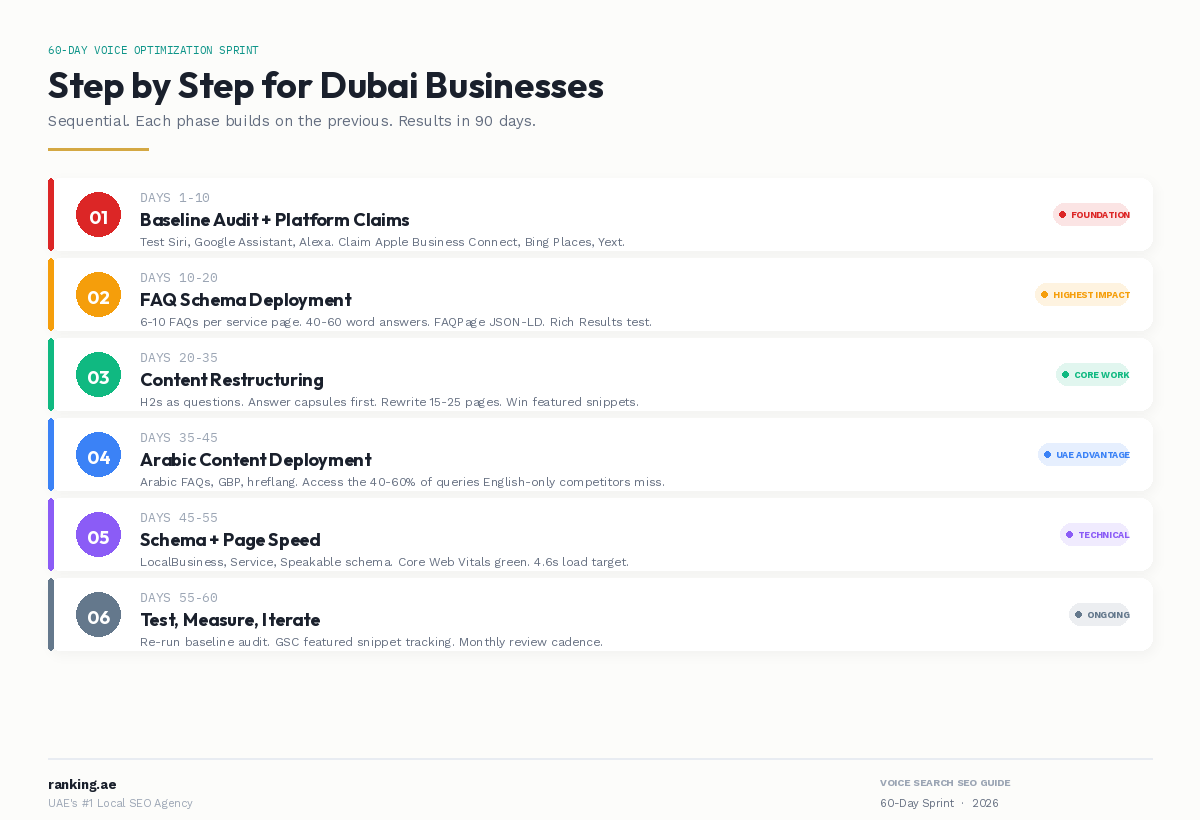
What Dubai Businesses Should Not Do When Optimizing for Voice
Do not keyword-stuff conversational queries. Writing "voice search SEO Dubai voice search Dubai voice SEO" throughout a page is the opposite of voice optimization. Voice assistants match semantic intent, not exact keyword repetition. Backlinko found that only 1.71 percent of voice search results include exact keyword matches in the title tag. The pages that win voice use natural language that matches how customers actually speak, which is conversational and varied, not keyword-dense.
Do not abandon traditional SEO for voice. Voice answers come from pages that already rank well in traditional search. Featured snippets (40.7 percent of voice answers) and top-three organic positions (another 40+ percent) are themselves traditional SEO outcomes. A page that cannot rank in the top 10 for a query will not be read aloud by Google Assistant. The foundational local SEO work remains mandatory. Voice is a layer on top, not a replacement.
Do not ignore Apple Maps because the business is small. The UAE has one of the highest Apple device penetration rates globally. A Dubai business invisible on Apple Maps is invisible to Siri for the large iPhone segment of the market. The Apple Business Connect claim takes 20 minutes. There is no justifiable reason to skip it.
Do not build custom Alexa Skills before the foundation is complete. Custom Skills appear in industry coverage because they sound sophisticated. For most Dubai businesses, the return from claiming Bing Places, ensuring Yext consistency, and implementing FAQ schema is 50x the return from building a custom Skill. Skills belong in the enterprise phase of voice optimization, after the fundamentals are in place.
Do not skip Arabic because "our customers speak English." The 40 to 60 percent of UAE voice queries that originate in Arabic are specifically queries that English-only competitors cannot reach. The business owners who assume their customer base is all English-speaking are describing the customers they already have, not the customers they could capture by being visible in a channel competitors ignore.
Frequently Asked Questions
How much of UAE search is actually voice?
Over 50 percent according to industry analysis of UAE-specific data from Prontosys and Dataspot. Globally, voice accounts for approximately 20 to 31 percent of searches depending on the measurement methodology. The UAE's higher adoption is explained by three factors: smartphone penetration exceeding 99 percent, heavy use of voice while driving on Sheikh Zayed Road and the E11 during long commutes, and strong smart speaker adoption in luxury residential developments. The number will continue climbing as voice accuracy improves and Arabic language support strengthens.
Should small Dubai businesses optimize for voice or is it only for enterprises?
Small businesses have a structural advantage in voice. The Single Answer Economy means voice returns one answer, not ten. A small local business that dominates a narrow category in a specific neighborhood can win voice queries that large multi-location competitors cannot, because voice assistants weigh proximity and relevance heavily and a hyperlocal specialist often matches those signals better than a brand with locations across Dubai. The optimization sprint scales down to 30-40 hours of work for a single-location business, which is well within small business capacity.
Does voice search replace Map Pack ranking?
No. Voice and Map Pack are overlapping but distinct surfaces. Map Pack shows three businesses; voice shows one. Winning Map Pack position one substantially increases voice answer probability but does not guarantee it. The Map Pack ranking factors (proximity, relevance, prominence) matter for both, but voice additionally weights content structure, FAQ schema, and answer capsule formatting. A business can hold Map Pack position one and still lose voice to a position-three competitor whose FAQ schema is more extractable.
How does voice search interact with ChatGPT and AI search?
Voice and AI search are converging. The Single Answer Economy framework from this article is the same framework that explains the 1.2 percent problem in AI visibility. Both voice and AI search narrow from many options to one (or a handful of) recommended businesses. The content structure that wins voice (answer capsules, FAQ schema, clean heading hierarchy, short sentences) is the same structure that wins ChatGPT and Perplexity citations. The work compounds: optimizing for voice simultaneously improves AI visibility, and vice versa.
What is Speakable schema and is it worth implementing?
Speakable is Google's structured data markup that identifies specific sections of a page as formatted for audio delivery. It is currently in limited rollout for news publishers but widely documented for non-news businesses. For Dubai service businesses, Speakable's return is modest compared to FAQPage schema (which is supported universally and directly feeds voice answers). Implement FAQPage first, add Speakable after the rest of the sprint is complete, and treat it as a future-proofing investment rather than a near-term ranking lever.
How do I track voice search performance?
Voice-specific tracking is limited because voice queries appear in Google Search Console as regular queries with no voice indicator. The closest proxies are: featured snippet impressions (trackable in GSC), "People also ask" impressions, question-based query impressions (queries starting with how/what/where/when/why), and smart speaker query data where available through Alexa Skills analytics or Google Assistant Actions. The most practical ongoing measurement is monthly voice query testing across Siri, Google Assistant, and Alexa using a standardized set of 15-20 queries, tracking how often your business appears.
Does voice search matter for e-commerce in the UAE?
Growing but still smaller than local service voice. UAE voice commerce sits at roughly 15 to 20 percent of consumers who have made a voice purchase, compared to 70+ percent who have used voice for local business discovery. The larger near-term opportunity for Dubai e-commerce is voice-discovered product research (asking Siri for product recommendations) rather than voice-completed purchases. Optimize for the discovery query first; voice checkout becomes a secondary priority as payment authentication maturity improves.
How long before voice optimization shows results?
Schema changes and GBP updates produce measurable movement within 2 to 4 weeks. Content restructuring (answer capsules, FAQ sections) produces featured snippet acquisitions within 4 to 8 weeks. Full competitive voice visibility in Dubai service categories typically takes 4 to 6 months of sustained optimization. Arabic voice authority builds faster than English (3 to 5 months) because Arabic competition is thinner. The timeline expectations in our SEO timeline guide apply with voice-specific adjustments.
Three O'Clock on Sheikh Zayed Road, Six Months Later
The driver from the opening of this article will hit traffic at the Mall of the Emirates interchange again at some point. She will press the voice button on her steering wheel. She will ask for a salon in Al Barsha with walk-ins. Her car will read back a business name. That name will either be yours or it will not.
The difference is not luck. It is whether someone at the business did the work in the preceding months. Claimed Apple Business Connect. Implemented FAQ schema on the services page. Rewrote the H2s as questions. Produced the Arabic version of the FAQ. Fixed the page speed. Tested voice queries across Siri, Google Assistant, and Alexa and iterated based on what did and did not appear. Every step takes a few hours. The cumulative result is the difference between being the one business Siri names and being one of the dozens it does not.
Voice search is not becoming a future consideration. It is already 50 percent of UAE search volume and climbing. The adoption curve in the UAE is steeper than in almost any market globally, driven by 99 percent smartphone penetration, heavy driving time, and smart speaker standardization in luxury residential stock. The business owners reading this article have two realistic paths forward. Execute the 60-day sprint and position the business for the Single Answer Economy. Or wait, and watch competitors who moved earlier capture the voice answers that are now being asked about their category in their neighborhood every day. The voice search market is not saturated. It is consolidating, and the window for first-mover positioning in most Dubai categories is measured in months, not years.
———
Request a free SEO audit and we will run the baseline voice query test across Siri, Google Assistant, and Alexa for your business, identify which queries your competitors are winning that you are not, and deliver the specific 60-day sprint that closes the voice visibility gap. View pricing for voice-inclusive SEO packages, or explore the full blog library for the operational guides that feed every section of this article .