"How long until I see results?"
It is the first question every business owner asks before investing in SEO. It is also the question most agencies answer badly. The typical response is some variation of "it depends" or "three to six months," delivered without context, without specificity, and without any connection to the particular business asking the question. That vague answer is one of the reasons SEO agencies have a 38% annual churn rate. Businesses sign up expecting results by week eight, see nothing tangible, and cancel before the investment has had time to compound.
We are going to give you a different kind of answer. Not a range pulled from a blog post. A framework mapped to four variables you can assess for your own business right now: your industry, the competition in your specific market, the starting condition of your website, and the budget you are able to commit. Each combination produces a different timeline. And every timeline we cite is grounded in either published research, our own UAE client data, or both.
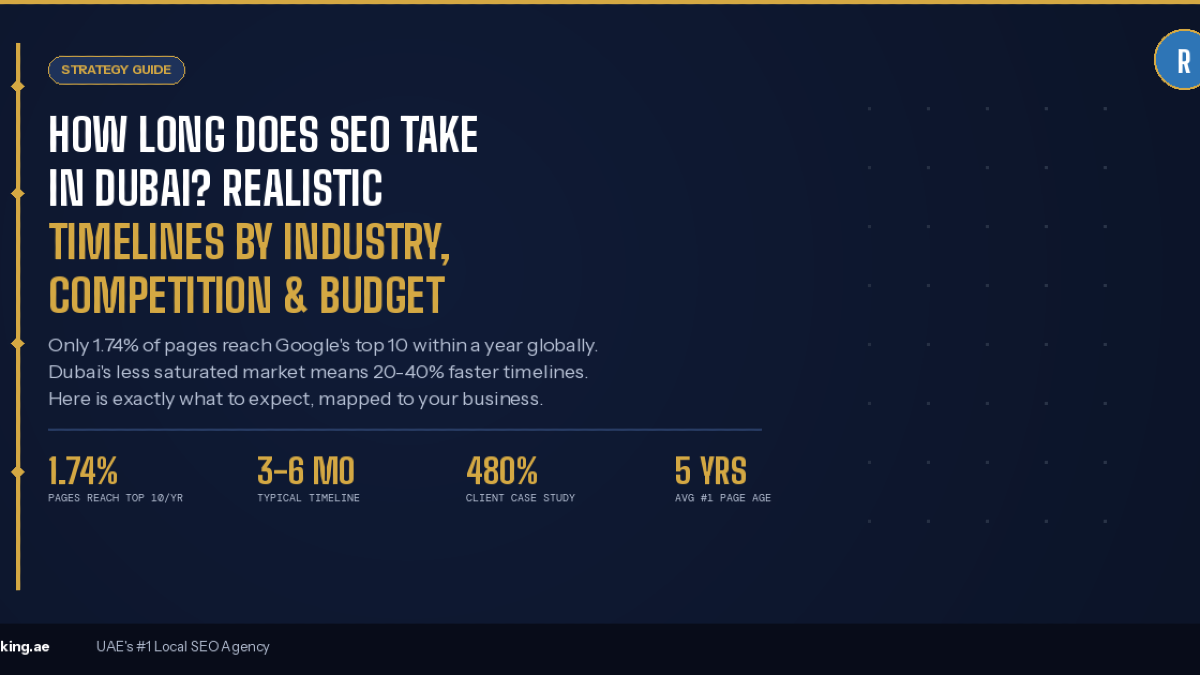
Before we begin, one number to anchor the conversation. A 2025 Ahrefs study of over 1 million pages found that only 1.74% of newly published pages reach Google's top 10 within a year. The average page sitting at position #1 is five years old. That is the global baseline. The good news for UAE businesses: Dubai's competitive landscape is significantly less saturated than the US or UK markets these studies sample, which means faster timelines are achievable with the right strategy. The bad news: it still does not happen in 30 days, and anyone who promises otherwise is selling something that does not exist.
What the Global Research Actually Says
Three studies form the empirical foundation for SEO timeline expectations. Understanding them prevents both unrealistic optimism and unnecessary pessimism.
The Ahrefs Time-to-Rank Study (2025 Update)
Ahrefs analyzed 1.3 million random keywords and tracked the ranking history of the pages appearing in the top 10 results. The findings:
Only 1.74% of newly published pages reach the top 10 within one year. This is down from 5.7% in the original 2017 version of the study. Ranking has gotten harder, not easier.
72.9% of pages in Google's top 10 are more than three years old. Up from 59% in 2017. The SERPs are increasingly dominated by established content.
The average #1 ranking page is five years old. Up from approximately two years in 2017. Google increasingly rewards pages that have accumulated trust, backlinks, and engagement over time.
Of the pages that DO reach the top 10, 40.82% do so within the first month. This is the crucial finding most people miss. Early momentum matters enormously. If a page does not gain traction quickly, its chances decline rapidly after six months.
Only 0.3% of pages rank in the top 10 for high-volume keywords (50,000+ monthly searches) within a year. High-volume head terms are a years-long investment. Long-tail, specific keywords are where faster results live.
The Ahrefs Poll: Industry Consensus
A poll of 3,680 SEO professionals on LinkedIn and X confirmed the practitioner consensus: three to six months for initial measurable results, with most professionals noting that competitive industries extend to six to twelve months. Shopify's research aligns, citing three to six months as the window where "most websites will see results from their SEO strategy."
What Google Itself Says
Google's John Mueller has stated that it could take up to a year for Google to figure out where to rank new sites, a phenomenon the industry calls the "Google sandbox." Google's own SEO documentation advises businesses to expect that "in most cases, SEOs need four months to a year to implement improvements and then see potential benefits." That framing is important: four months to a year includes both the implementation period and the results period. The work starts before the clock does.
"Be wary of SEOs that claim to guarantee rankings, allege a special relationship with Google, or advertise a priority submit to Google." — Google Search Central
Why Dubai Is Different from the Markets These Studies Sample
Every major SEO timeline study samples predominantly US and UK keywords. Dubai's competitive landscape differs in ways that meaningfully affect timelines.
Lower keyword difficulty for most local terms. The keyword "dentist near me" in New York faces competition from thousands of indexed, optimized pages. The same search in Dubai Marina faces a fraction of that competition. Lower keyword difficulty translates directly into faster ranking timelines. Our Google Maps ranking factors guide explains the signals that determine Map Pack positions, and in Dubai, many businesses have not yet optimized for them, leaving positions available.
GBP optimization gaps are wider. We audit businesses across the UAE regularly. The majority of Google Business Profiles in Dubai are either unclaimed, claimed but unoptimized, or optimized once and never updated. Our GBP optimization playbook covers what "fully optimized" actually means. When your competitors have not done this work, you move faster relative to them.
Arabic language competition is dramatically lower. Our Arabic SEO guide documents this in detail: Arabic search competition in the UAE is 40-50% lower than English equivalents for the same services. A business that adds Arabic content is competing in a near-empty field, and results come faster because the field is smaller.
Review velocity is achievable. Dubai businesses often serve high customer volumes (particularly in hospitality and retail) but have not implemented systematic review generation. When we deploy the strategies from our Google Reviews operations manual, clients typically build review volume faster than global benchmarks because the starting base is so low.
The net effect: timelines published by Ahrefs and Shopify represent competitive Western markets. UAE businesses operating in less saturated local search environments can realistically expect timelines 20-40% faster than those global benchmarks, provided the strategy is sound and execution is consistent.
The Four Variables That Determine Your Timeline
Generic advice says "it depends." Here is exactly what it depends on, and how to assess each variable for your business.
Variable 1: Your Industry
We have published detailed SEO guides for four industry verticals in the UAE. Each faces different competitive dynamics, different regulatory structures, and different timeline expectations.
Restaurants and F&B. Our restaurant SEO guide covers this vertical in depth. Restaurants generate high review volumes naturally, food photography gives Google strong visual signals, and community-level keywords ("best Thai restaurant JBR," "brunch Dubai Marina") face moderate competition. Expect initial Map Pack movement in 6-10 weeks from GBP optimization and review velocity alone. Full organic visibility across target keywords: 3-5 months.
Medical clinics and dental practices. Our medical SEO guide details the YMYL complexity. Healthcare SEO moves slower because Google applies higher scrutiny to medical content. DHA licensing provides E-E-A-T authority, but building topical depth in health content takes time. Expect Map Pack improvements in 8-12 weeks. Full organic rankings for competitive medical terms: 5-8 months.
Real estate agencies. Our real estate SEO guide explains the portal competition challenge. Agencies compete with Bayut, Property Finder, and Dubizzle for head terms while targeting community-level long-tail keywords where portals are weakest. GBP results come in 8-12 weeks. Community page rankings for long-tail terms: 3-5 months. Competitive broad terms: 6-12 months.
Hotels and hospitality. Our hotel SEO guide covers the OTA competition structure. Hotels face Booking.com and Expedia dominating head terms, but neighborhood and experience keywords are winnable. GBP improvements in 6-10 weeks. Neighborhood search visibility: 3-5 months. Brand defense and direct booking capture: 4-8 months.
Service businesses (salons, legal, fitness, education). These verticals face moderate competition in the UAE. A salon in JBR, a law firm in DIFC, a gym in Business Bay. GBP optimization and citation work typically produce Map Pack movement in 4-8 weeks. Full local visibility: 3-5 months.
Variable 2: Your Competition Level
Competition is not abstract. You can assess it right now. Open Google, search your primary service plus your area (for example, "dentist Dubai Marina" or "hotel near Burj Khalifa"), and examine the Map Pack results and the first page of organic results.
Low competition (Map Pack shows businesses with fewer than 20 reviews, incomplete profiles, no recent posts): You can realistically enter the Map Pack within 4-8 weeks with aggressive GBP optimization, citation work, and review generation. This is common in newer Dubai communities, niche services, and non-English search terms.
Moderate competition (Map Pack shows businesses with 20-100 reviews, partially optimized profiles, some content): Expect 8-16 weeks for Map Pack entry. You need GBP optimization plus content development, consistent review generation, and initial link building. This is typical for most Dubai service businesses.
High competition (Map Pack shows businesses with 100+ reviews, fully optimized profiles, active posting, strong websites): Expect 4-8 months for Map Pack positioning. You need the full stack: GBP, content, reviews, link building, schema markup, and multilingual optimization. This is typical for saturated verticals in central Dubai (restaurants in DIFC, hotels on Palm Jumeirah, dental clinics in Jumeirah).
The factors that determine competition level are detailed in our breakdown of what actually determines who shows up first on Google Maps.
Variable 3: Your Starting Condition
Where you begin determines how much foundational work is needed before optimization produces visible results.
New website, new business (zero authority, no GBP history, no reviews, no content): Add 2-4 months to any timeline estimate. You are building from nothing. Google needs time to discover, index, evaluate, and trust a new domain. John Mueller's guidance about "up to a year" applies most directly here. Every signal starts from zero.
Established but neglected (website exists, GBP claimed, some reviews, but no SEO work done): This is the most common starting point for UAE businesses. The foundation exists but is underoptimized. You have domain history (which matters), some review base (which helps), and an indexable website (which can be improved). Timelines match the industry estimates above. This is the starting condition where ROI comes fastest because you are activating existing assets, not building new ones.
Technically broken (website with crawl errors, duplicate content, speed issues, penalties, or prior bad SEO work): Add 1-3 months for remediation before growth begins. We flag the most common technical issues in our 10 Local SEO Mistakes guide. Technical debt must be resolved before new optimization can compound. A fast car on a broken road goes nowhere.
Previously penalized or negatively affected by an algorithm update: Recovery timelines vary from 2-6 months depending on the severity and nature of the issue. This requires specialist assessment before any timeline estimate is meaningful.
Variable 4: Your Budget and Resource Level
SEO is not a fixed-cost project. It is an ongoing investment, and the level of investment directly affects the speed and depth of results. Our pricing breakdown covers the full market range. Here is how our tiers correlate with timelines:
Starter (AED 1,499/month): Covers GBP optimization, basic citation management, review strategy guidance, and monthly reporting. This tier addresses the foundation. Expect Map Pack improvements in 6-12 weeks for low-to-moderate competition markets. Organic content development is limited at this level, so broader keyword rankings take longer. Best for: single-location businesses in moderate competition verticals.
Growth (AED 2,999/month): Adds monthly content production, deeper technical SEO, active link building, and review management. This is where compound growth begins. Map Pack results in 6-10 weeks. Organic visibility for target keywords within 3-5 months. Consistent traffic growth curve from month 4 onward. Best for: businesses ready to invest in sustainable growth.
Dominate (AED 4,999/month): Adds multilingual content (Arabic, Hindi, Russian), community/area page development, advanced link building, competitive analysis, and comprehensive AEO/GEO optimization. This tier produces the fastest and broadest results because every channel is active simultaneously. Map Pack improvements within 4-8 weeks. Organic keyword growth within 2-4 months. AI search visibility within 3-5 months. Best for: businesses in competitive verticals, multi-location operations, and those targeting multilingual markets.
Higher investment accelerates results because more tactics can execute simultaneously. A Starter-tier client builds the foundation and waits for compound effects. A Dominate-tier client builds the foundation, content, links, reviews, and multilingual coverage in parallel, and compound effects arrive sooner because more signals are active at once.
What Our Own Client Data Shows
Global studies provide benchmarks. Our client work in the UAE provides ground truth.
Our LicensePlate.ae case study is the most documented example in our portfolio. Starting condition: GBP claimed but abandoned, 11 reviews (3 unanswered), NAP inconsistencies across 8 directories, 6.2-second page load time, zero Arabic content, no schema markup. Moderate competition (number plate and automotive services in Dubai).
Month 1 (Foundation): GBP overhaul, citation audit and correction, technical speed optimization (6.2s down to 2.1s), keyword research. Results: GBP impressions increased 40% from baseline. No ranking changes yet. This is the month where most impatient clients question the investment.
Month 2 (Content + Reviews): First blog posts published, location pages built, WhatsApp review request system deployed, Arabic GBP description added. Results: reviews grew from 11 to 28, Map Pack appearances began for secondary keywords, organic impressions doubled.
Month 3 (Velocity): Content production accelerated, schema markup implemented across all pages, link building initiated. Results: Map Pack position for primary keyword, organic traffic up 120% from baseline, Arabic search queries appearing in Search Console.
Month 4 (Compounding): Reviews crossed 50, Arabic content expanded, continued content and link building. Results: organic traffic up 280% from baseline, multiple Map Pack positions, phone calls up 210%.
Month 5 (Dominance): Full Map Pack dominance for primary keywords, organic traffic up 480% from baseline, direction requests up 270%, phone calls up 340%. The compounding curve was in full effect: every tactic reinforced every other tactic.
"The results did not arrive linearly. Month 1 was invisible. Month 2 was encouraging. Month 3 was exciting. Month 4 was undeniable. Month 5 was transformative." — ranking.ae client results documentation
This timeline (5 months to 480% growth) is faster than global benchmarks would suggest, and the reason is exactly what we described above: Dubai's competitive landscape for local search is less saturated than the US/UK markets that global studies sample. The strategies were not novel. They were the same tactics described across our 14-post blog library. The speed came from consistent execution in a market with opportunity.
Why SEO Results Accelerate: The Compounding Effect
The most common misunderstanding about SEO timelines is that progress is linear. It is not. SEO compounds.
Month 1 you fix your GBP and technical foundation. Google begins to understand your business better, but nothing visible changes for the user.
Month 2 you add content and start generating reviews. Google now has more pages to index and more signals to evaluate. Your GBP starts showing up for a handful of secondary keywords. Each new review adds a small trust signal.
Month 3 you continue building content, links, and reviews. Now those content pages start linking to each other. The reviews create social proof that improves click-through rates. The improved click-through rates send engagement signals to Google. Google starts testing you in more search results.
Month 4 the compound effect is visible. More rankings produce more traffic. More traffic produces more reviews (from customers who found you via search). More reviews improve your Map Pack position. The better Map Pack position produces more clicks. Each output becomes the input for the next cycle.
This is why quitting at month 2 or 3 is the most expensive mistake a business can make. You have invested in the foundation but left before the compounding began. The businesses that see 400%+ traffic growth are the ones that maintained consistency through the uncomfortable early months when the dashboard barely moved.
As Ahrefs' data shows, 40.82% of pages that eventually reach the top 10 do so within the first month of entering those rankings. The preparation period (months 1-3) is what positions the page for that rapid ascent. Cut the preparation short, and you never reach the launch point.
What Can Produce Results in Weeks, Not Months
Not everything takes months. Some actions produce visible changes within days or weeks.
GBP completion and optimization. If your Google Business Profile is unclaimed, incomplete, or has incorrect information, fixing it can produce Map Pack visibility changes within 1-3 weeks. We have seen businesses that were invisible in the Map Pack begin appearing after a single day of GBP work because the competition had not done this basic step. Our GBP playbook walks through every field.
Review generation activation. Deploying a systematic review request process (WhatsApp, email, QR code) typically produces 10-30 new reviews in the first month. Google re-evaluates Map Pack positions when review signals change significantly. Businesses with fewer than 10 reviews that add 20 in a month often see immediate Map Pack improvements. Details in our reviews guide.
Citation and NAP correction. If your business name, address, or phone number is inconsistent across directories, fixing those discrepancies can improve local ranking signals within 2-4 weeks as Google reconciles the corrected data.
Technical fixes for critical issues. A website that loads in 6 seconds, has broken pages, or blocks search engine crawling is actively suppressing its own rankings. Fixing these issues produces rapid indexation improvements. The traffic was always there. Your website was preventing Google from sending it.
Arabic GBP and core content. Adding Arabic descriptions and content to your GBP and website targets a near-empty competitive space. We have seen Arabic-language Map Pack positions appear within 2-3 weeks of Arabic content going live. Read our Arabic SEO guide for why this works so quickly.
These quick wins do not replace a long-term strategy. They are the first visible proof points that build confidence while the deeper work compounds.
Red Flags: Timeline Promises That Should Make You Walk Away
Our guide to choosing an SEO agency in Dubai covers the full evaluation framework. When it comes to timelines specifically, these promises indicate either incompetence or dishonesty:
"Guaranteed first page in 30 days." Google explicitly warns against agencies that guarantee rankings. If you could buy a first-page position in 30 days, every business would do it. The fact that they cannot is what makes SEO valuable.
"We have a special relationship with Google." No one does. Google's own documentation says this. An agency claiming otherwise is lying.
"Results start immediately." GBP quick wins can appear in days or weeks, yes. But any agency promising immediate organic ranking improvements either does not understand SEO or is planning to use paid ads and call them organic results.
"SEO takes 12-18 months before you see anything." This is the opposite extreme and equally misleading. It sets expectations so low that the agency can deliver mediocre work for a year without accountability. In Dubai's local search market, a well-executed strategy should produce measurable signals within 8-12 weeks. Not dominance, but measurable movement.
The honest answer is always specific. It references your industry, your competition, your starting condition, and your budget. If the agency cannot articulate those variables, they cannot give you a meaningful timeline.
How to Know If Your SEO Is Actually Working Before Rankings Change
Rankings are lagging indicators. They are the last thing that changes, not the first. Here are the leading indicators that tell you whether your SEO investment is on track during the early months:
Google Search Console impressions. If impressions are increasing, Google is testing your pages in more search results. You may not be getting clicks yet, but increasing impressions mean Google considers your content relevant. This is typically the first metric to move (weeks 3-6).
GBP insights: views, searches, and actions. If your GBP is generating more views, more discovery searches, and more actions (calls, directions, website clicks), the optimization is working. These metrics often move before Map Pack position changes become visible.
Indexed page count. If Google Search Console shows more of your pages indexed, your content is being discovered and stored. Each indexed page is a potential ranking asset.
Keyword position tracking for long-tail terms. Track positions for 20-50 specific long-tail keywords. These move before head terms do. If your long-tail rankings are improving (positions 50-100 moving to 20-40, then 10-20), the strategy is working.
Referral traffic from directories and citations. If citation and directory listings are generating clicks, your local presence is strengthening. This traffic also sends trust signals to Google.
Review count and response rate. Growing review count with consistent response rates builds the social proof that both Google and prospective customers evaluate.
If these leading indicators are positive at month 2-3, the lagging indicators (Map Pack position, organic rankings, traffic, leads) will follow. If these indicators are flat, something needs to change before month 4.
The Most Expensive Mistake: Quitting at Month Three
The 38% annual churn rate in SEO agencies exists primarily because expectations and timelines are misaligned at the point of sale. An agency promises vague results. The client expects visible changes by month two. Month three arrives with modest improvements that feel underwhelming relative to the investment. The client cancels.
Here is what that client never sees: month four, when the compound effects would have kicked in. Month five, when the early content starts ranking. Month six, when the review velocity crosses the threshold that changes Map Pack positions. The investment from months one through three is not lost; it is foundational. But the return on that foundation only materializes if you stay long enough to build on it.
We are transparent about this dynamic because it serves no one to hide it. If you commit to three months and plan to evaluate at that point, you will likely be disappointed. If you commit to six months with monthly check-ins on leading indicators, you will have enough data to make an informed decision about continuing, adjusting, or stopping.
Our pricing does not require long-term contracts because we believe the results should retain clients, not the paperwork. But we are honest that the results typically need 4-6 months to become conclusive. Understanding the difference between local and regular SEO and what each takes helps set appropriate expectations from day one.
Estimate Your Own Timeline: The Assessment Framework
Use these four questions to estimate a realistic timeline for your business:
Question 1: What is your industry? Low-competition service business (salon, fitness, education) = faster. High-competition regulated vertical (medical, real estate, hotel) = slower. Cross-reference with the industry timelines in Section 3.
Question 2: How competitive is your specific local market? Search your primary keyword + area on Google. Count the reviews on the top 3 Map Pack results. Under 20 each = low competition. 20-100 = moderate. 100+ = high. Cross-reference with the competition assessment in Section 3.
Question 3: What is your starting condition? New website with no history = add 2-4 months. Established but neglected = standard timelines apply. Technically broken = add 1-3 months for remediation first.
Question 4: What budget tier fits your business? Starter (AED 1,499) = slower but foundational. Growth (AED 2,999) = compound growth curve. Dominate (AED 4,999) = fastest and broadest. Review our pricing page for full details on what each tier includes.
Combine your answers. A new restaurant in a moderately competitive area at the Growth budget tier: approximately 3-5 months to consistent Map Pack visibility and organic traffic growth. An established real estate agency in a highly competitive area at the Dominate tier: approximately 4-7 months for community page rankings and 6-10 months for competitive terms. A technically broken medical clinic website at the Starter tier: 1-3 months of remediation plus 5-8 months of optimization, so 6-11 months total.
These are estimates, not guarantees. But they are specific, grounded in data, and honest. That is more than most agencies provide.
Find Out Exactly Where You Stand
Every timeline begins with understanding your starting condition. Our free SEO audit assesses your GBP status, technical health, citation consistency, review profile, and competitive position. It tells you which of the four starting conditions applies to your business and which quick wins can produce early results.
Request your free SEO audit and we will map your specific timeline based on the framework in this guide. Or explore our pricing tiers to see which investment level matches your growth goals. If you want to understand the fundamentals first, start with our complete guide to local SEO in Dubai.
Frequently Asked Questions
Can SEO really show results in less than three months?
Yes, for specific actions. GBP optimization can produce Map Pack visibility changes in 1-3 weeks. Review generation shows measurable impact within 4-6 weeks. Arabic content additions can produce rankings within 2-3 weeks in near-empty competitive spaces. These are quick wins, not full organic ranking changes, but they are real, measurable improvements. Full organic visibility across target keywords typically requires 3-6 months.
Why does medical or healthcare SEO take longer?
Google classifies healthcare content as YMYL (Your Money or Your Life) and applies higher scrutiny. E-E-A-T signals (expertise, experience, authority, trustworthiness) carry more weight, and building those signals through credentialed content, authoritative backlinks, and regulatory compliance takes longer. Our medical SEO guide details the DHA-specific optimization that accelerates this process in the UAE.
Is local SEO faster than regular SEO?
Generally yes. Local SEO targets a geographically constrained market with fewer competitors, and Google Business Profile optimization produces faster visible changes than organic website ranking. Our comparison of local vs regular SEO explains why most UAE businesses benefit from starting with local SEO and layering regular SEO on top.
Does spending more on SEO guarantee faster results?
Not "guarantee," but higher investment does correlate with faster timelines because more tactics can execute simultaneously. A Starter-tier client builds the foundation over months one through three. A Dominate-tier client builds the foundation, content library, multilingual coverage, and link profile in parallel, compressing the timeline. The pricing breakdown maps investment levels to specific deliverables.
What happens if I stop SEO after six months?
Unlike paid advertising, which stops the moment you stop paying, SEO results persist after you stop investing. Your GBP stays optimized. Your content stays indexed. Your reviews stay published. However, competitors who continue investing will eventually surpass you. SEO is maintenance as much as it is growth. The compound effect works both ways: it accelerates when you invest and decelerates when you stop.
How do I know if my current SEO agency is on track?
Check the leading indicators described in Section 8: Search Console impressions, GBP views and actions, indexed page growth, long-tail keyword movement, and review velocity. If these are positive at month 2-3, the strategy is working. If they are flat, ask your agency to explain why and what they plan to change. Our agency evaluation guide provides 10 diagnostic questions to ask.