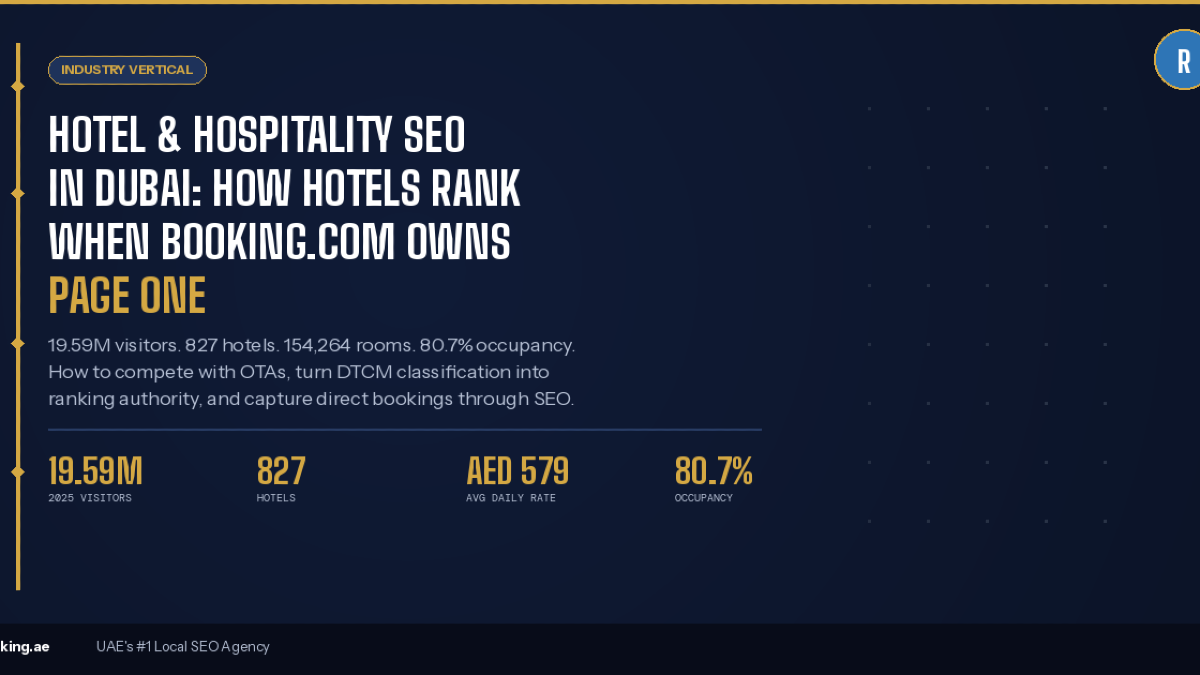
Dubai welcomed 19.59 million international overnight visitors in 2025, a 5% increase over 2024 and the third consecutive record year. The city's 827 hotel establishments held 154,264 rooms, achieved 80.7% average occupancy, and recorded 44.85 million occupied room nights. The average daily rate hit AED 579, up 8% year on year, while revenue per available room reached AED 467, an 11% increase.
Those are extraordinary numbers. They also mask a problem that most hotel operators feel but few articulate clearly: the overwhelming majority of those bookings are intermediated. Online travel agencies capture roughly 40% of the global travel market. Booking Holdings and Expedia Group together account for over 40% of global OTA share, and collectively spent $5.2 billion on marketing in Q2 2025 alone. Every booking that comes through an OTA costs the hotel 15% to 25% in commission. For a property with an ADR of AED 579, that is AED 87 to AED 145 per room night going to a middleman.
Search engine optimization is the only channel that lets hotels reclaim that margin at scale. When a traveler searches "beachfront hotel JBR" or "boutique hotel Downtown Dubai with rooftop pool," the property that appears in the Google Map Pack or the top organic results captures a direct inquiry. No commission. No rate parity constraint. No algorithm deciding which hotel the OTA pushes above yours.
The challenge is that hotel SEO in Dubai operates under a unique competitive structure. You are competing with OTAs that have domain authorities above 90, millions of indexed pages, and performance marketing budgets in the billions. You are also operating within a regulatory framework where the Department of Economy and Tourism (DET) classifies every establishment, issues operating permits, and monitors compliance. Those constraints, just like RERA licensing in real estate and DHA credentials in healthcare, are not obstacles. They are competitive advantages that independent hotels can convert into ranking signals.
This guide explains exactly how hotels, resorts, and hotel apartments in Dubai build organic visibility, compete with OTAs where they are weakest, and turn every regulatory credential into a trust signal Google rewards.
If you are new to local SEO fundamentals, start with our complete guide to local SEO in Dubai. This post builds on that foundation with strategy engineered specifically for hospitality.
Why Hotel SEO in Dubai Is Structurally Different from Other Verticals
The OTA Problem Is a Distribution Tax
In most local service industries, your competitors are other service providers. A dental clinic competes with other dental clinics. A restaurant competes with other restaurants. Hotels compete with Booking.com, Expedia, Agoda, TripAdvisor, Hotels.com, and a dozen other platforms that collectively dominate the first page of Google for virtually every hotel search.
Booking.com attracts over 562 million monthly visits globally and holds dominant organic and paid positions in both European and Middle Eastern markets. Booking Holdings and Expedia Group account for nearly all search visibility for hotel searches in paid and organic placements, with Booking leading in both spaces. Trying to outrank Booking.com for "hotels in Dubai" is mathematically unrealistic for a single property. That is not your battlefield.
Your battlefield is the long-tail, experience-specific, neighborhood-level search where OTAs serve a standardized listing page and your hotel can serve a genuine answer. "Hotel with private beach access Palm Jumeirah." "Family hotel near Dubai Mall with kids club." "Adults-only boutique hotel DIFC with rooftop bar." These queries carry booking intent, and the property that answers them with depth wins the click.
This is the same strategic principle we apply in restaurant SEO (competing with Zomato and TripAdvisor on cuisine-specific queries) and real estate SEO (competing with Bayut and Property Finder on community-level searches). The pattern is identical: you cannot beat the aggregator at scale, but you can beat them at depth.
Seasonality Drives Everything
Dubai's tourism calendar creates pronounced search demand cycles that hotels must anticipate, not react to. Peak season (November through March) drives the highest search volumes for accommodation. Ramadan creates a completely different demand pattern: iftar experiences, spiritual tourism, and staycation deals replace standard leisure searches. Summer (June through August) historically the quietest period for international tourism but increasingly important for domestic staycations and value-driven packages. Event periods (Dubai Shopping Festival, Art Dubai, Formula 1, GITEX, Arabian Travel Market) create temporary demand spikes for specific hotel types and locations.
Hotels that build content around these seasonal patterns before the demand arrives capture the traffic. A page optimized for "Dubai Ramadan staycation deals 2026" needs to be indexed and ranking by February, not published in March. We detailed similar seasonal strategy in our restaurant SEO guide around Ramadan iftar keywords. The principle applies identically to hotels.
DTCM Classification as an E-E-A-T Signal
Every hotel in Dubai operates under a classification system administered by the Department of Economy and Tourism. This system rates establishments from 1 to 5 stars, with additional categories for budget hotels, hotel apartments, guest houses, resorts, and youth hostels. The classification is based on detailed criteria covering room size, amenities, service standards, safety features, and environmental practices.
In 2025, 153 hotels earned the Dubai Sustainable Tourism Stamp, more than double the 70 awarded the previous year. These certifications carry authority for the same reason DHA licensing matters for medical SEO and RERA registration matters for real estate SEO. Google's quality raters evaluate whether content comes from organizations with genuine expertise and authority. A hotel that displays its DTCM classification, links to its official tourism registry, and publishes content authored by certified hospitality professionals carries regulatory credibility that OTA listing pages cannot match.
This is the third vertical where we see the pattern: DHA licensing for clinics, RERA certification for real estate agencies, and now DTCM classification for hotels. In every case, regulatory compliance becomes the E-E-A-T moat that distinguishes the licensed operator from the aggregator.
Google Business Profile Optimization for Hotels
The Google Business Profile is the single most important local SEO asset for any hotel. When a traveler searches "hotel near Burj Khalifa" or "resort Palm Jumeirah," the Map Pack appears above both organic results and OTA ads. Our complete GBP optimization playbook covers the mechanics. Here is what changes for hospitality.
Category and Attribute Selection
Your primary category should match your DTCM classification: "Hotel," "Resort hotel," "Boutique hotel," "Hotel apartment," "Motel," or "Extended stay hotel." Google uses primary category as the strongest signal for Map Pack inclusion. Secondary categories should cover your actual service offerings: "Conference hotel," "Wedding venue," "Spa," "Restaurant." Each secondary category unlocks new search queries.
Google Business Profile attributes for hotels are extensive and directly influence search matching. Mark every applicable attribute: pool, fitness center, beach access, airport shuttle, business center, pet friendly, wheelchair accessible, free Wi-Fi, kids club, spa, parking. Each attribute helps Google match your property to filtered searches. A traveler who searches "pet-friendly hotel Dubai" will only see properties that have marked that attribute. Missing it means invisible for that query.
Photos That Google's Vision AI Reads
Hotels have more visual content opportunities than any other business type. Google's Vision AI analyzes uploaded images to understand what a business offers. Upload at minimum: exterior shots (daytime and evening), lobby, each room type, bathroom, pool area, gym, restaurant and bar, meeting rooms, beach or garden, spa, and breakfast setup. Name each file descriptively before uploading: "deluxe-sea-view-room-palm-jumeirah.jpg" rather than "IMG_4829.jpg."
Hotels with 100+ GBP photos consistently outperform those with fewer than 20 on engagement metrics. Virtual tours and 360-degree room walkthroughs are particularly powerful for hospitality because they answer the question every traveler asks: "What does the room actually look like?"
Google Posts for Hotels
Hotels have a natural content cadence most businesses lack: seasonal packages, event promotions, F&B offers, spa deals, and new room renovations. Publish Google Posts weekly at minimum. During peak season and Ramadan, post daily. Every post should include a high-quality image, a clear offer or announcement, and a CTA that drives to your direct booking engine, not to an OTA.
Effective hotel Google Posts include: "Ramadan Iftar Package: AED 199 per person, book direct for 15% off," "Summer Staycation: 3 nights for the price of 2, direct bookings only," "New rooftop lounge now open, reservations at [direct link]." Each post signals activity and relevance to Google while driving commission-free traffic.
Reviews: The Trust Currency of Hospitality
Hotels have a structural advantage for review generation that most businesses envy: volume. A 200-room hotel at 80% occupancy serves roughly 160 rooms per night, thousands of guests per month. Even a modest conversion rate of 5% produces dozens of new reviews monthly.
Our complete Google Reviews operations manual covers the mechanics in detail. For hotels specifically:
Timing: Send the review request on checkout day, either via email or WhatsApp. The experience is freshest and satisfaction is highest at departure, especially when checkout goes smoothly.
Multilingual requests: Dubai's visitor base spans dozens of nationalities. Western Europe accounted for 21% of visitors (4.1 million), South Asia 15% (2.89 million), GCC 15% (2.99 million), and CIS/Eastern Europe 15% (2.89 million). Send review requests in the guest's language. A GBP with reviews in English, Arabic, Russian, Hindi, German, and French signals international trust that a competitor with English-only reviews cannot match.
Response strategy: Respond to every review within 24 hours, in the same language it was written. For negative reviews, acknowledge specifically, explain what you have done to address the issue, and invite the guest to return. Google's algorithm weighs recency and frequency of review responses as engagement signals. Our Arabic SEO guide explains why Arabic-language engagement is still massively underexploited across the UAE.
Website Architecture That Competes with OTAs
Your hotel website cannot beat Booking.com by trying to list more hotels. You win by being the definitive authority on one property and its surrounding area. Here is the architecture that works.
The Neighborhood Expertise Strategy
OTAs serve every hotel in a city through a standardized template. They do not explain what it is like to actually stay in JBR versus Downtown versus Business Bay. That gap is your content opportunity.
Build a dedicated "Area Guide" section on your website covering everything a guest needs to know about your neighborhood: restaurants within walking distance (with your own recommendations, not a generic list), transportation options (metro station distance, taxi rank location, water taxi availability), attractions and landmarks (with actual walking times, not "nearby"), shopping, nightlife, family activities, and practical tips (best time to visit the beach, which pool gets sun in the afternoon, where to watch the sunset).
This content serves two purposes simultaneously. For SEO, it captures long-tail searches like "things to do near [your hotel area]" and "best restaurants walking distance [your area]" that OTAs do not target. For conversion, it answers the question every direct booking visitor asks: "What will my stay actually be like?" OTAs answer that question with a star rating and a map pin. You answer it with genuine local knowledge.
Room Type Pages, Not Just a Booking Widget
Most hotel websites treat room types as a booking widget: a photo carousel, a bulleted amenity list, a price, and a "Book Now" button. That is not content Google can rank. Build dedicated pages for each room type with genuine descriptions: what the view looks like at different times of day, which floor levels offer the best experience, who the room is designed for (couples, families, business travelers), what makes it different from the category below and above.
These pages target transactional long-tail keywords: "sea view room Palm Jumeirah with balcony," "family suite Dubai with kitchenette," "executive room DIFC business hotel." OTAs list your rooms. You can explain your rooms. That depth is what earns organic visibility.
The F&B Venue as Its Own Ranking Asset
If your hotel has a restaurant, bar, rooftop lounge, or pool club, each venue is a separate SEO asset with its own search demand. "Best rooftop bar JBR" and "brunch near Dubai Marina" are searches that bring people to your property who may never have considered staying there. A guest who discovers your restaurant through organic search today may book a room six months later.
Create a dedicated page for each F&B outlet with its own GBP listing (if it has a separate entrance or distinct identity), its own schema markup (Restaurant schema), its own review generation, and its own content strategy. We covered F&B-specific GBP optimization in detail in our restaurant SEO guide. The same principles apply to hotel restaurants, with the added advantage that the hotel's domain authority lifts the restaurant pages.
Event and Conference Venue Pages
Dubai is one of the world's leading MICE (meetings, incentives, conferences, exhibitions) destinations. Hotels with conference facilities leave enormous organic traffic on the table by burying their meeting rooms behind a single "Events" page with a contact form.
Build dedicated pages for each venue configuration: "Ballroom seating 500 guests," "Boardroom meeting room for 12," "Outdoor terrace reception." Target keywords like "conference venue Dubai Marina capacity 200," "wedding venue Palm Jumeirah beachfront," "corporate offsite venue DIFC." Each page should include room dimensions, capacity in different configurations, AV equipment, catering options, and photos of actual events (with client permission).
The Keyword Architecture Hotels Miss
Hotel search intent in Dubai falls into five distinct clusters. Most properties only target the first.
Accommodation intent: "hotels in Dubai Marina," "resort Palm Jumeirah," "hotel apartment Downtown Dubai." These are the head terms where OTA competition is maximum. Your GBP and brand name queries compete here.
Experience intent: "hotel with private beach Dubai," "adults-only pool hotel Dubai," "hotel with best view of Burj Khalifa," "spa hotel Dubai for couples." These are the queries where a well-optimized property page with specific amenity descriptions outperforms a generic OTA listing.
Event intent: "wedding venue hotel Dubai," "conference hotel Business Bay," "New Year's Eve gala dinner Dubai hotel." Events generate the highest per-booking revenue and have the longest search-to-booking timeline, meaning organic content has more time to influence the decision.
Seasonal and promotional intent: "Dubai summer staycation deals 2026," "Ramadan iftar hotel buffet," "Dubai Shopping Festival hotel packages," "Eid staycation offers." These keywords spike predictably and can be captured with content published 4-6 weeks before the season.
Comparison and research intent: "JBR vs Downtown Dubai which is better for tourists," "is Dubai Marina or Palm Jumeirah better for families," "best area to stay in Dubai for first-time visitors." These queries appear in the research phase and position your property as the authority on your area. If your hotel publishes the definitive guide to choosing between JBR and Downtown, every reader who lands on that page is one click from your booking engine.
The properties that build organic traffic across all five clusters create a content moat that OTAs, by their aggregator structure, cannot replicate. Each cluster feeds into the others: a guest who discovers your area guide (research intent) encounters your room pages (experience intent) and eventually reaches your booking engine (accommodation intent).
Schema Markup for Hotels
Implement Hotel schema on your homepage with complete property details: star rating (matching your DTCM classification), amenities, check-in/check-out times, number of rooms, price range, and geographic coordinates. For individual room types, use HotelRoom schema with bed configuration, occupancy, floor area, and amenity list. For your F&B venues, use Restaurant schema with cuisine type, price range, and hours.
For event venues, use MeetingRoom schema with capacity and available configurations. Implement FAQPage schema on your FAQ page and area guide pages. Schema does not directly boost rankings, but it earns rich snippets that improve click-through rates, which compounds into better rankings over time. More detail on structured data strategy in our AEO and GEO guide.
Multilingual SEO for Dubai's Global Guest Base
Dubai's visitor demographics in 2025 tell the multilingual story clearly. Western Europe delivered 4.1 million visitors (21%), South Asia 2.89 million (15%), GCC 2.99 million (15%), CIS and Eastern Europe 2.89 million (15%), and MENA 2.17 million (11%). A hotel website optimized only in English is visible to roughly 40% of its addressable market.
Arabic: GCC and MENA visitors combined represent 26% of arrivals (5.16 million). Arabic hotel searches carry significantly lower competition than English equivalents. A page targeting "فندق عائلي في دبي مارينا" (family hotel in Dubai Marina) faces a fraction of the English competition. Our Arabic SEO guide details why this remains the single largest untapped opportunity in UAE search.
Russian: CIS and Eastern Europe represent 15% of visitors (2.89 million). Russian-speaking tourists are particularly concentrated in luxury and beach segments (Palm Jumeirah, JBR, Dubai Marina). Russian-language hotel pages face almost zero competition in the UAE.
Hindi: South Asian visitors represent 15% of arrivals (2.89 million), with Indian nationals as the largest single nationality group. Hindi-language content for hotels is virtually nonexistent in the UAE market.
German: Germany is one of the top individual source markets within Western Europe. German travelers are known for direct booking preference and thorough research behavior. German-language content captures a high-conversion audience.
Implementation priority: Arabic first (largest combined market share), then Russian (highest per-guest spend in hospitality), then Hindi (largest single-nationality group), then German (highest direct-booking propensity). Each language needs native-speaker content, not machine translation. Implement hreflang tags correctly. Broken hreflang is one of the most common mistakes we flag, as detailed in our local SEO mistakes guide.
The Direct Booking SEO Strategy
Every hotel's ultimate SEO goal is reducing OTA dependency by capturing bookings directly. Here is the playbook.
Brand Name Defense
OTAs bid on your brand name. When someone searches "[Your Hotel Name] Dubai," Booking.com and Expedia often appear above your own website in paid results. Organic SEO is your defense. Your website should rank #1 organically for every variation of your hotel name. If it does not, you have technical SEO problems (site authority, indexation, or canonical issues) that need immediate attention.
Build dedicated pages for common brand modifiers: "[Hotel Name] rooms and rates," "[Hotel Name] location and directions," "[Hotel Name] reviews," "[Hotel Name] wedding packages." Each page captures a specific brand search that an OTA might otherwise intercept.
Price Match Messaging in Organic Content
If you offer a best-rate guarantee for direct bookings (and you should), make this visible in your meta descriptions, your GBP description, and your page content. "Book direct and save 10% vs. OTA prices" in a meta description improves click-through rate from organic results because it gives the searcher a financial reason to choose your website over the Booking.com listing below it.
Content That Answers Questions OTAs Cannot
OTAs know the price, the star rating, and the guest reviews of your property. They do not know which room has the best sunset view, where the quietest pool is, what time the beach gets crowded, or how to get an upgrade. Your website should answer every question a potential guest could ask. These detailed answers become long-tail content that ranks for queries OTAs never target.
"Which floor has the best view at [Hotel Name]?" "Is the pool heated in winter at [Hotel Name]?" "What is the breakfast like at [Hotel Name]?" These searches exist. If your FAQ page answers them with genuine, specific detail, you capture the click.
Link Building for Hotels in the UAE
Tourism authority listings. Ensure your hotel appears on the Visit Dubai official portal and the DTCM hotel directory with correct details and a backlink to your website. Government tourism authority links carry exceptional trust weight.
Travel media and bloggers. Dubai is one of the most covered travel destinations globally. Invite travel journalists and content creators for stays and experiences. Each published review with a backlink strengthens your domain authority. Prioritize publications with strong domain ratings over Instagram follower counts.
OTA profiles themselves. Your listings on Booking.com, Expedia, TripAdvisor, and Agoda should link back to your official website where possible. These are high-authority, contextually relevant backlinks.
Local business partnerships. Tour operators, desert safari companies, yacht charter services, and airport transfer providers that link to your hotel as a recommended accommodation create natural, relevant backlinks.
Industry associations. Dubai Hotel Association, UAE Hotel Association, and Arabian Hotel Investment Conference (AHIC) membership pages provide authoritative backlinks within the hospitality vertical.
Event partnerships. If your hotel hosts or sponsors events (Dubai Food Festival, Art Dubai, conferences), ensure the event website links to your hotel's event page, not to a generic OTA listing.
AEO and AI Search for Hotels
When a traveler asks ChatGPT "What is the best area to stay in Dubai for a family?" or Google AI Overview generates an answer for "hotels near Dubai Mall with pool and kids club," the results pull from structured, data-rich, authoritative content. Hotels that optimize for AI-generated answers capture a traffic channel most competitors ignore entirely.
Our AEO and GEO guide covers the full framework. For hotels specifically:
Structure FAQ content with clear question-answer pairs. "What is the best area to stay in Dubai for families?" followed by a 2-3 sentence factual answer citing your area's schools, beaches, and family attractions. AI models extract these pairs directly.
Publish comparison content. "JBR vs. Downtown Dubai for First-Time Visitors" with structured comparison tables covering walkability, beach access, dining options, nightlife, family friendliness, and average hotel prices. AI models cite comparison content heavily.
Include specific data. Distance to airport (24 km, 28 minutes), distance to nearest metro (350 meters), number of restaurants within walking distance (47), beach length (1.7 km). Specific numbers are what AI models cite, not vague descriptors.
Cite DTCM and DET data. AI models trust content that references official tourism statistics. Quoting occupancy rates, visitor numbers, and tourism performance from DET reports builds the citation authority that AI models prioritize.
Mistakes Hotels Make with SEO in Dubai
Over-reliance on OTA visibility as a substitute for SEO. "We are already on Booking.com" is not an SEO strategy. It is a distribution cost. Every booking through an OTA costs 15-25% commission. A direct booking through organic search costs the incremental cost of SEO, which drops with every additional booking. The math favors SEO at any reasonable occupancy rate.
Brand website as a brochure, not a booking engine. If your website shows beautiful photos but makes it easier to call the front desk than to book online, you are leaking direct bookings. The booking engine should be accessible from every page, mobile-optimized, and faster than navigating to Booking.com.
No content beyond room listings. A hotel website with six pages (home, rooms, dining, spa, contact, about) cannot compete for organic traffic. OTAs have millions of pages. You need depth in your area guides, room descriptions, event content, seasonal packages, and blog posts to build the indexable footprint that earns rankings.
Ignoring the F&B opportunity. Your restaurant, bar, and pool club are separate ranking assets. A hotel that treats its rooftop lounge as a subsection of the "Dining" page is missing thousands of monthly searches for "rooftop bar [area]," "brunch [area]," and "restaurant [area]."
English-only optimization. In a city where 60% of visitors come from non-English-primary markets, an English-only website is an incomplete product. Read our Arabic SEO guide for the magnitude of this missed opportunity.
For the broader pattern of local SEO errors, read our 10 Local SEO Mistakes Dubai Businesses Make.
What Hotel SEO Costs in Dubai
Hotels require more content, more languages, and more ongoing seasonal optimization than most local businesses. Our full pricing breakdown for SEO in Dubai covers the market-wide range. For hotels specifically:
At our Growth tier (AED 2,999/month), this covers GBP optimization, citation management, review strategy, monthly content production, and technical monitoring for a single-property hotel. The Dominate tier (AED 4,999/month) adds multilingual content production, area guide development, F&B venue optimization, event page strategy, and advanced link building.
The ROI calculation for hotels is straightforward. If your average direct booking is worth AED 579 per room night (the 2025 Dubai ADR), and a direct booking saves 15-25% in OTA commission, each direct booking captured through organic search saves AED 87 to AED 145. A hotel that converts just 20 additional room nights per month to direct bookings through SEO saves AED 1,740 to AED 2,900 monthly in commissions alone, before counting the compound value of repeat guests who book direct after their first stay.
The 90-Day Execution Plan for Hotel SEO
Month 1: Foundation
GBP overhaul. Verify and optimize your profile. Set correct primary category matching DTCM classification. Add all applicable attributes. Upload 100+ photos covering every area of the property. Write a description that includes DTCM star rating, key amenities, neighborhood identity, and direct booking CTA. Establish weekly Google Post cadence.
Technical audit. Crawl your website for Core Web Vitals issues (image-heavy hotel sites frequently fail LCP benchmarks), broken links, missing schema, mobile responsiveness, and booking engine integration. Ensure your booking engine is on-domain (booking.yourhotel.com) rather than a redirect to a third-party URL that leaks SEO value.
Citation audit. Verify NAP consistency across Booking.com, Expedia, TripAdvisor, Google, Bing, Apple Maps, Visit Dubai, and travel directories. Fix discrepancies. Ensure your DTCM listing is current.
Month 2: Content Foundation
Publish area guide. 2,000+ word neighborhood guide covering dining, attractions, transportation, beaches, shopping, and practical tips. This becomes your primary long-tail content asset.
Build room type pages. Dedicated page for each room category with descriptive content, not just specs. Target experience-intent keywords.
Launch F&B pages. Separate page for each restaurant, bar, and venue with individual schema markup and distinct content targeting.
Arabic GBP and core pages. Add Arabic description to GBP. Translate area guide and top room pages into Arabic. Implement hreflang tags.
Month 3: Velocity
Seasonal content. Publish pages targeting the next seasonal cycle (Ramadan packages, summer staycation, DSF deals) 4-6 weeks before demand arrives.
Event venue pages. Build dedicated pages for each meeting room and event configuration with capacity, equipment, and photo galleries.
Review generation. Implement automated post-checkout review request via email and WhatsApp. Target multilingual reviews.
First blog posts. "Complete Guide to [Your Area] for First-Time Dubai Visitors" and "Best Restaurants Near [Hotel] That Locals Actually Recommend." These capture comparison and research intent.
By month three, you should have a GBP that reflects DTCM authority, an area guide capturing neighborhood searches, room type pages targeting experience intent, F&B venues ranking independently, Arabic language coverage, and a review generation system. That is the foundation that compounds from month four forward.
How to Evaluate an SEO Agency for Hotels
Our guide to choosing an SEO agency in Dubai covers the full diagnostic framework. For hotels specifically, ask:
Do they understand the OTA landscape? An agency that promises to outrank Booking.com for "hotels in Dubai" does not understand hospitality SEO. One that proposes neighborhood expertise content, direct booking optimization, and brand defense strategy does.
Do they know DTCM classification? If the agency cannot explain how DTCM star ratings function as E-E-A-T signals or why your classification should appear in your schema markup, they lack hospitality vertical expertise.
Can they produce multilingual content? A hotel serving guests from 50+ nationalities needs content in Arabic at minimum, ideally Russian, Hindi, and German. Ask about native-speaker content production capabilities.
Do they track commission savings? The metric that matters for hotel SEO is not ranking positions. It is the shift in direct-to-OTA booking ratio. Every percentage point shift from OTA to direct saves measurable commission cost.
Start Ranking Where Your Guests Are Searching
Dubai's hospitality market recorded AED 467 RevPAR across 44.85 million occupied room nights in 2025. The hotels that appear in Google Maps when travelers search by neighborhood, experience, and event type capture direct bookings that never touch an OTA commission structure.
We build local SEO strategies specifically for hotels, resorts, and hotel apartments in the UAE. From GBP optimization and area guide development to multilingual content production, F&B venue SEO, and review management, every tactic in this guide is part of our hotel and hospitality SEO service.
Request a free SEO audit for your hotel and we will show you exactly where you are visible, where you are losing to OTAs, and what to fix first. Or review our pricing to see which tier matches your property's needs.
Frequently Asked Questions
How long does hotel SEO take to show results in Dubai?
GBP improvements (photos, reviews, posts) produce visible Map Pack changes within 6-10 weeks. Area guide and room type page rankings for long-tail keywords typically begin within 3-4 months. Competitive seasonal terms take 4-6 months of advance preparation. Hotels see faster initial results than many verticals because high review volumes and strong GBP signals accelerate Map Pack inclusion. General timelines are covered in our local SEO guide.
Can a single hotel compete with OTAs in organic search?
Not on head terms like "hotels in Dubai." Yes, on property-specific, experience-specific, and neighborhood-specific queries. "Best hotel with private pool in Palm Jumeirah" or "business hotel near DIFC with meeting rooms" are searches where a well-optimized property page can outperform a generic OTA listing. That is where the direct booking opportunity lives.
Should hotels invest in local SEO or regular SEO?
Both. Local SEO drives Map Pack visibility for "near me" and area-based searches. Regular SEO drives organic rankings for area guides, blog content, and event pages. Our comparison of local vs regular SEO explains the distinction. Hotels need both because the guest journey spans research (regular SEO content) and booking-intent search (local SEO and GBP).
How important are multilingual pages for hotel SEO in Dubai?
Critical. Over 60% of Dubai's visitors come from non-English-primary markets. Arabic, Russian, Hindi, and German pages face dramatically lower competition than English equivalents while targeting substantial visitor segments. Read our Arabic SEO guide for the scale of this opportunity.
Does DTCM classification affect hotel SEO?
Indirectly but significantly. DTCM classification functions as an E-E-A-T signal, establishing your property as a government-verified, standards-compliant operation. Including your star rating in schema markup, GBP description, and website content strengthens the trust signals Google evaluates for YMYL (your money, your life) travel queries. The same pattern applies to DHA licensing for medical practices and RERA registration for real estate agencies.
What is the ROI of hotel SEO compared to OTA commissions?
At Dubai's 2025 average daily rate of AED 579, each room night booked directly instead of through an OTA saves AED 87-145 in commission. A hotel converting 30 room nights per month from OTA to direct through organic search saves AED 2,610-4,350 monthly. Over a year, that is AED 31,320-52,200 in retained revenue, far exceeding the cost of a professional SEO program. Our cost breakdown details how SEO investment compares across the market.