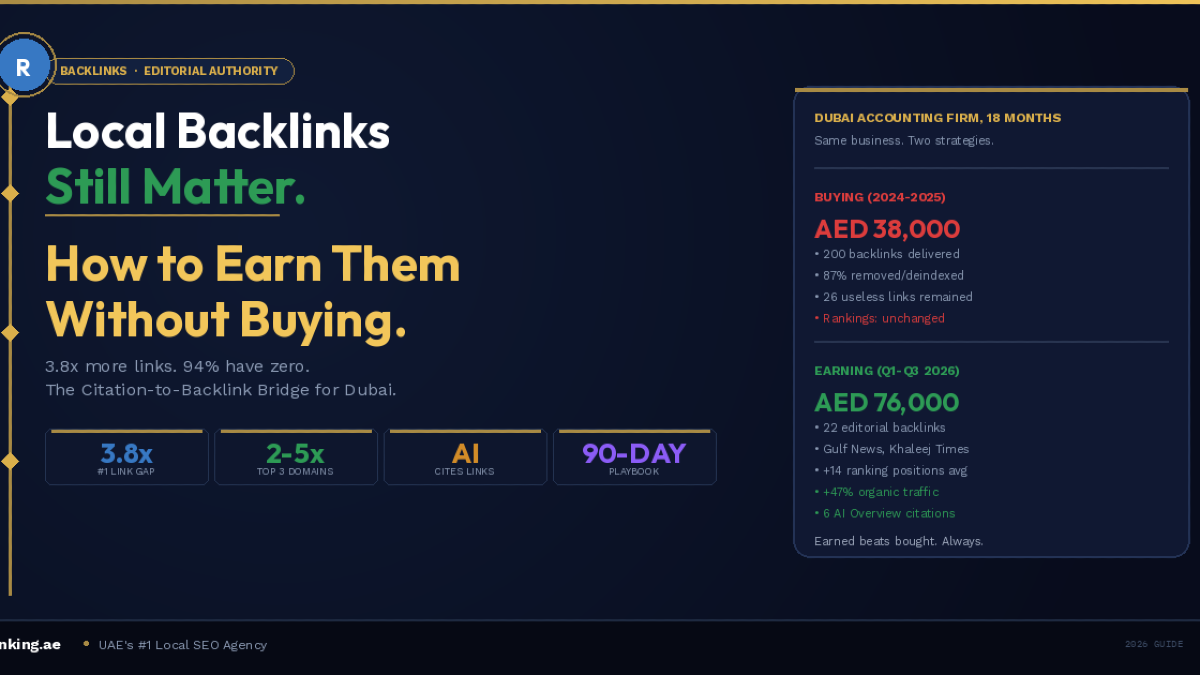
A Dubai accounting firm spent AED 38,000 across 2024 on a "link building package" that delivered 200 backlinks. The package was advertised on LinkedIn as "high-DA UAE-relevant links" with case studies and screenshots that looked legitimate. The firm signed up because the price-per-link looked reasonable and the agency claimed to specialize in the UAE market.
Twelve months later, the firm ran an audit. Of the 200 backlinks delivered, 87 percent had been removed, pointed from sites that had since been deindexed by Google, or sat on private blog networks that Google had penalized. The remaining 13 percent (roughly 26 links) were technically live but came from sites with no organic traffic, no editorial standards, and no relevance to UAE business audiences. Average rankings on the firm's priority queries were unchanged or slightly lower. Organic traffic was flat. The AED 38,000 had purchased nothing of lasting value.
In Q1 2026 the firm reallocated AED 12,000 to a different approach. Three pieces of original research were produced: a survey of 200 UAE small businesses on VAT compliance pain points, a data analysis of corporate tax registration patterns since the June 2023 introduction, and a comparative study of accounting software adoption across UAE free zones. The first piece was picked up by Khaleej Times. The second was cited in a Gulf News column. The third earned a mention in Arabian Business and a follow-up interview with the firm's managing partner. Three editorial backlinks from genuine UAE authority sources outperformed 200 paid backlinks combined. By Q3 2026 the firm's rankings had moved on twelve priority queries, organic traffic was up 41 percent year-over-year, and three of the editorial pieces were being cited inside Google AI Overviews when prospects asked AI assistants about UAE corporate tax basics.
This article covers why backlinks remain a foundational ranking factor in 2026 despite Google's public efforts to downplay them, the specific reason local backlinks matter more than ever in Dubai, the Citation-to-Backlink Bridge framework that distinguishes entity verification from authority transfer, the editorial sources that produce real backlink value in the UAE market, and the 90-day acquisition playbook that earns links without buying them.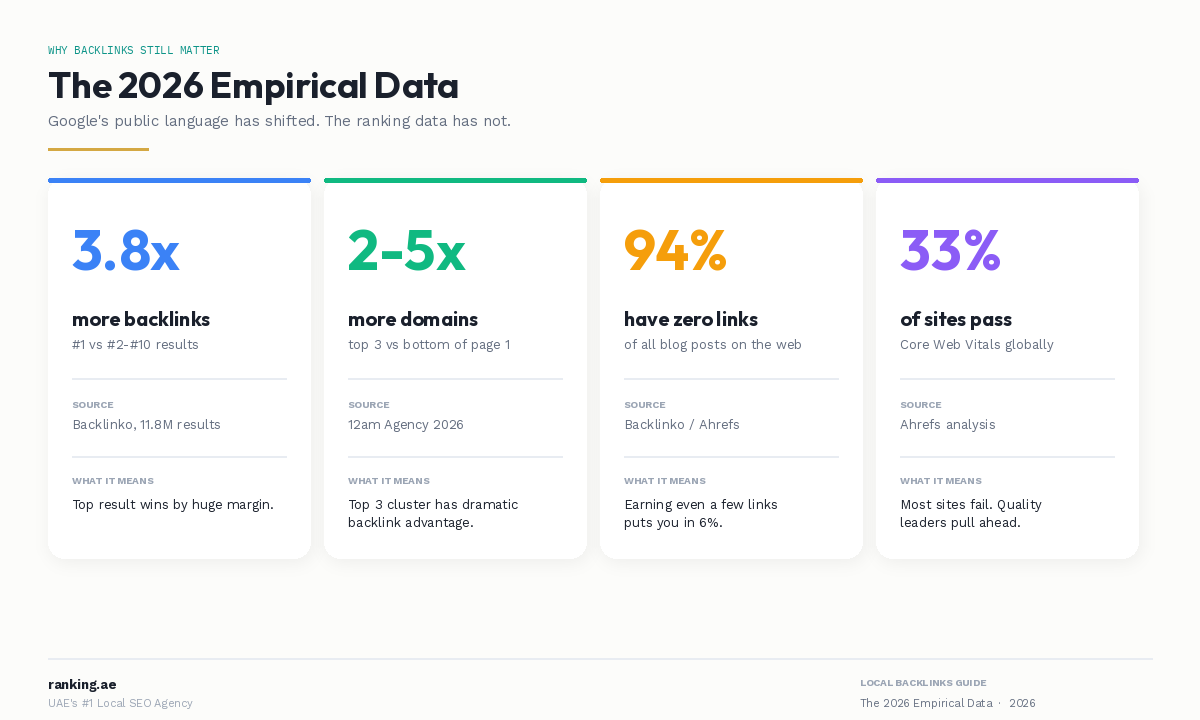
1. The Backlink Debate: Why Google's Public Position Has Diverged from the Empirical Data
In March 2024, Google quietly dropped the word "important" from its description of links as a ranking factor. Links became, per the official documentation, "a signal when determining the relevancy of pages." Not "an important signal." Just a signal. Search Engine Land's detailed analysis of the shift captured the public statements: Gary Illyes told a search conference in April 2024, "We need very few links to rank pages. Over the years, we've made links less important." John Mueller said publicly, "My recommendation would be not to focus so much on the absolute count of links."
A reasonable Dubai business owner reading these statements concludes that backlinks no longer matter. The conclusion is wrong. The empirical data tells a different story than the public language.
A Backlinko study analyzing 11.8 million Google search results found that the #1 result on Google has on average 3.8 times more backlinks than the pages ranked #2 through #10. The correlation between domain authority and ranking is strong and consistent across categories. A separate analysis by 12am Agency found that pages in the top 3 spots typically have 2 to 5 times more unique referring domains than pages at the bottom of page one. Independent research by Ahrefs and Rankability's aggregation of multiple ranking factor studies reach similar conclusions: top-ranking pages systematically have stronger backlink profiles than the pages they outrank, and 94 percent of all blog posts have zero external links — meaning the businesses that earn even a handful of editorial links operate in a category most of the web never reaches.
The reconciliation between Google's public language and the empirical data is straightforward. Google has not made backlinks less important. Google has made low-quality backlinks worthless and high-quality backlinks more important than ever. The shift is from quantity to quality, not from significant to insignificant. The companies still selling 200-link packages on LinkedIn are operating in a market that Google has spent a decade systematically dismantling. The companies earning a small number of editorial backlinks from authoritative sources are operating in the market that actually moves rankings in 2026. Stan Ventures' analysis of the 2024 Google API leak confirmed several previously contested points: backlinks remain a core PageRank input, links from newer pages are weighted higher than links from older content (the freshdocs API module finding), and click signals on backlinks (the NavBoost system) reinforce the ranking value of links that real users actually follow.
A second reconciliation matters as well. AI search has not reduced the importance of backlinks. It has increased it. AI Overviews, ChatGPT, Perplexity, and Gemini all use backlink signals to verify which sources are trustworthy enough to be cited in generated answers. The Citation Gap we documented in our zero-click analysis depends partly on entity authority, which depends partly on backlink profile. A Dubai business with a thin backlink profile is unlikely to be cited inside AI Overviews regardless of how well its content is structured. Backlinks have become the entry fee to the AI search era, not the relic of the pre-AI era.
"In 2026, backlinks serve as the primary verification signal for AI models. If top-tier sites link to you, AI models are far more likely to cite your brand as the definitive source in their generated answers."
— 12am Agency, "Are Backlinks Still Important for SEO in 2026?"
2. The Citation-to-Backlink Bridge: Why Most Dubai Businesses Conflate Two Different Tools
The most common conceptual mistake we see in Dubai SEO programs is treating citations and backlinks as the same thing. They are not. They serve different functions, produce different ranking signals, and require different acquisition strategies. Conflating them produces budgets that under-invest in the actual ranking lever.
Citations: entity verification
A citation is a mention of your business name, address, and phone number on a third-party site, with or without a link. Citations on UAE directories like Yellow Pages UAE, EmiratesBD, Dubai Chamber directory, and the broader UAE directory ecosystem documented by Hi Dubai establish that your business exists, has a physical presence in the UAE, and has consistent business information across the web. Google uses citations as an entity verification signal. The more places Google sees the same Name-Address-Phone (NAP) data, the more confident Google becomes that your business is real and located where it claims to be.
Citations are foundational. The local SEO checklist we published for UAE businesses covers the citation-building work in detail. Most Dubai businesses need 30 to 50 consistent UAE citations to establish a strong entity verification baseline. The work is mechanical (claim profiles, fill in the same NAP data, upload photos) and produces measurable Map Pack improvements within 60 to 90 days. But citations alone do not produce strong ranking authority. They prove the entity exists. They do not prove the entity matters.
Backlinks: authority transfer
A backlink is a hyperlink from one website to another. Backlinks transfer ranking authority through Google's PageRank-derived algorithms. Not all backlinks are equal. A backlink from Gulf News passes substantially more authority than a backlink from a small business directory. A backlink from a topically relevant industry publication (Construction Week Online for a contractor, Hospitality News Middle East for a hotel) passes more authority than a backlink from an unrelated lifestyle blog. The mechanism is qualitative: Google evaluates the source's authority, the source's topical relevance, and the editorial nature of the link before assigning ranking value.
Editorial backlinks (links earned through PR, original research, expert commentary, or genuine third-party citation) produce the strongest ranking effect. Paid backlinks (links bought from agencies, link farms, or "guest post" networks) produce diminishing returns and increasing risk as Google's algorithms get better at detecting them. The Site Reputation Abuse update from May 2024 specifically targeted the practice of buying article placements on high-authority domains, devaluing many backlink approaches that worked in 2022 but no longer work in 2026.
Why the Bridge matters
The Citation-to-Backlink Bridge is the operational sequence that produces both. Phase one builds citations across 30 to 50 UAE directories to establish entity verification. Phase two earns editorial backlinks from authoritative sources to produce authority transfer. Most Dubai businesses skip phase one (or do it badly) and then complain that phase two is not working. Editorial publications evaluate businesses partly on whether they appear to be legitimate, established entities. A business with no citation footprint, an incomplete GBP, and a thin website looks risky to a journalist evaluating whether to cite the business. The citation foundation makes the editorial outreach credible. The editorial backlinks transfer the authority that citations alone cannot.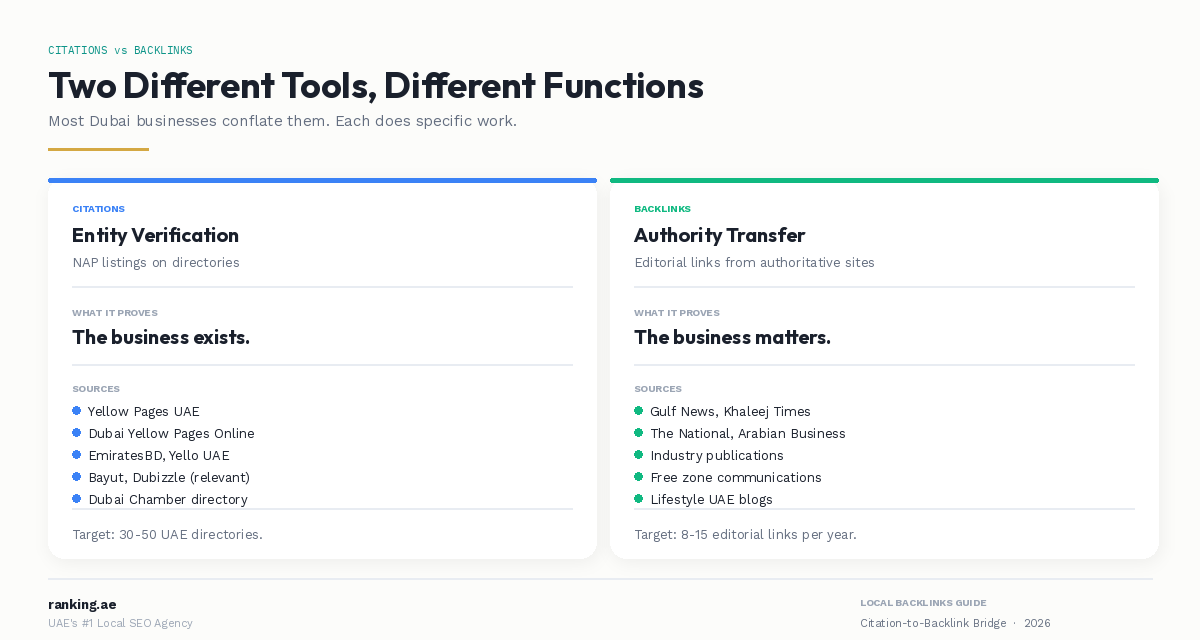
3. Why Local Backlinks Carry More Weight in Dubai Specifically
A backlink from a UAE source to a UAE business is interpreted differently by Google than a backlink from a US source to the same UAE business. The difference is contextual relevance, and it matters more in 2026 than it did five years ago because Google's algorithms are now actively assessing topical neighborhoods and geographic relevance signals. Editorial Link's synthesis of the Semrush ranking factor study put it directly: "earning backlinks from unique domains is still important, both at page and domain level," with relevance and topical fit weighted heavily in the modern algorithm.
A Dubai law firm earning a backlink from Gulf News (a UAE publication writing about UAE legal news) is sending Google three signals simultaneously: the link is editorial, the source is authoritative, and the source is topically and geographically aligned with the linked business. The same law firm earning a backlink from a small US legal blog gets a weaker signal across all three dimensions. The US blog might be editorial and authoritative within its own context, but the geographic and topical alignment is missing. Google has gotten better at detecting and weighting this alignment over the past three years specifically because of the Helpful Content Update and the Core Updates of 2023-2025.
Three additional UAE-specific factors compound the local backlink advantage.
Factor one: regulatory authority signaling
UAE-licensed businesses face specific regulatory frameworks that Google's algorithms now factor into trust signals. A DHA-licensed medical clinic earning backlinks from UAE health publications or government health communication channels signals regulatory legitimacy in a way that backlinks from foreign publications cannot. The same applies to RERA-registered real estate brokers, DED-licensed retail businesses, ADGM and DIFC-regulated financial services firms, and DHA-credentialed practitioners. The local backlink is not just a ranking signal. It is a regulatory authority signal.
Factor two: language alignment
Backlinks from Arabic-language UAE sources to Arabic-language pages on a Dubai business website produce stronger ranking effects than equivalent backlinks from English-language sources. The Arabic SEO opportunity we documented separately applies to backlinks as much as to content. A Dubai medical clinic with an Arabic version of its services page and editorial backlinks from Arabic UAE publications (Al Bayan, Al Khaleej, Emarat Al Youm) reaches a market segment competitors with English-only properties cannot. Arabic backlinks remain dramatically less competitive than English backlinks because the supply is smaller and most agencies do not pursue them.
Factor three: AI Overview citation seeding
Google AI Overviews and the broader AI search ecosystem source heavily from regionally relevant content for regional queries. A user in the UAE searching "best dermatologist Dubai Marina" triggers an AI Overview that pulls from UAE-relevant sources. Backlinks from UAE editorial publications signal regional relevance to the AI ranking layer in a way that global backlinks do not. As AI Overviews continue expanding into the UAE search landscape, the local backlink advantage grows rather than diminishes.
4. The UAE Backlink Source Hierarchy: Where Real Authority Lives
Not all UAE backlink sources are equal. The hierarchy below is ranked by authority transfer, editorial credibility, and difficulty of acquisition. The strongest local SEO programs target sources from each tier rather than concentrating exclusively on the top tier.
Tier 1: National news publications
Gulf News, Khaleej Times, The National, Arabian Business. These are the highest-authority editorial sources in the UAE. Backlinks from these publications transfer significant ranking authority and signal credibility for both Google and AI search systems. Acquisition is difficult: the route is through PR pitches tied to original data, expert commentary on UAE-specific business trends, or news hooks where the business has direct relevance. A single Tier 1 backlink can move rankings on competitive queries more than dozens of lower-tier links combined. The investment required is genuine PR work, not directory submission.
Tier 2: Industry-specific UAE publications
Construction Week Online (construction, real estate development), Hospitality News Middle East (F&B, hotels), Logistics Middle East (supply chain, logistics), MEED (infrastructure, finance), Arabian Business Healthcare (medical, pharma), Time Out Dubai (lifestyle, F&B, entertainment), What's On Dubai (consumer lifestyle), Esquire Middle East and Vogue Arabia (premium lifestyle and fashion). Topical relevance produces strong authority transfer for businesses operating in the corresponding sectors. Acquisition is moderately difficult: industry publications are more responsive to expert commentary, original research, and case studies than to generic pitches.
Tier 3: Free zone and chamber publications
DMCC publications, DIFC publications, Dubai Chamber of Commerce communications, Abu Dhabi Department of Economic Development communications, RAKEZ news, ADGM publications. These are official-adjacent sources that carry strong regulatory and trust signals specifically for businesses operating within those free zones or jurisdictions. Acquisition is structured: most free zones run member spotlight programs, case study features, and event-tied content opportunities for member businesses. The barrier is participation rather than competitive pitching.
Tier 4: Local lifestyle and city blogs
Hi Dubai, MyDubai.com, Dubai Online, lifestyle blogs run by UAE-based content creators with engaged audiences. Authority transfer is moderate but the content fit is often natural for restaurants, salons, fitness studios, and consumer-facing service businesses. Acquisition involves relationship building with the publication editors and providing genuinely interesting content (not promotional copy). For consumer-facing Dubai businesses, this tier produces meaningful traffic in addition to ranking signal.
Tier 5: UAE business directories
Yellow Pages UAE, Dubai Yellow Pages Online, EmiratesBD, Yello UAE, GetListedAE, Hi Dubai, Bayut, Dubizzle, Zawya. These are primarily citation sources rather than backlink sources. Some offer do-follow links on profile pages, which provides modest authority transfer alongside the entity verification value. The work is mechanical and should be completed early in the SEO program (within the first 90 days) but should not be confused with the higher-tier work that earns editorial backlinks.
A reasonable backlink portfolio for a mid-sized Dubai service business in 2026 contains: 30-50 Tier 5 citations (foundational), 5-10 Tier 4 lifestyle blog features (relationship-driven), 3-5 Tier 3 free zone or chamber mentions (membership-driven), 2-4 Tier 2 industry publication features per year (PR-driven), and 1-2 Tier 1 national news mentions per year (original-research-driven). The total volume is small. The cumulative authority is substantial.
5. Why Paid Link Building Fails in Dubai (And How to Recognize the Pitches That Will Waste Your Budget)
The Dubai market is heavily targeted by link-selling agencies, both UAE-based and offshore. The pitches arrive on LinkedIn, in cold emails, and through "performance SEO" packages from generalist marketing agencies. The pitches use specific patterns. The patterns have specific failure modes.
Pattern one: "100 high-DA backlinks for AED [low price]"
The economics tell the story. A genuine editorial backlink from an authoritative UAE publication has no listed price because it is not for sale. Earning one requires PR work that costs the agency or business roughly AED 3,000 to 8,000 in time per placement when done correctly. An agency offering 100 backlinks at AED 80 per link (AED 8,000 total) is selling something that genuine editorial outreach cannot produce. What they actually deliver is some combination of: links from foreign private blog networks (PBNs) that Google has been deindexing systematically since 2022, links from "general directory" sites with no organic traffic, links from sites that themselves have been penalized, and links bought through "guest post" networks that violate Google's spam policies. The Site Reputation Abuse update from May 2024 specifically targeted this category.
Pattern two: "We will get you on Forbes / Entrepreneur / Inc."
Some agencies sell access to Forbes Council, Entrepreneur Leadership Network, Newsweek Expert Forum, and similar paid placement programs. These are technically "backlinks from authoritative domains" but Google's algorithms have learned to discount paid contributor placements significantly since 2024. The link technically exists. The ranking value is minimal. The agency is selling the appearance of authority, not the authority itself. Some Dubai businesses spend AED 15,000 to 40,000 annually on these placements with no measurable ranking benefit.
Pattern three: "Niche edits" and "link insertions"
The agency claims to insert links into existing articles on relevant blogs. The insertion looks natural to a casual reader. Google's algorithms detect these insertions through pattern analysis (the linked phrase often does not match the article's natural editorial direction, the same insertion pattern repeats across many sites in the same network) and devalue or penalize them. The economics again tell the story: a genuine editorial mention earned through original research or expert commentary cannot be sold for AED 200-500 per placement. Anything in that price range is a network operation Google has likely already identified.
Pattern four: "Guaranteed first-page rankings"
Any agency guaranteeing rankings is either lying or planning to use methods that will eventually harm the site. Ranking is a function of dozens of factors that no agency controls. The pitch is a sign that the agency is operating outside legitimate SEO practice. The SEO myths post we published covers the broader pattern of misleading SEO sales claims; ranking guarantees are the most common.
How to evaluate any link-building proposal
Three questions reveal whether the proposal is legitimate. First: "Can you show me three example placements you have earned in the past 90 days for similar UAE businesses?" Real PR-driven link building produces a portfolio of named placements at named publications. Mass-link-selling cannot. Second: "What is the editorial process for each placement?" Real placements involve pitches, journalist conversations, fact-checking, and editorial revision. Mass-link-selling involves a spreadsheet and a deposit. Third: "What happens if a placement is removed or the source publication is penalized?" Real PR work produces durable placements; mass-link-selling produces churn. The agencies offering refunds or replacements for "removed links" are essentially admitting that their delivery is unstable.
6. The 90-Day Backlink Acquisition Playbook for Dubai Businesses
The playbook below produces 8 to 15 editorial backlinks from UAE authoritative sources within 90 days for a typical mid-sized Dubai service business. The work is sequenced to compound: each phase produces assets and relationships that the next phase uses.
Days 1-15: Citation foundation (Tier 5 work)
Build the 30-50 UAE directory citations as the entity verification baseline. Use a master NAP document to ensure consistency. Claim profiles on Yellow Pages UAE, Dubai Yellow Pages Online, EmiratesBD, Yello UAE, GetListedAE, Hi Dubai, Bayut (if relevant), Dubizzle (if relevant), Zawya, Dubai Chamber directory, sector-specific platforms (Zomato/Talabat for F&B, Bayut/Property Finder/Dubizzle for real estate, Doctify for medical, Trustpilot for ecommerce). The work is mechanical but produces both citation foundation and a small number of do-follow backlinks from the directory profile pages.
Days 15-30: Original data asset development
Create one or two pieces of original UAE-specific content that journalists and editors actually want. The format that works most reliably: a small primary research effort (survey 100-300 UAE customers or businesses on a topic relevant to your sector), an analysis of public UAE data (DEWA energy consumption patterns, RERA real estate transaction data, DOH health statistics, UAE Open Data initiatives) presented through your sector lens, or a comparative case study (your business outcomes versus published industry benchmarks, with permission to share). The asset should be distinctive enough that no UAE publication has already covered it. The development cost is typically AED 3,000 to 12,000 in time depending on scope.
Days 30-50: Tier 1 and Tier 2 publication outreach
Pitch the original asset to UAE national news (Gulf News, Khaleej Times, The National, Arabian Business) and to industry-specific publications (Construction Week Online, Hospitality News Middle East, MEED, etc., based on sector). The pitch format that works: a 150-200 word email containing the data finding, the news angle (why it matters now), and the offer of expert commentary from a named practitioner at the business. Pitch one publication at a time per cycle to avoid simultaneous publication dilution. Expect a 15-25 percent positive response rate from Tier 2 publications and a 5-10 percent rate from Tier 1. Five well-targeted pitches typically produce one Tier 1 placement or two Tier 2 placements.
Days 50-65: Free zone and chamber engagement
Engage your free zone (DMCC, DIFC, ADGM, RAKEZ, Dubai South, Dubai Internet City, Dubai Media City, etc.) member relations team. Most free zones run member spotlight programs, case study features, event speaker opportunities, and panel placements that produce backlinks from official free zone communications. The work is structured: complete the member profile properly, respond to member spotlight requests, propose case study topics that align with the free zone's communication priorities, attend events. Three to five free zone backlinks per year are realistic for engaged members.
Days 65-80: Industry expert positioning
Position a named practitioner at your business as a quotable expert on a narrow topic. The work involves: a defined expertise area (not "marketing" but "B2B SaaS pricing strategy in MENA," not "law" but "DIFC arbitration for cross-border tech disputes"), a writing portfolio of articles or commentary on the topic, presence on platforms where journalists source experts (LinkedIn, ResponseSource, HARO, expert databases of UAE-specific PR firms). Once positioned, the practitioner becomes a recurring source for UAE journalists, producing ongoing editorial mentions and backlinks over time. This is the highest-leverage long-term work in the entire playbook.
Days 80-90: Measure, document, build the next 90-day cycle
Document every backlink earned. Track referring domain authority, anchor text, link context, and any traffic generated. Identify what worked and what did not in the first 90 days. Build the priority list for the next 90 days based on what produced the strongest signal. Backlink acquisition is ongoing work, not a one-time project. The 90-day cycles compound: by the end of year one a Dubai business running this playbook should have 30-60 quality editorial backlinks, durable journalist relationships, and a position as a recognized voice in their narrow expertise area.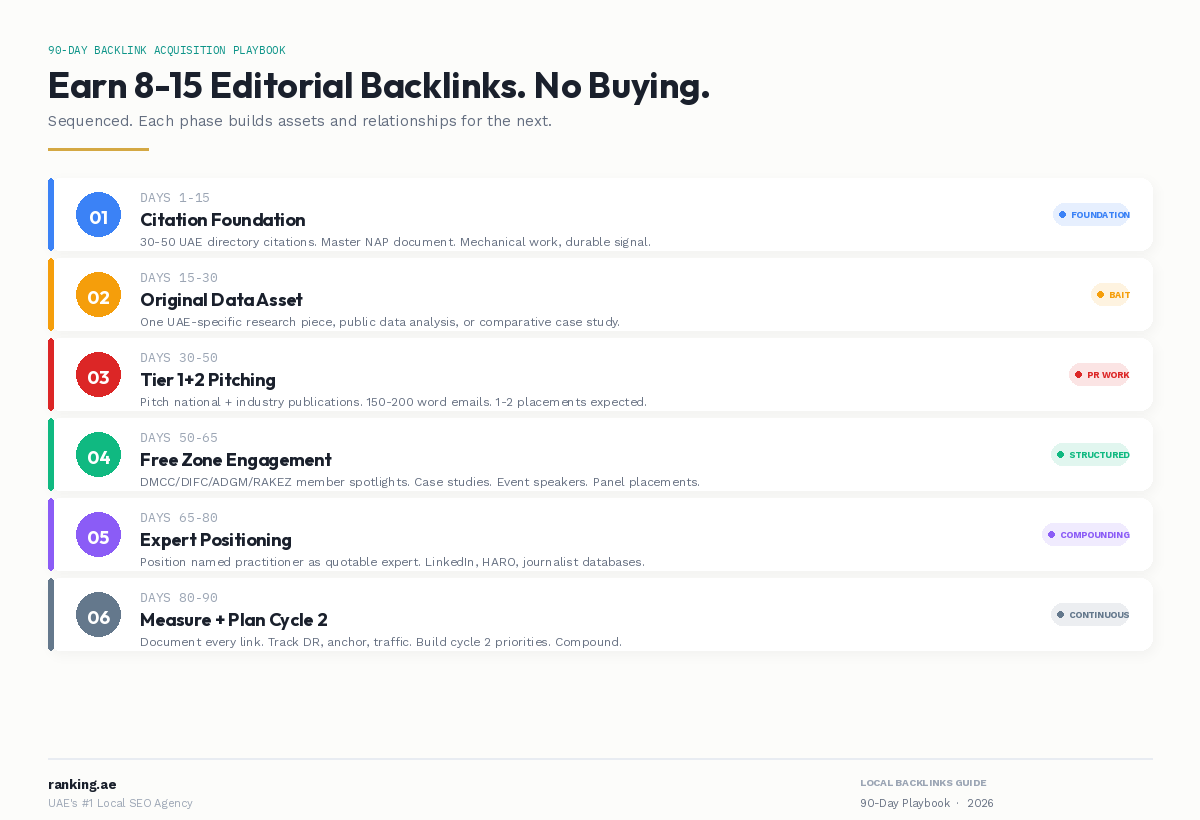
What Dubai Businesses Should Not Do When Building Backlinks
Do not buy "guaranteed DA70+ backlinks" from LinkedIn marketers. The market for paid bulk backlinks has been systematically dismantled by Google over the past decade. The agencies still selling these packages are operating either on outdated assumptions or on the expectation that the business owner will not run a 12-month audit. The pattern of the Dubai accounting firm in this article's opening repeats hundreds of times annually in the UAE market.
Do not pursue Forbes Council, Entrepreneur Leadership Network, or similar paid contributor placements. The cost is high, the ranking value is minimal, and Google's algorithms specifically discount paid contributor links since 2024. The visible authority of the publication does not translate into ranking authority for the link.
Do not chase "exact match anchor text" for backlinks. A natural backlink profile has anchor text variation: brand name, branded phrase, naked URL, generic phrases ("click here," "read more"), and long-tail descriptive phrases. A backlink profile dominated by exact-match keyword anchor text ("Dubai accounting firm," "best lawyer in Dubai," "law firm DIFC") looks manipulated to Google's algorithms. The Penguin updates and subsequent algorithm refinements specifically target this pattern.
Do not skip the citation foundation work because backlinks "are more important." They are more important for ranking authority. They are not a substitute for entity verification. A business with no citation footprint and an isolated handful of editorial backlinks looks suspicious to Google's algorithms because the entity context is missing. The Citation-to-Backlink Bridge requires both phases.
Do not measure backlink success only by domain authority numbers. Domain Authority (Moz), Domain Rating (Ahrefs), and similar metrics are useful proxies but not perfect signals. A backlink from a high-DR site with no organic traffic, no editorial standards, or topical mismatch produces less ranking value than a backlink from a moderate-DR site with strong editorial credibility and topical alignment. Quality is multidimensional.
Frequently Asked Questions
How many backlinks does my Dubai business need to rank?
There is no universal number, but the directional answer is "fewer than agencies tell you, and from better sources than you currently have." A typical mid-sized Dubai service business competing for moderately competitive queries needs a backlink profile of 30 to 60 quality editorial backlinks (combined Tier 1 through Tier 4) plus a citation foundation of 30 to 50 UAE directory listings. The total of 60 to 110 unique referring domains is competitive against most local competitors. Volume above 200 starts producing diminishing returns; volume below 30 typically caps ranking potential.
How long does it take to see ranking impact from new backlinks?
Google needs to crawl the linking page (typically 3 to 14 days for active sites), evaluate the link, and incorporate the signal into ranking calculations (typically another 4 to 8 weeks). The full ranking impact from a new editorial backlink usually appears within 6 to 12 weeks. Compounding effects from multiple backlinks earned over a quarter typically produce visible Search Console improvements within 90 to 120 days. The SEO timeline expectations covered in our timeline guide apply directly to backlink work.
Are nofollow links worth pursuing?
Yes, with nuance. Google has stated since 2019 that nofollow links are now treated as "hints" rather than directives, meaning some nofollow links do transfer ranking signal. More importantly, nofollow links from authoritative editorial sources (mentions in major news publications, industry publications, etc.) provide brand entity signals, referral traffic, and AI Overview citation eligibility even when they do not pass classical PageRank. A nofollow link from Gulf News is more valuable than a dofollow link from a small unknown blog.
Do brand mentions without links help?
Yes. Google's algorithms now process unlinked brand mentions through entity recognition systems. When a major UAE publication mentions your brand by name in the context of your industry, Google connects those entities and builds your reputation in the algorithmic graph. Unlinked mentions in authoritative publications often serve as precursors to earned linked mentions later. The work to earn unlinked mentions is the same as the work to earn linked mentions: original research, expert commentary, news angles, relationship building.
Should I disavow toxic backlinks from past link-building work?
Selectively, yes. Use Google Search Console's Links report to review your current backlink profile. If you find a meaningful pattern of low-quality or spammy backlinks (especially links from obvious link networks, sites in unrelated languages or topics, or sites that have been deindexed), the disavow tool can be used to tell Google to ignore those links. The disavow process is conservative work: only disavow links that are clearly low-quality and that you cannot get removed by request. Most Dubai businesses with limited link-building histories do not need to disavow; the businesses that bought "1000 link packages" in 2020-2023 sometimes do.
Does our website need to be high quality before pursuing backlinks?
Yes, foundationally. Editorial publications evaluate businesses partly on whether the site looks legitimate, professional, and substantive. Pitching Khaleej Times for a backlink to a thin-content site with broken pages, an empty blog, and unclear service descriptions produces a near-zero response rate. The site quality work (content depth, Core Web Vitals performance, E-E-A-T signaling, professional design) is prerequisite to effective backlink outreach. The two pieces of work compound: better site, better outreach response rate, more backlinks earned, more authority for the site.
Can I do this work in-house or do I need an agency?
Either path can work. In-house works when there is dedicated capacity for original research, PR pitching, and journalist relationship building (typically 8-12 hours per week of focused time from a marketing manager who has the writing skills and the patience for outreach). Agency work makes sense when those capabilities do not exist internally and when the budget supports the AED 8,000-25,000 monthly range that PR-driven link acquisition costs in the UAE market. The work that does not produce results is hybrid arrangements where the in-house team expects the agency to do everything but cannot provide the original data, expert quotes, and case studies the agency needs to pitch effectively.
How do backlinks interact with AI search visibility?
Directly. Backlinks are now entity authority signals that AI search systems use to determine which sources to cite in generated answers. The Citation-First Framework we documented for AI Overview optimization depends substantially on backlink profile because AI systems treat backlinks as the verification layer that determines whether a brand should be named in the AI summary. A Dubai business with a thin backlink profile is unlikely to be cited by ChatGPT, Perplexity, or Google AI Overviews regardless of how well its content is structured. Backlinks have become the entry fee to AI search visibility.
How do local backlinks differ for Abu Dhabi or Sharjah businesses?
The same hierarchy applies with emirate-specific variations. Abu Dhabi businesses prioritize backlinks from Abu Dhabi-specific publications (Abu Dhabi News, Etihad Magazine, Abu Dhabi Business Hub), the Abu Dhabi Department of Economic Development, and ADGM. Sharjah businesses prioritize Sharjah Chamber, Sharjah Media Office, and SEDD-related publications. Our Abu Dhabi SEO guide covers the city-specific backlink considerations in detail.
Q3 2026 at the Accounting Firm
The accounting firm from the opening of this article reviewed its results in October 2026, eighteen months after redirecting its link-building budget. The numbers show what the work produced when the methodology changed.
Total quality editorial backlinks earned across 18 months: 22, distributed across Tier 1 (3 from Gulf News, Khaleej Times, Arabian Business), Tier 2 (8 from industry publications including MEED and Tax Notes International), Tier 3 (4 from DMCC and Dubai Chamber communications), Tier 4 (7 from UAE business and accounting blogs). Average ranking improvement on 12 priority queries: 14 positions. Organic traffic year-over-year: +47 percent. Direct AI Overview citations on UAE corporate tax queries: 6 distinct citations across ChatGPT, Perplexity, and Google AI Overviews. Total cost: approximately AED 76,000 across the eighteen months, primarily in original research production and PR work. The previous AED 38,000 in twelve months had produced nothing of comparable durability.
The lesson is not that backlinks are easy. They are not. They require original substance (the original research, the expert positioning, the news angle), durable relationships (with journalists who learn over time that your business is a reliable source), and patience (the 90-day cycle has to compound for several quarters before the cumulative effect is visible). What the lesson is, instead: backlinks are not difficult in the way most Dubai businesses think they are difficult. They are not difficult to buy (anyone can buy them; the buying is what fails). They are difficult to earn, in the same way any genuinely valuable business asset is difficult to earn. The agencies selling shortcuts are not solving the difficulty. They are pretending the difficulty does not exist. The Dubai businesses that accept the difficulty, do the work, and run the 90-day playbook quarter after quarter are the ones whose backlink profiles compound into durable competitive advantages. The businesses still buying packages from LinkedIn pitches are funding the agencies and learning, twelve months later, that AED 38,000 produced 26 worthless links. The choice is not between expensive and cheap. The choice is between durable and ephemeral, between earned and bought, between the work that compounds and the work that vanishes when the next algorithm update arrives.
———
Request a free SEO audit and we will benchmark your current backlink profile against your top three Dubai competitors, identify the citation and editorial opportunities your business is missing, and produce the specific 90-day acquisition plan that closes the gap. View pricing for PR-driven link acquisition tiers, or explore the full blog library for the operational guides that feed every section of this article.