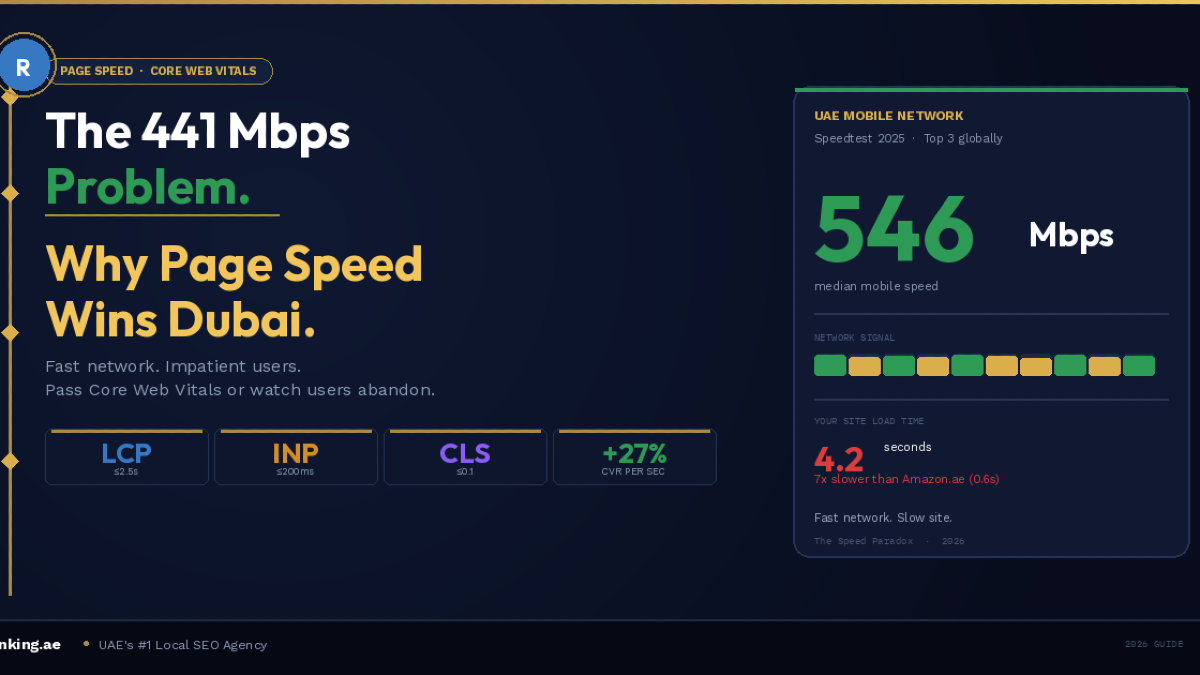
A Dubai law firm in DIFC ran their website through Google PageSpeed Insights in February 2026 and got a mobile score of 47 out of 100. The firm's technical lead looked at the score and said the equivalent of "this is fine, we'll fix it next quarter." Then the firm's marketing director ran a parallel test from a UAE-specific testing location, opened Amazon.ae on her phone (0.6 seconds to interactive), opened the firm's own site (4.2 seconds to interactive), and asked one question: would a potential client comparing two firms wait 4.2 seconds for the firm's site to load when Amazon loads in 0.6?
The firm's deal flow that quarter had been declining. The site speed audit became the first agenda item at the next partners' meeting. By the time we audited the site three weeks later, we documented eleven distinct technical issues that were costing the firm both Google rankings and user trust. The fix took six weeks. Map Pack visibility for "law firm DIFC" recovered from position 7 to position 3. Average session duration on service pages doubled. Form submissions increased 38 percent. None of the work involved adding new content, building backlinks, or running ads. It involved fixing a website that loaded too slowly for a market where users have the world's third-fastest mobile network in their pocket.
This is the 441 Mbps Problem, and almost no Dubai business is talking about it correctly. The standard global narrative assumes that fast infrastructure produces patient users (because they have bandwidth to spare for slow sites). The opposite is true. UAE mobile speeds reached approximately 546 Mbps median in 2025, placing the country among the global top three. A Dubai user has a baseline of 0.5-0.8 second page loads across the apps they use most: Amazon.ae, Talabat, Careem, Noon, Al Ansari Exchange, ENBD app. When a Dubai business website takes four seconds to load, the user does not adjust expectations downward to accommodate the site. They abandon. Fast infrastructure produces impatient users, not tolerant ones. This is the Speed Paradox, and it makes Dubai businesses face stricter de facto Core Web Vitals thresholds than the global Google standard.
This article covers why mobile speed is the most underrated ranking factor in Dubai's market, the three Core Web Vitals that determine whether your site gets indexed favorably in 2026 (LCP, INP, CLS, with INP having quietly replaced FID in March 2024 in a transition most Dubai sites missed), the technical foundation that determines pass-or-fail status, and the 30-day Core Web Vitals sprint that takes a typical Dubai service business from PageSpeed Insights failure to passing scores.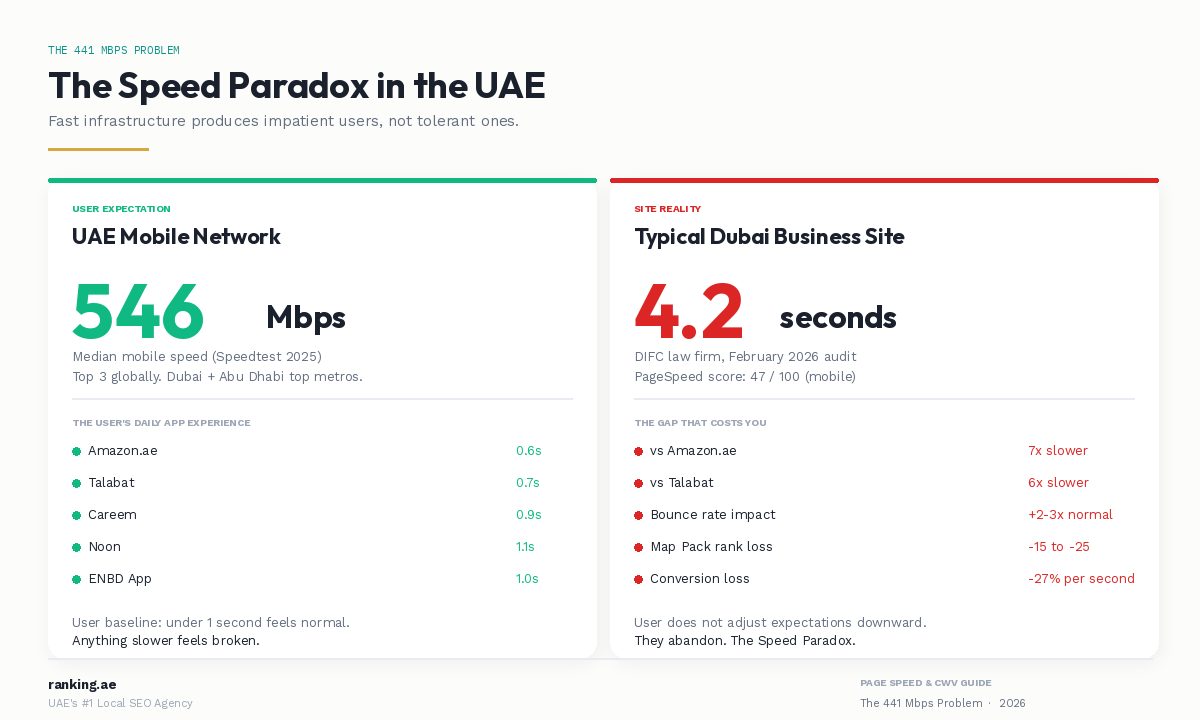
1. The 441 Mbps Problem: Why Dubai's Fast Mobile Network Makes Slow Sites Look Worse
Two facts about the UAE digital market are simultaneously true and almost universally misunderstood.
First fact. The UAE has one of the fastest mobile networks on earth. Speedtest Global Index data has consistently placed the country in the top three globally for mobile download speed since early 2024. The country ranks ahead of South Korea, ahead of Norway, ahead of every European market, and far ahead of the United States. Dubai and Abu Dhabi specifically are listed among the world's fastest metro areas for mobile speed. The infrastructure is not "good enough." It is world-class.
Second fact. Most Dubai business websites do not load like they are running on a world-class network. The same UAE consumer who experiences 0.6 second load times when opening Amazon.ae or 0.8 second loads on Talabat encounters Dubai service business websites that take 3, 4, sometimes 6 seconds to become interactive. The website is not slow because the network is slow. The network is fast. The website is slow because nobody optimized it for the network the user is actually on.
The combination of these two facts produces the Speed Paradox. The user experiencing 0.6 second loads on the apps they use most has calibrated their expectations to fast networks, not slow websites. When the user lands on a Dubai service business website that takes four seconds, the website does not feel "okay because the network is fast." It feels broken. The user has no patience for it because they have no reason to. Their phone has demonstrated that fast loads are possible. The website is the variable that failed, not the infrastructure.
The practical implication for Dubai businesses is severe. Bounce rates on slow Dubai sites are higher than bounce rates on equivalently slow sites in markets with poorer infrastructure. The user has more options, faster alternatives, and lower tolerance. A Dubai service business website with a 4-second load time is not just losing rankings (Google penalizes slow sites in the SERP). It is losing the users who do reach the site, because those users were comparing the experience against Amazon and Talabat, not against other slow Dubai websites.
Industry research backs the bounce-rate effect. Independent analysis cited by Wisdom IT Solutions found that a 1-second improvement in load time increases conversions by up to 27 percent, and that websites passing all Core Web Vitals thresholds rank an average of 15 to 25 positions higher in Google search results than slow competitors in the same market. The 27 percent conversion lift number was conservative for the UAE market specifically. The 15-25 position ranking lift is what most Dubai businesses are losing to faster competitors without ever realizing what is causing the loss. Page speed is also a direct contributor to the proximity, relevance, and prominence factors that determine Map Pack ranking; a slow site weakens the prominence signal in addition to the broader organic ranking signal.
2. The Three Core Web Vitals That Determine Your Ranking in 2026 (LCP, INP, CLS)
Google's Core Web Vitals are three specific page experience metrics that contribute directly to search ranking signals. The thresholds are precise. The data Google uses comes from real Chrome user experiences (not lab simulations), aggregated through the Chrome User Experience Report (CrUX). A site passing the Core Web Vitals assessment has at least 75 percent of real-user page loads meeting all three thresholds simultaneously. A site failing any one of the three is treated as failing overall.
LCP: Largest Contentful Paint (loading speed)
LCP measures the time from page navigation start to when the largest visible content element finishes rendering. The largest element is usually the hero image, the largest heading, or the main video player. The threshold for "Good" is 2.5 seconds or less at the 75th percentile of real-user experiences. Between 2.5 and 4 seconds is "Needs Improvement." Above 4 seconds is "Poor."
For a Dubai business, the LCP threshold is the single most actionable Core Web Vital. The largest contentful element is almost always an image (hero banner, product photo, headshot, location image). LCP failures almost always trace to one of three causes: image files that are too large (uncompressed JPEGs or PNGs over 500 KB), images served without a content delivery network (CDN), or images loaded via JavaScript instead of native HTML. The fixes are mechanical and repeatable. Image compression to WebP format. CDN deployment for image delivery. Native HTML img tags with explicit width and height attributes and the loading="eager" attribute on above-the-fold images.
INP: Interaction to Next Paint (responsiveness)
The Core Web Vital that most Dubai sites have not adapted to. INP officially replaced First Input Delay (FID) on March 12, 2024, and FID was deprecated in the same transition. INP is a stricter metric. Where FID measured only the input delay before the browser began processing the first interaction on a page, INP measures the full latency of every interaction during a session: input delay plus processing time plus presentation delay. INP reports the worst representative interaction during the session as the score, which means a single slow click on a complex form field can sink the entire INP score for the page.
The INP threshold is 200 milliseconds or less at the 75th percentile. 200 to 500 ms is "Needs Improvement." Above 500 ms is "Poor." Most Dubai sites that passed FID before March 2024 do not pass INP today, because FID was systematically easier to satisfy. The stricter measurement exposed real interaction problems that FID had hidden. A typical Dubai site built before 2024 with heavy JavaScript frameworks (React, Vue, Angular without proper code-splitting) often shows INP scores in the 400-800 ms range, well into the "Poor" category. The site owners are not aware because most of them have not opened PageSpeed Insights since the metric changed.
CLS: Cumulative Layout Shift (visual stability)
CLS measures unexpected visual movement of page elements as the page loads. The threshold for "Good" is 0.1 or less. The metric exists because layout shifts cause specific user frustrations: tapping a button that moved, losing reading position because content jumped, accidentally clicking the wrong element. The most common causes of poor CLS in Dubai sites are images without explicit dimensions (so the layout reflows when the image loads), web fonts that swap and trigger reflow, advertisements injected after page load that push content down, and embedded social media widgets that load late and shift layout. The fixes are well-documented: explicit width and height on every image, font-display: optional or swap with proper fallback fonts, reserved space for ads and embeds, and avoidance of dynamically-injected content above the fold.
"At least 75 percent of INP experiences should respond to user input in under 200 milliseconds to be considered good."
— Google Chrome team, INP Core Web Vitals Launch Announcement
3. Why INP Replaced FID and What Most Dubai Sites Have Not Updated
The INP transition is the single largest Core Web Vitals event of the past three years, and the majority of Dubai service business websites have not adapted to it. The reason is not technical complexity. It is awareness. Most agencies that built or maintain these sites still optimize for FID because FID was the metric they trained on, and they have not revisited the technical brief since.
The shift from FID to INP matters operationally because FID was lenient. FID measured only the delay before the browser started processing the first interaction. If a user clicked a button on a Dubai site, FID measured the milliseconds before the click handler began. If the click handler then took 800 milliseconds to actually do anything (validate a form, fetch data, render an updated UI), FID did not capture that latency at all. The user experienced 800ms of unresponsiveness. FID reported "good." The metric was structurally blind to the most common interaction problem: slow JavaScript execution after the click.
INP captures the full latency. Input delay (browser preparing to handle the event) plus processing time (JavaScript actually doing the work) plus presentation delay (browser painting the next frame). The same Dubai site that passed FID with a 30 ms first-input delay now fails INP because the actual click-to-screen-update time is 600 ms. The user experience never changed. The measurement got honest.
The practical consequence for Dubai businesses is that the INP failure rate is dramatically higher than the historical FID failure rate. Independent analysis by Ahrefs found that only 33 percent of sites globally are meeting the Core Web Vitals threshold since INP became official. The figure for Dubai service business websites is meaningfully worse, because Dubai web development tends to use heavy WordPress installations with multiple page-builder plugins, custom theme code, and third-party tracking scripts that each add interaction latency. A typical Dubai law firm, real estate agency, or medical clinic website built between 2020 and 2023 is now failing INP without anyone at the business knowing.
The diagnostic is one click away. Open Google PageSpeed Insights. Enter the URL. Look at the "Core Web Vitals Assessment" section. If INP is shown in red or amber, the site is failing the responsiveness threshold and losing ranking signal. If INP is shown in green, the site is passing on this dimension. The Dubai businesses where INP is "not shown" or "insufficient field data" almost always have severe traffic deficits, because the metric only populates when the site has enough Chrome user data, and sites without enough Chrome user data are sites without enough traffic.
4. The Speed Paradox: Why Dubai User Tolerance Is Lower, Not Higher
The Speed Paradox is the operational thesis of this article. Standard global SEO content treats markets with fast infrastructure as forgiving (because users have bandwidth) and markets with slow infrastructure as unforgiving (because users notice every slowdown). Both assumptions are wrong for the UAE.
The mechanism is calibration. A user's patience for slow loading is anchored to their personal experience baseline, not to abstract industry standards. A Dubai user who opens Talabat (typical load 0.7 seconds), Amazon.ae (typical load 0.6 seconds), Careem (typical load 0.9 seconds), and Noon (typical load 1.1 seconds) has an experiential baseline that any site loading slower than 2 seconds feels objectively slow. The user has not read a Google Core Web Vitals threshold document. They have used apps for hours every day that load in under one second. The four-second Dubai service business website is not a "moderate" load. It is a "broken" load. The user closes the tab.
This explains a specific phenomenon Dubai SEO agencies have observed for years without naming. Two competing service businesses, identical Map Pack ranking, identical website content, identical review counts. One captures most of the inquiries from search. The other captures few. The technical SEO audit reveals the difference: one site loads in 1.4 seconds, the other in 4.6 seconds. The faster site is not winning by 30 percent. It is winning by 200 percent or more, because the slow site's users are bouncing before they convert. Map Pack visibility brought users to both sites. Page speed determined which users stayed long enough to become leads.
Google's LCP threshold for "Good" is 2.5 seconds. The Dubai user's tolerance threshold appears to be closer to 1.5 seconds based on session-duration and bounce-rate data from UAE testing. Dubai businesses optimizing only to Google's threshold are technically passing the Core Web Vitals assessment but still losing users to faster competitors and faster apps. The de facto standard for the UAE market is stricter than the de jure Google standard. The businesses that understand this calibrate their performance budgets to a 1.5-second LCP target and build the technical foundation to maintain it. The businesses that target 2.5 seconds and call the work done are leaving meaningful conversion behind.
5. Mobile-First in a Mobile-First Market: Specific UAE Network Conditions That Matter
The standard advice "optimize for mobile first" lands differently in a market where smartphone penetration exceeds 99 percent and the majority of search queries originate on mobile devices. For Dubai specifically, mobile-first is not a recommendation. It is the only configuration that matches user reality. The same network conditions also drive the voice search visibility patterns we documented separately; voice answers preferentially come from pages that load in under 4.6 seconds on mobile, which makes Core Web Vitals work foundational to voice optimization as well as to traditional ranking.
Test from UAE-relevant locations
A site that scores 78 on PageSpeed Insights when tested from a US server can score 52 when tested from a UAE-relevant server. The difference is latency to origin, CDN edge availability in the Middle East region, and the specific way the site's assets are distributed across global infrastructure. Free testing tools default to US-based servers, which produce optimistic numbers for sites hosted in the US or Europe but unrealistic numbers for the actual UAE user experience. GTmetrix allows location selection; Pingdom allows location selection; Google's PageSpeed Insights uses CrUX field data which reflects real UAE Chrome users automatically. Use the field data, not the lab simulation, when assessing UAE performance.
CDN with Middle East presence
Cloudflare, Akamai, and AWS CloudFront all maintain edge servers in the UAE (Dubai) and adjacent markets (Bahrain, Saudi Arabia). A site without a CDN, or with a CDN that lacks Middle East edge presence, serves every Dubai user from servers in Frankfurt, London, or Singapore depending on hosting choice. Each of these introduces 80-150 milliseconds of additional latency on every request. For a typical website with 40 to 80 requests per page, the cumulative latency penalty is significant. CDN deployment with Middle East edges is foundational for any Dubai business serious about speed. Implementation is one-day work for most sites; the impact on LCP is typically 30-50 percent reduction.
Hosting location matters less than CDN location
A common misconception is that hosting in the UAE is necessary for fast UAE delivery. CDN edge caching makes hosting location largely irrelevant for static assets (images, CSS, JavaScript). What matters is dynamic content delivery (the initial HTML response, API calls, server-side rendering) where origin server location does affect latency. For most Dubai service business websites, the optimal configuration is hosting in a major cloud region (typically AWS Bahrain, Azure UAE North, or Google Cloud Dammam for the closest origin) with a global CDN handling all static asset delivery. Hosting in the UAE specifically is a bonus, not a requirement.
Mobile network conditions for testing
Lab testing tools default to either "Mobile 4G Slow" or "Desktop" simulation. Neither matches the typical UAE mobile experience, which is closer to "Mobile 5G" with much higher available bandwidth but variable latency depending on the specific cell tower and time of day. Lighthouse and PageSpeed Insights deliberately test against slower simulated networks to surface performance issues that would appear under stress. The right interpretation is that PageSpeed Insights mobile scores are conservative for the typical UAE user, but field data (CrUX, Real User Monitoring) shows what users actually experience. A site that scores 65 on PageSpeed Insights mobile with strong CrUX field data is performing better in the real UAE market than a site scoring 85 on PageSpeed Insights with weak field data.
6. The Technical Foundation: Hosting, CDN, Image Optimization, JavaScript Discipline
The Core Web Vitals scores are outputs. The inputs are four technical foundations that determine whether the outputs pass or fail. For a Dubai business, the work in each of these foundations follows a predictable sequence with predictable returns.
Hosting
The single highest-leverage technical decision. Shared hosting (Hostinger basic, GoDaddy basic, Bluehost basic) on a $4-12 per month plan is the cause of approximately 60 percent of Dubai small business site speed problems. Shared hosting puts the site on a server with hundreds or thousands of other sites; resource contention produces unpredictable response times that ruin LCP and INP scores. Managed WordPress hosting (Kinsta, WP Engine, SiteGround GoGeek tier or higher) at $25-50 per month produces dramatically better baseline performance for service business sites. For e-commerce or higher-traffic sites, dedicated cloud hosting at $80-200 per month is the correct tier. The hosting upgrade alone often produces a 20-40 point improvement in PageSpeed Insights mobile scores with no other changes.
CDN
Cloudflare's free tier produces meaningful speed improvements for most Dubai sites. The configuration is straightforward (point your domain's nameservers at Cloudflare, enable the recommended page rules and caching settings) and takes approximately one hour. The free tier alone resolves most LCP issues for image-heavy sites. The Pro tier ($20/month) adds image optimization and additional performance features that are worth the upgrade for sites with significant image content. Bunny CDN ($1-5/month for typical traffic) is an alternative for sites that want CDN performance without the Cloudflare DNS migration.
Image optimization
The single highest-impact ongoing discipline. Modern image formats (WebP, AVIF) provide 25-50 percent file size reduction compared to JPEG and PNG with no visible quality loss. Modern responsive image markup (srcset and sizes attributes) ensures that mobile devices download mobile-sized images, not desktop versions scaled down. Lazy loading defers below-the-fold images until they are needed. The combination of these three (WebP/AVIF, responsive srcset, lazy loading) typically reduces total page weight by 40-70 percent on image-heavy Dubai sites. WordPress sites can implement most of this with the ShortPixel or Smush plugin (one-time setup, ongoing automatic optimization).
JavaScript discipline
The most common source of INP failures. Dubai web development tends to accumulate JavaScript over time: the original theme, multiple page-builder plugins, analytics tools, marketing automation pixels, chat widgets, A/B testing tools, popup tools, and live chat scripts. Each one adds milliseconds to the main thread. By the third year of accumulation, the site is loading 40+ JavaScript files on every page, several of which are duplicate or outdated. The JavaScript audit (identifying every script, removing the unused ones, deferring the non-critical ones, replacing heavy plugins with lighter alternatives) is the most labor-intensive but highest-leverage technical work in a Core Web Vitals recovery. The same audit patterns we documented across 50 UAE businesses showed that JavaScript bloat was the single most common technical issue, present in 84 percent of sites we audited. The pattern shows up so consistently that we list it as one of the 10 most damaging local SEO mistakes Dubai businesses make. For multi-location businesses with multiple location pages, the JavaScript audit must be run on every location page template independently because per-page accumulation patterns can differ.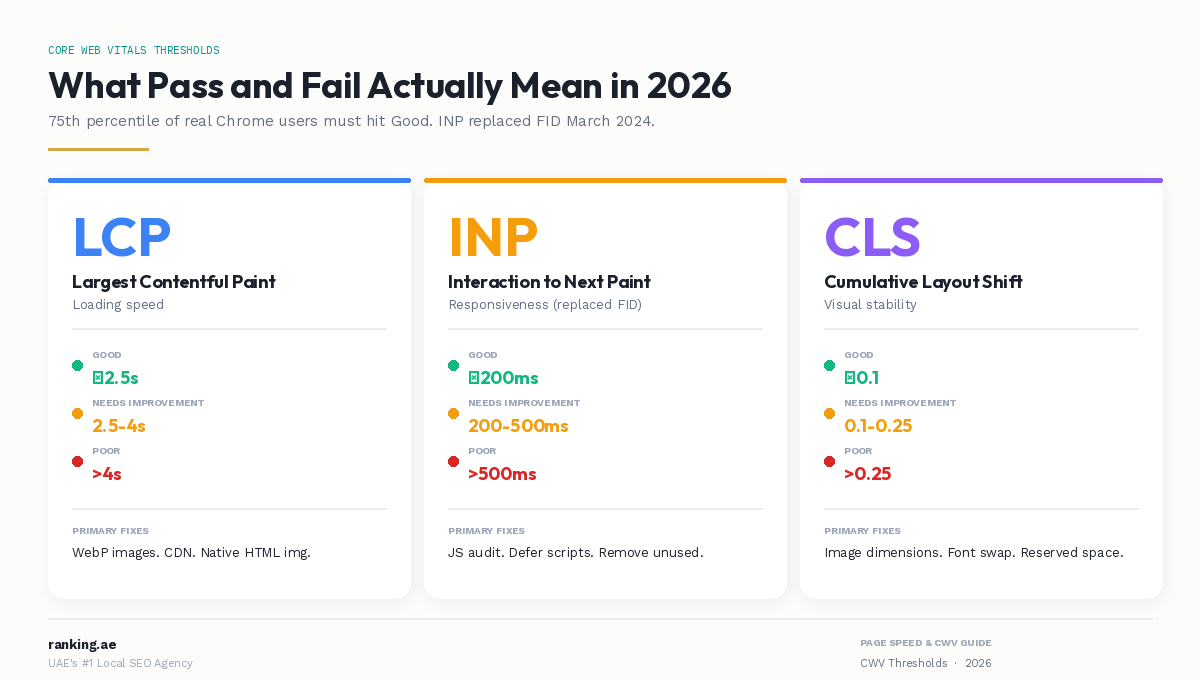
7. The 30-Day Core Web Vitals Sprint for Dubai Businesses
The sprint operationalizes everything in this article. Run it sequentially. Each phase produces measurable PageSpeed Insights improvements that compound into the next phase's work.
Days 1-3: Baseline measurement and diagnosis
Run PageSpeed Insights on the homepage and the top 5 traffic-receiving pages. Document mobile scores, LCP, INP, CLS, and the specific opportunities Google flags. Open Google Search Console > Core Web Vitals report to see the field-data picture across the entire site. Run Lighthouse in Chrome DevTools (mobile simulation, slow 4G throttling) to capture the lab data and the specific recommendations. Run a parallel test using GTmetrix from a UAE-relevant testing location. The baseline document should contain: current mobile score, current LCP/INP/CLS values for top pages, current CrUX assessment status, top 10 specific issues flagged by Lighthouse, and an estimated time-to-fix per issue. Without this baseline, the rest of the sprint cannot be measured for impact.
Days 3-7: Hosting evaluation and CDN deployment
If the site is on shared hosting under $15/month, this is the highest-leverage week of the sprint. Evaluate managed WordPress hosting options (Kinsta, WP Engine, SiteGround Cloud) and migrate if budget allows. The hosting migration alone typically produces 15-30 point PageSpeed Insights improvements. If the site is already on premium hosting, deploy Cloudflare (free tier minimum, Pro tier preferred) with appropriate page rules. CDN deployment with no other changes typically produces 10-20 point improvements. By end of week one, baseline scores should improve by 25-45 points just from infrastructure work.
Days 7-14: Image optimization
Audit every image on the site. Convert all hero images and above-the-fold images to WebP. Add explicit width and height attributes to every image tag. Implement responsive srcset for any image that displays at different sizes on mobile vs desktop. Enable lazy loading on all below-the-fold images. For WordPress sites, install ShortPixel or Smush and run a bulk optimization on existing media library. Compress any image still over 200 KB. By end of week two, total page weight should drop 30-50 percent and LCP should be within or close to the 2.5 second threshold.
Days 14-21: JavaScript audit and reduction
Open Chrome DevTools > Coverage tab. Reload the homepage. Identify which JavaScript files are loaded but not used on the page. For WordPress, audit the active plugins list and deactivate any plugin not in active use (this typically removes 10-20 percent of total JavaScript on a typical site). Defer non-critical JavaScript using async or defer attributes on script tags or via plugin configuration (WP Rocket, Perfmatters). Remove any tracking pixel or marketing tag that is not actively used in current campaigns. By end of week three, INP scores should improve from the typical 400-600 ms baseline to 200-300 ms, with the goal of consistently passing the 200 ms threshold.
Days 21-25: CSS and font optimization
Inline critical CSS for above-the-fold rendering. Defer non-critical CSS. Optimize font loading: subset font files to required characters only, use font-display: swap for proper text fallback during font load, preload critical fonts to avoid FOIT (flash of invisible text). For CLS specifically, ensure font fallbacks have similar metric overrides to prevent layout shift when web fonts load. By end of week 25, CLS should be solidly under 0.1.
Days 25-30: Verify, document, monitor
Re-run all baseline measurements. Document before-and-after PageSpeed Insights scores, LCP/INP/CLS values, and the specific issues that were resolved. Set up ongoing monitoring: Real User Monitoring (RUM) via Cloudflare's built-in tools or a dedicated provider (SpeedCurve, Calibre); weekly automated PageSpeed Insights tests on top 10 pages; monthly Search Console Core Web Vitals review. Build the regression-prevention discipline: any new plugin installation requires a before-and-after PageSpeed test; any new third-party script requires impact assessment; any image upload requires WebP conversion. The 30-day sprint produces a passing baseline; the ongoing discipline maintains it. Core Web Vitals should be a permanent line item in the SEO Report Card framework we use to grade ongoing investment performance, alongside ranking, traffic, and conversion metrics.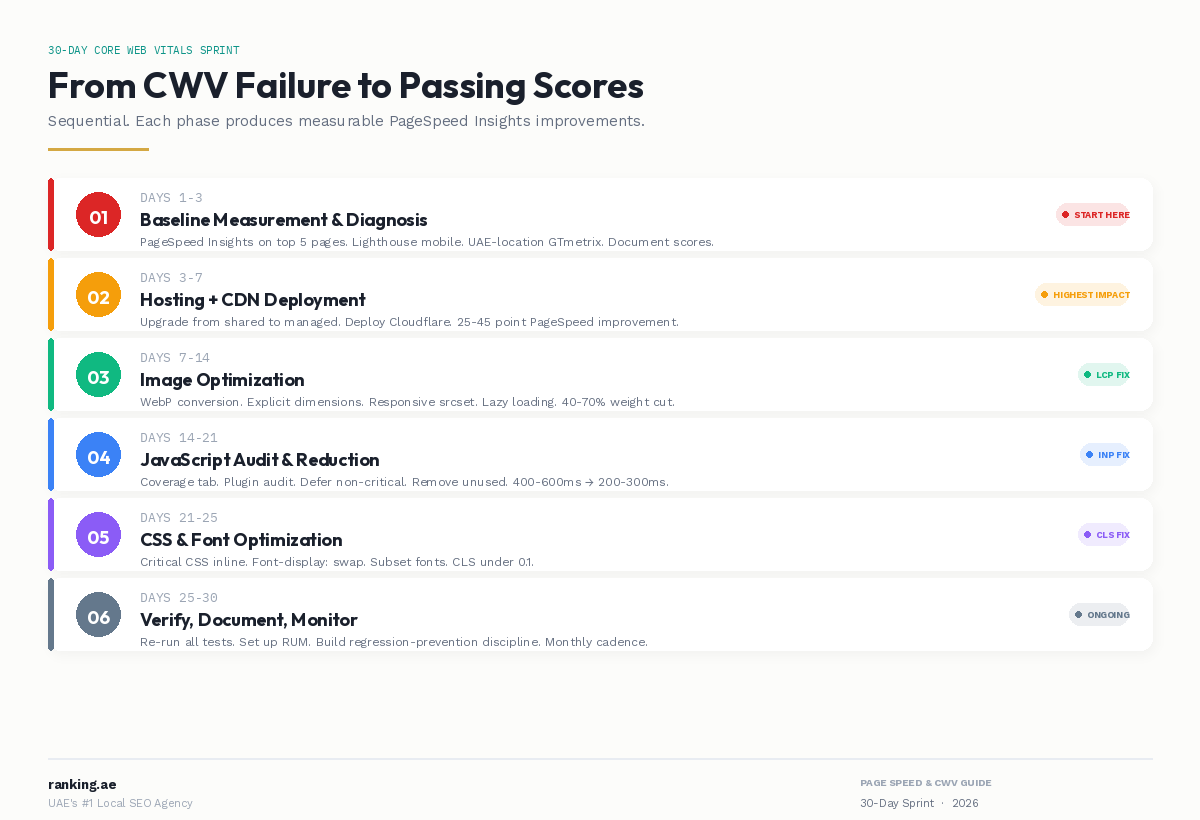
What Dubai Businesses Should Not Do When Optimizing for Speed
Do not chase a 100/100 PageSpeed Insights score. The score is a directional metric, not a target. A site scoring 92/100 with passing LCP, INP, and CLS in real-user data is functionally identical to a site scoring 100/100 in terms of ranking signal. Time spent optimizing 92 to 100 is time not spent on conversion improvements that move actual revenue. The threshold is "passing the assessment," not "perfect score."
Do not optimize lab data while ignoring field data. Lab data (Lighthouse, lab-mode PageSpeed Insights) tests the site once under controlled conditions. Field data (CrUX, real-user monitoring) measures actual user experiences. Google's ranking algorithm uses field data. A Dubai site that passes lab tests but has poor field data is not getting the ranking signal benefit. Field data is the only metric that matters for ranking.
Do not skip the JavaScript audit because the site "feels fast on my phone." The technical lead testing the site on their personal iPhone 15 with full Wi-Fi at the office is not the median user. The Dubai customer on a four-year-old Android device on cellular network in a basement parking garage is the relevant user. INP testing requires real-user data across the full distribution of devices and conditions, which is what CrUX provides automatically.
Do not assume a Wix or Squarespace site cannot pass Core Web Vitals. Both platforms have improved significantly since 2022. A 2026 Wix or Squarespace site with proper image optimization, minimal third-party widgets, and good content discipline can pass Core Web Vitals. The most common reason these sites fail is excessive widget installation and gallery overuse, not platform limitation.
Do not over-rely on PageSpeed Insights as the sole diagnostic. PageSpeed Insights is excellent for surface-level diagnosis but limited for deep INP investigation. Chrome DevTools Performance tab, the Web Vitals extension, and dedicated RUM tools provide deeper visibility into specific interaction problems. The diagnostic toolkit should include all four, not just PageSpeed Insights.
Frequently Asked Questions
Does Google really use page speed as a ranking factor in Dubai?
Yes. Core Web Vitals have been a confirmed Google ranking factor since the Page Experience Update rolled out in 2021. The factor is geography-neutral; the same thresholds apply to Dubai sites as to global sites. The reason it matters more in Dubai specifically is the calibration effect described in the Speed Paradox section. Dubai users have lower tolerance for slow sites, which produces higher bounce rates, which feed into engagement signals that further influence ranking. The compound effect makes page speed disproportionately important in the UAE compared to slower-network markets. Page speed also indirectly strengthens the Google Business Profile signals that drive Map Pack ranking, because GBP engagement metrics (clicks to website, average session) feed back into the prominence factor.
My site scores 65 on PageSpeed Insights mobile. Is that good enough?
Probably not. The PageSpeed Insights score itself is less important than the underlying Core Web Vitals values. A site scoring 65 with passing LCP, INP, and CLS in field data is acceptable. A site scoring 65 with failing INP is not, regardless of the overall score. Look at the Core Web Vitals Assessment specifically (the green/amber/red indicators), not the aggregate score. If any one of LCP, INP, or CLS is amber or red, the site is leaving ranking signal on the table.
How long does it take to see ranking improvements after fixing Core Web Vitals?
Field data updates daily in PageSpeed Insights but the underlying CrUX dataset uses a 28-day rolling window. So a fix deployed today produces measurable field data changes starting tomorrow but does not show in the full CrUX assessment until 28 days later. Ranking changes typically follow 4-8 weeks after sustained Core Web Vitals improvements. Our SEO timeline guide for Dubai businesses covers the broader expectation framework; the technical-specific timeline is faster than content-driven SEO timelines because Core Web Vitals work produces clean, measurable improvements that Google's algorithm responds to relatively quickly.
Does the hosting location need to be in the UAE?
No, with one nuance. Static assets (images, CSS, JavaScript) should be served via a CDN with Middle East edge presence (Cloudflare, Akamai, AWS CloudFront). Origin hosting (where the dynamic HTML is generated) should be in a nearby cloud region (AWS Bahrain, Azure UAE North, or Google Cloud Dammam) for the lowest latency. Hosting physically inside the UAE is sometimes valuable for compliance reasons (data residency requirements for certain industries), but performance-wise, the regional cloud + CDN combination outperforms most UAE-only hosting providers.
My site uses a popular page builder like Elementor or Divi. Can I pass Core Web Vitals?
Yes, but with effort. Both Elementor and Divi are heavier than custom-coded themes by default, which makes Core Web Vitals harder but not impossible. The specific work for these page builders includes: enabling their built-in performance optimization features (Elementor's Optimized DOM, Divi's Critical CSS), removing widgets and modules not in active use, deferring non-critical scripts, and selecting lightweight Elementor or Divi child themes rather than the default heavy ones. We have brought Elementor sites from PageSpeed scores of 35 to scores of 80+ in 30 days. The work is real but not exotic.
What about Webflow, Framer, and other modern site builders?
These platforms typically produce better baseline Core Web Vitals scores than WordPress with page builders. Webflow sites often pass Core Web Vitals out of the box with reasonable image discipline. Framer is similar. The trade-off is platform lock-in (harder to migrate later) and feature limitations (custom backend functionality is harder than WordPress). For Dubai service businesses where website performance is more important than backend flexibility, modern site builders are often the right choice. For e-commerce or businesses with complex backend requirements, WordPress with proper hosting and optimization remains the more flexible foundation. Our e-commerce SEO guide for UAE businesses covers the platform-specific considerations for Shopify, WooCommerce, and Magento on Core Web Vitals.
How does page speed interact with AI search visibility?
Directly. Our AI search visibility guide documented that AI Overview citation requires top-10 organic ranking, which itself requires passing Core Web Vitals. The page speed work is foundational to AI visibility, not separate from it. A site failing Core Web Vitals is unlikely to rank in the top 10, which makes it unlikely to be cited by ChatGPT, Perplexity, or Google AI Overviews. Page speed is the entry fee to the entire 2026 search visibility landscape, not just traditional rankings.
What is the most common page speed mistake Dubai businesses make?
Hosting under-investment. A typical Dubai service business pays AED 50-200 per month for hosting that costs the business AED 5,000-15,000 per month in lost conversions and lower rankings. The hosting decision is often made once at site launch by a junior staff member or an external agency, then never revisited. The asymmetry between cost (hosting upgrade is AED 100-300/month) and benefit (15-25 position ranking lift, 27 percent conversion lift) makes this the highest-ROI technical decision most businesses can make. Yet it is the decision most commonly skipped because hosting feels like a settled topic. The SEO pricing breakdown we published covers how hosting fits into total SEO investment economics for Dubai businesses.
Can I run Core Web Vitals testing myself or do I need an agency?
You can run the diagnostics yourself. PageSpeed Insights is free and covers the field-data assessment Google uses for ranking signal. Chrome DevTools is free and covers the deep technical investigation. Google Search Console is free and covers the site-wide Core Web Vitals report. The diagnostics are accessible to non-developers. The fixes are where agency support typically becomes valuable, particularly the JavaScript audit and the image optimization at scale. A reasonable workflow for a Dubai business is to run the diagnostics monthly internally, document the trend, and engage technical help when specific issues appear that exceed in-house capability. Our local SEO ultimate guide for Dubai covers how technical SEO sits within the broader optimization framework, and the UAE SEO glossary includes definitions for every technical term used in this article.
Q3 2026 at the DIFC Law Firm
The law firm from the opening of this article completed the 30-day Core Web Vitals sprint in March 2026. The PageSpeed Insights mobile score moved from 47 to 84. LCP improved from 4.2 seconds to 1.6 seconds. INP improved from 480 ms to 180 ms. CLS dropped from 0.18 to 0.04. All three Core Web Vitals are now consistently in the green at the 75th percentile of real-user data.
What changed in the firm's business outcomes was not just rankings, although rankings did improve. Map Pack visibility for "law firm DIFC" recovered from position 7 to position 3 within six weeks of the technical work completing. Bounce rate on the homepage dropped from 64 percent to 41 percent. Average session duration on service pages doubled from 1:12 to 2:31. Form submissions increased 38 percent in Q2 2026 compared to Q4 2025. The marketing director presented the Q2 results at the partners' meeting and the firm authorized a quarterly Core Web Vitals review as a permanent agenda item.
The lesson is not that page speed is the most important SEO factor. It is not. Content quality, link authority, and Map Pack signals all matter at least as much. The lesson is that page speed is the most underrated factor in the Dubai market specifically, because the 441 Mbps mobile network has calibrated user expectations to a level that most Dubai business websites do not meet. The businesses that fix the speed gap are not winning a marginal advantage. They are stopping the daily user defection that has been silently costing them rankings, traffic, and revenue. The 30-day sprint pays for itself within the first quarter of completion in almost every category we have tracked. The window for "we'll fix it next year" closed in 2024 when INP became official. The window for "we'll fix it next quarter" is closing now. The window for "we'll fix it this month" is the one that produces the Q3 result the law firm presented at its partners' meeting.
———
Request a free SEO audit and we will run the PageSpeed Insights baseline on your top 10 pages, identify every Core Web Vitals failure, and produce the specific 30-day technical sprint that takes your site from CWV failure to passing scores. View pricing for technical SEO retainer tiers, or explore the full blog library for the operational guides that feed every section of this article.