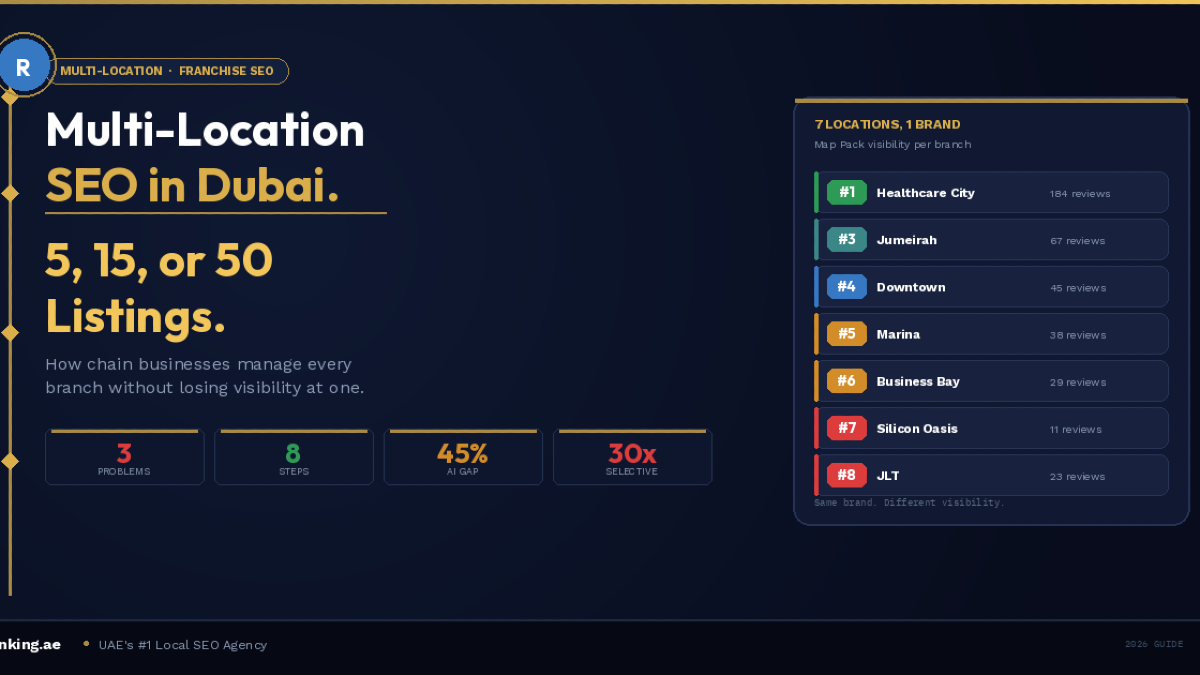
A clinic group with seven locations across Dubai ran an internal audit in January 2026 and found that their Healthcare City branch held Map Pack position 1 for "dermatologist Dubai" in its catchment area, while their JLT branch sat at position 8 for the same category. Position 8 is not on the visible Map Pack. It is below the fold, behind a "More places" click that 94% of users never make. The JLT branch was functionally invisible to anyone searching on Google Maps.
Same brand. Same doctors rotating between branches on a weekly schedule. Same website. Same GBP description, copy-pasted across all seven profiles with only the address changed. Same review request template sent from the same email address regardless of which branch the patient visited. The Healthcare City branch had 184 reviews at 4.6 stars. The JLT branch had 23 reviews at 4.2 stars. The Jumeirah branch had 67 reviews. The Silicon Oasis branch had 11. The branches were not competing against other clinics. They were competing against each other for the same brand-name searches, and most of them were losing.
This is the pattern we see across every multi-location business in Dubai that has not deliberately built a per-location SEO strategy. Restaurant chains, salon franchises, fitness chains, retail outlets, medical groups, professional services firms with multiple offices. The brand invests in one strong flagship location (usually the first one opened, usually in the most visible neighborhood) and treats every subsequent location as a copy of the original. Google does not reward copies. It penalizes them. And the penalty is not a ranking drop. It is a visibility gap between the strongest and weakest location that widens every month it goes unaddressed.
This article covers the three structural problems that make multi-location SEO different from single-location work in Dubai, the operational framework that prevents the visibility gap from forming, and the specific per-location checklist that turns every branch into a ranking-capable entity rather than a duplicate of the flagship.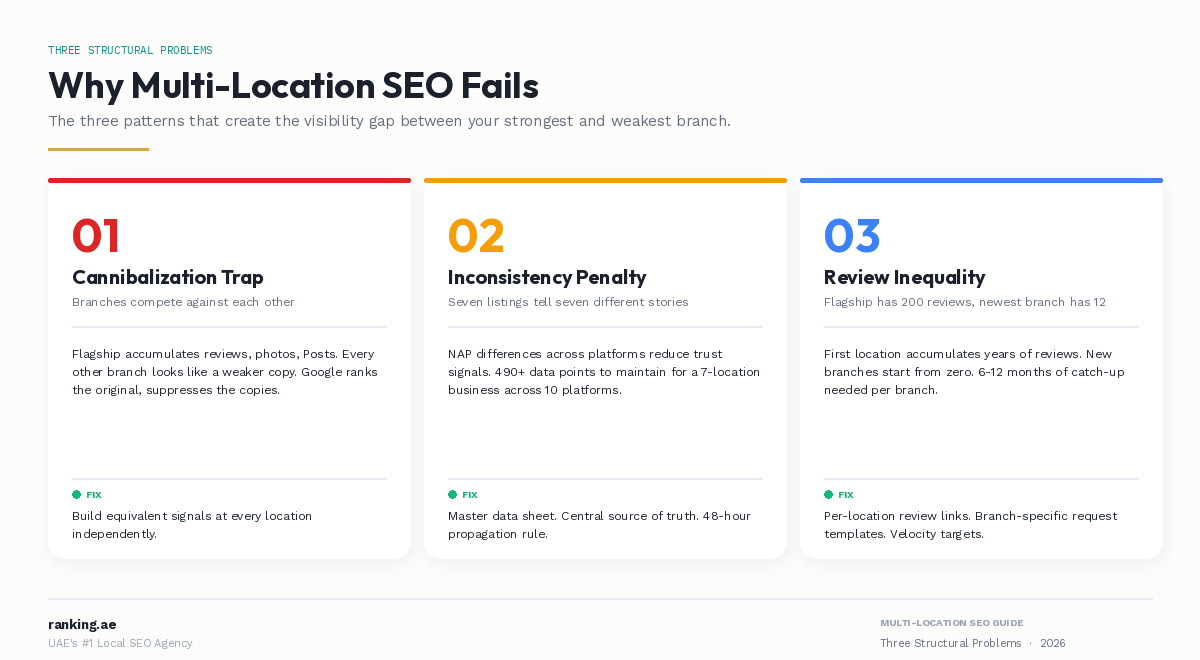
1. The Cannibalization Trap: When Your Branches Compete Against Each Other
When a restaurant chain has branches in JLT, Downtown, and Marina, all three locations compete for brand-name searches. A customer searching "Comptoir 102 Dubai" triggers a Map Pack that shows the nearest location based on the searcher's GPS position. This is working as intended. The problem begins when the same customer searches "French restaurant Dubai" or "brunch Dubai." Now the three branches are competing for the same non-brand query, and Google must choose which location to show.
If all three locations share the same website, the same GBP descriptions, the same service lists, and the same content, Google has no basis for differentiating them beyond proximity. The branch closest to the searcher wins the Map Pack. The other two are invisible. But proximity alone is not the only ranking factor. The three pillars of Map Pack ranking (proximity, relevance, prominence) all contribute. A branch with lower proximity but higher prominence (more reviews, more GBP activity, more website engagement) can outrank a closer branch with thin signals. This is why the Healthcare City clinic with 184 reviews outranks the JLT clinic with 23 reviews even for searchers who are geographically closer to JLT.
The cannibalization trap works like this. The flagship location accumulates the majority of the brand's digital signals. It gets the most reviews because it was the first location and has the longest customer history. It gets the most photos because the marketing team photographs it first. It gets the most GBP Posts because it is the location the social media manager thinks of as "the main one." It gets the most website traffic because the location page was built first and has accumulated the most backlinks. Google interprets these signals as evidence that the flagship is the authoritative location. Every other branch looks like a weaker copy.
The fix is not to reduce signals at the flagship. It is to build equivalent signals at every other location. Each branch needs its own review velocity, its own photo library, its own GBP Post cadence, its own location-specific content, and its own identity in Google's entity graph. The cost of this work scales linearly with the number of locations. A five-location business needs roughly five times the review management, content production, and GBP administration of a single-location business. Most multi-location operators underestimate this cost and then wonder why branches two through five never rank.
2. The Inconsistency Penalty: What Happens When Seven Listings Tell Seven Slightly Different Stories
The biggest technical threat to a multi-location brand in Dubai is NAP (Name, Address, Phone) inconsistency. In 2026, search algorithms and AI models are acutely sensitive to conflicting data. If one directory says your JLT branch closes at 6:00 PM and your GBP says 7:00 PM, your trust signal drops. If your website lists "Dr. Ahmad's Clinic" but your GBP says "Dr Ahmad Clinic" (missing the apostrophe and the "'s"), Google treats them as potentially different entities. Small inconsistencies that a human would ignore create measurable confusion for algorithms.
The inconsistency penalty compounds across platforms. A seven-location clinic group has business information on Google Maps, Apple Maps, Bing Places, Facebook, Instagram, Fresha (for medical aesthetics), Practo or Vezeeta (for medical), Zomato or Talabat (for restaurants), Bayut or Property Finder (for real estate), and dozens of local directories. Each platform has its own format for entering business data. Each location creates seven data entry opportunities and seven potential inconsistencies per platform. Multiply seven locations by ten platforms by seven data fields (name, address, phone, hours, categories, website, description), and the total number of data points that must be consistent reaches 490. A single marketing coordinator managing this manually will introduce errors.
The operational fix is a master data sheet. One document, maintained centrally, containing the canonical version of every business detail for every location. When anything changes at any location (new hours, new phone number, staff change, service addition), the change enters the master sheet first and propagates to every platform within 48 hours. The businesses that treat data consistency as ongoing operational discipline rather than periodic cleanup are the ones that both Google and AI search systems learn to trust. Our AI visibility guide documented that ChatGPT and Perplexity achieve only 68% data accuracy for business profiles, compared to 100% for Gemini. Inconsistent data across platforms is the primary cause of that gap.
"Franchise SEO doesn't fail because teams don't work hard. It fails because the strategy is built on shortcuts that don't scale. Copy-paste location pages. Identical GBP descriptions. One review management process for twenty branches. These are the shortcuts that create the visibility gap."
— Entrepreneur, "The Real Playbook for Scaling Multi-Location Local SEO," March 2026
3. The Review Inequality Problem: Why Your Flagship Has 200 Reviews and Your Newest Branch Has 12
Review inequality is the single largest driver of Map Pack disparity between locations in the same brand. The pattern is predictable. The first-opened location has had the longest time to accumulate reviews. Customers who searched for the brand by name found the flagship first and reviewed it. The review request system was set up at the flagship and refined there. Staff at the flagship have been trained to ask for reviews for years.
New branches start from zero. Even if the review request system is identical, the new branch has fewer customers in the first months, which means fewer review opportunities. The staff are new and may not be trained on review solicitation. The GBP is newly created and has not accumulated enough engagement signals for Google to prioritize it in the Map Pack. The new branch needs six to twelve months of deliberate review acceleration to reach competitive parity with the flagship. Most brands do not invest in this acceleration and then cannot understand why the new branch "just doesn't rank."
Our review generation operations manual covers the foundational process for a single location. For multi-location businesses, three adaptations are required. First, each location needs its own unique review link that routes to that specific GBP profile, not to a generic brand review page. Second, the review request should reference the specific branch the customer visited ("Thank you for visiting our JLT clinic today") rather than the generic brand name. Third, review velocity targets should be set per location with catch-up goals for newer branches, typically 8 to 12 reviews per month for the first six months, tapering to 4 to 6 per month once the branch reaches competitive review volume for its Map Pack.
The review content dimension matters equally for AI search visibility. The SOCi 2026 Local Visibility Index found that AI-recommended locations average 4.3-star ratings and significantly higher review volumes. For multi-location brands, this means every branch must independently meet the AI confidence threshold. A brand with 500 total reviews distributed 300/100/50/30/20 across five locations has one AI-visible branch and four invisible ones. The same 500 reviews distributed 100/100/100/100/100 gives all five branches competitive AI visibility.
4. The Dubai-Specific Multi-Location Challenge: Emirates, Free Zones, and Language Zones
Multi-location businesses in Dubai face challenges that do not exist in single-city markets elsewhere. Three are specific to the UAE structure.
Cross-emirate licensing
A salon chain with branches in Dubai Marina, Sharjah Al Nahda, and Abu Dhabi Yas Mall operates under three different licensing authorities: DED Dubai, SEDD Sharjah, and the Abu Dhabi Department of Economic Development. Our Sharjah SEO guide documented how the SEDD licensing framework creates specific E-E-A-T requirements that differ from DED Dubai. A multi-location brand operating across emirates needs to reference the correct licensing authority on each branch's GBP, website, and schema markup. Using DED credentials on a Sharjah-licensed branch is a factual error that quality raters can detect.
Free zone vs mainland
A business with a branch in DIFC and another in Business Bay operates under two regulatory frameworks even though the locations are 800 meters apart. DIFC has its own legal system, its own courts, and its own business registration process. The Business Bay branch operates under DED Dubai mainland regulations. These regulatory distinctions affect E-E-A-T signals, trust page content, and the schema markup that identifies each location's legal entity. Google's quality raters are trained to identify regulatory misrepresentation, and the UAE's complex free zone structure makes this a specific risk for multi-location businesses that treat all branches as interchangeable.
Language zone variations
Dubai's neighborhoods have meaningfully different language compositions. JLT and Marina have high international expat density where English searches dominate. Deira and Al Qusais have higher Arabic and South Asian language search patterns. Sharjah branches serve a higher proportion of Arabic-speaking customers than most Dubai neighborhoods. Our Arabic SEO guide documented that Arabic competition runs 40 to 50 percent below English competition for most categories. For multi-location businesses, this means the Arabic content investment should not be uniform across branches. A Deira branch needs significantly more Arabic content than a Marina branch of the same brand. The content production allocation should follow the search language distribution of each location's catchment area.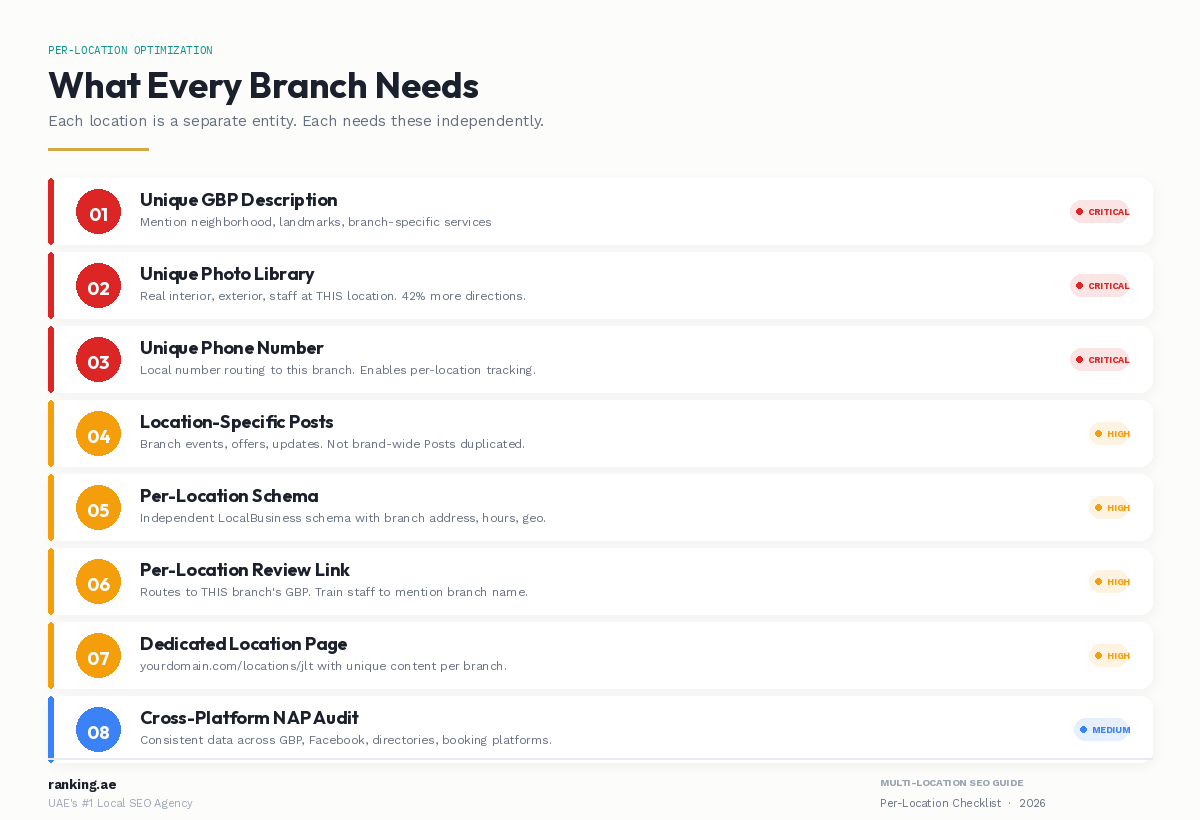
5. The Per-Location GBP Framework: What Every Branch Needs That Most Chains Skip
The GBP optimization playbook we published for single-location businesses covers the foundational work. For multi-location businesses, every item in that playbook must be executed independently at every location. Here is what that means operationally.
Unique descriptions
Each branch's GBP description should mention the specific neighborhood, nearby landmarks, and the specific services or specialties available at that location. A restaurant chain whose Downtown branch has a rooftop terrace and whose JLT branch has a dedicated family section should describe these distinctions in each profile. Entrepreneur's 2026 analysis confirms that Google detects copy-paste description patterns quickly and treats them as low-value content that reduces ranking confidence.
Unique photo libraries
Each branch needs its own photos showing the actual interior, exterior, staff, and customer experience at that specific location. According to Google's own data, businesses with photos receive 42% more requests for directions and 35% more clicks to their websites. Multi-location brands that upload the same corporate stock photos to every branch lose both the engagement signal and the location-specific trust signal. Google's AI can recognize duplicate photos across profiles. The investment in a professional photo session at each location (typically AED 1,500 to 3,000 per branch) pays for itself in ranking improvement within the first quarter.
Unique phone numbers
Each branch must have its own phone number that routes to that specific location. A shared central number across all branches confuses Google about which entity is which and makes call tracking impossible. Local phone numbers (Dubai landline or UAE mobile) are preferable to toll-free numbers for local SEO signal. The cost of an additional phone line is trivial compared to the ranking impact of unique phone tracking per location.
Location-specific Google Posts
Google Posts should be published for each location individually, referencing that branch's specific events, offers, and updates. A gym chain running a "Ramadan evening sessions" promotion at its JBR branch should publish a Post on the JBR GBP specifically, not a generic brand-wide Post duplicated across all profiles. Our seasonal content calendar covers the event-specific timing work. For multi-location businesses, each event on the DFRE calendar should trigger location-specific Posts at every branch that participates.
Per-location schema markup
Each branch needs independent LocalBusiness schema on its dedicated location page. The schema must reference the specific branch address, phone number, hours, services, and geo coordinates. Do not point all location schemas to the same parent Organization entity without also marking each as a distinct LocalBusiness. The Ask Maps preparation guide documented how Gemini and Ask Maps read directly from GBP and schema data. Multi-location businesses with proper per-location schema give AI systems clean, unambiguous data about each branch independently.
6. Website Architecture for Multi-Location Businesses: Subfolders, Not Subdomains
The correct website architecture for multi-location businesses in Dubai is a subfolder structure on a single domain. Each location gets its own dedicated page at a URL like yourdomain.com/locations/jlt or yourdomain.com/locations/downtown. This structure concentrates domain authority on a single domain while giving each location a dedicated, indexable page that Google can rank independently.
The common mistakes we see in our audit work across UAE businesses:
Mistake one: single "Locations" page. A page that lists all branches with addresses and maps but no unique content per location. Google cannot rank this page for any specific neighborhood because it covers all of them. Each location needs its own URL.
Mistake two: duplicate content across location pages. Location pages that are identical except for the address. Google treats these as thin content. Search Engine Land's 2026 analysis on local AI search confirmed that your website is now a source document for AI systems. Each location page needs unique descriptions of the branch, the neighborhood, the specific services or team at that location, and genuine location-specific FAQs. Pages with only the address swapped fail this test at every location except the first.
Mistake three: separate domains per location. Some franchise brands create jlt.yourbrand.com and downtown.yourbrand.com as separate subdomains. This splits domain authority across multiple weak domains instead of concentrating it on one strong domain. Unless there is a specific legal requirement (some franchise agreements mandate separate domains), subfolders on a single domain always outperform subdomains.
Mistake four: no internal linking between location pages. Location pages should link to each other ("Also visit our JLT branch" from the Downtown page). This internal linking signals to Google that the locations are part of a coordinated entity and helps users find the branch closest to them. The internal linking principles from our local SEO guide apply at the location-page level with the additional requirement that links between location pages use descriptive anchor text including the branch neighborhood name.
7. The Multi-Location AI Visibility Problem: Why SOCi Found That Chains Are Especially Vulnerable
SOCi's 2026 Local Visibility Index analyzed nearly 350,000 locations across 2,751 multi-location brands. The finding most relevant to this article: in retail, only 45% of brands leading in traditional local search also appeared in AI recommendations. More than half were invisible to ChatGPT, Perplexity, and Gemini despite ranking well on Google Maps.
Multi-location brands are especially vulnerable to AI invisibility because AI systems evaluate confidence at the location level, not the brand level. A brand with a strong flagship and four weak branches has one AI-visible location and four invisible ones. Localogy's analysis of the SOCi report captured the stakes: "the selectivity imposed by AI engines means there is less room for error." The brand equity that carries weaker branches in traditional search (where the brand name triggers familiarity and trust for any location) does not transfer to AI search, where each location is evaluated on its own merit against the confidence threshold.
The SOCi data also found that business profile accuracy on ChatGPT and Perplexity was only 68% for multi-location brands. The reason is that multi-location brands have more data points across more platforms, which creates more opportunities for inconsistency. Every inconsistency reduces AI confidence. The 30-day AI visibility audit we published should be executed independently for each branch of a multi-location business, not once for the brand as a whole.
The practical implication for Dubai chains and franchises: AI visibility work multiplies with the number of locations. A seven-location clinic needs seven schema implementations, seven content structure audits, seven cross-platform data reconciliations, and seven review enrichment strategies. This is the real cost of multi-location SEO that most franchises underestimate.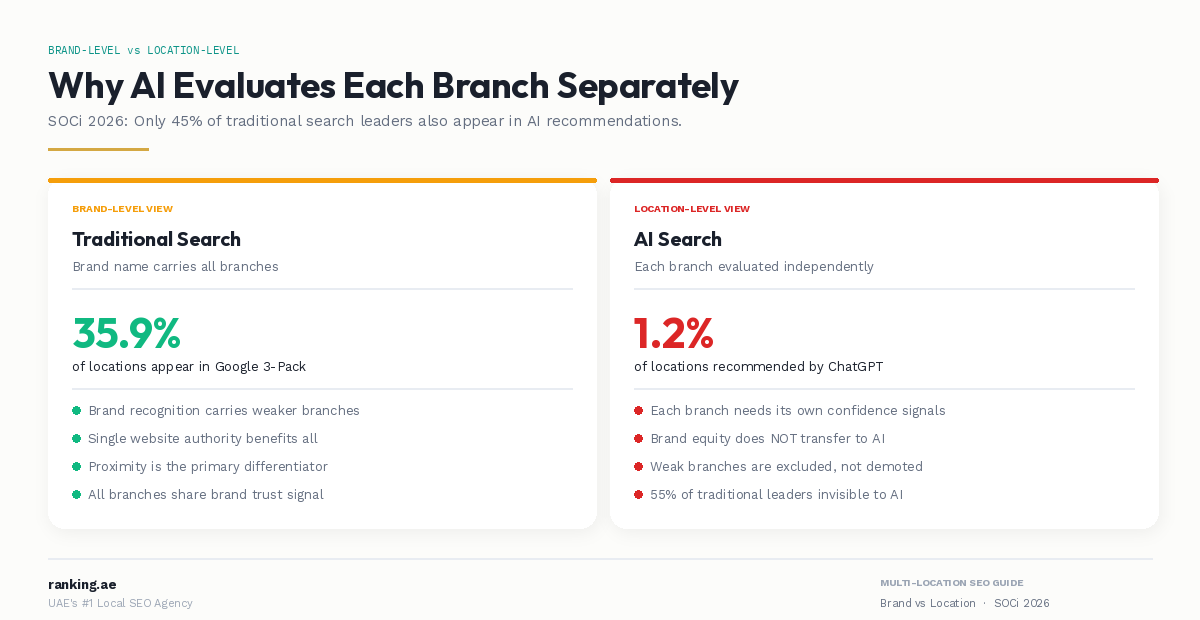
What Multi-Location Businesses in Dubai Should Stop Doing
Stop copy-pasting GBP descriptions. Every branch needs a unique description that references its specific neighborhood, hours, specialties, and distinguishing features. Shared descriptions are treated as thin content and reduce ranking confidence for every branch that uses them.
Stop using one review link for all branches. Each branch needs its own unique Google review link. A review that lands on the wrong branch's profile misdirects customer feedback and distorts the review signal for both locations.
Stop treating the flagship's SEO as the brand's SEO. The flagship's ranking does not benefit the other branches. Each branch needs its own investment in the same foundational work. The cost scales linearly with the number of locations. Budget accordingly.
Stop ignoring cross-emirate regulatory differences. A Sharjah branch licensed under SEDD should not display DED Dubai credentials. An Abu Dhabi branch should reference Abu Dhabi Department of Economic Development. A DIFC branch should reference DIFC Authority. Getting this wrong creates a subtle trust penalty that accumulates over time.
Stop uploading the same photos to every branch. Google's AI detects duplicate imagery across GBP profiles. Each branch should have unique photos showing the actual team, interior, exterior, and customer experience at that specific location.
Frequently Asked Questions
Do I need a separate GBP for each location?
Yes, without exception. Google treats each physical location as a separate entity. A shared GBP will only rank for one geographic area, leaving every other branch invisible. Each profile needs a unique phone number, unique photos, and a unique description. For businesses with ten or more locations, Google offers bulk verification to make this manageable at scale.
Should I use separate websites for each location?
No. Use subfolders on a single domain (yourdomain.com/locations/jlt). This concentrates domain authority while giving each location a dedicated, rankable page. Separate domains or subdomains split authority and make each branch weaker individually. The only exception is franchise agreements that legally require separate domains.
How do I handle review inequality between my locations?
Set per-location review velocity targets. New or underperforming branches should aim for 8 to 12 reviews per month until they reach competitive review volume for their Map Pack (typically 50 to 100 reviews for most Dubai categories). Established branches can maintain at 4 to 6 per month. Each branch needs its own review link that routes to its specific GBP. Train staff at each location to solicit reviews mentioning that specific branch.
What about businesses with rotating staff across locations?
Common in Dubai clinic groups and salon chains where practitioners rotate between branches. Each practitioner should be associated with every location they serve. The GBP at each location should list the practitioners available at that branch on specific days. Website location pages should show the weekly schedule for each branch. This prevents the scenario where a patient searches for a specific doctor and finds only the flagship location.
How does the Sharjah-Dubai border affect multi-location businesses?
Businesses with branches on both sides of the Sharjah-Dubai border face the Border-Zone Map Pack Effect we documented in the Sharjah guide. Google's proximity algorithm does not recognize emirate boundaries. A Sharjah branch and a Dubai branch near the border compete in the same Map Pack for the same customer searches. This is simultaneously an advantage (access to customers in both emirates) and a challenge (your branches cannibalize each other across the border). Service area configuration should acknowledge the cross-border dynamic.
How do I manage GBP for ten or more locations?
Use Google's Business Profile API or business management tools that connect to the API. Manual management of ten or more profiles introduces human error at scale. The API allows centralized updates to hours, descriptions, and Posts while maintaining per-location customization. For businesses without technical resources, third-party tools like BrightLocal, SOCi, or Yext provide managed interfaces on top of the API.
Does multi-location SEO cost more than single-location?
Yes, and the cost scales roughly linearly with the number of locations. Each branch needs its own GBP management, review strategy, content production, schema markup, and citation management. A business paying AED 3,000 per month for single-location SEO should budget roughly AED 1,500 to 2,500 per additional location for the per-location work on top of the brand-level investment. Our pricing guide covers the cost ranges. Underfunding multi-location SEO produces the visibility gap described in this article.
What is the most common mistake multi-location businesses make in Dubai?
Treating every branch as a copy of the flagship. Same GBP description, same photos, same review link, same schema. Google cannot differentiate a copy from the original, so it ranks the original and suppresses the copies. The fix is to give each branch a unique digital identity while maintaining brand consistency. Brand consistency means the same logo, the same service standards, the same quality. Unique identity means unique GBP content, unique photos, unique reviews, unique location-page content, and unique schema markup per branch.
How does Ask Maps change multi-location SEO?
Ask Maps evaluates attributes and review content per location when generating recommendations. A user asking "Find me a quiet coffee shop with Wi-Fi in JLT" will only see the JLT branch in results if that branch's GBP attributes include Wi-Fi and if that branch's reviews mention quietness. Completing attributes at the flagship and leaving them empty at other branches means only the flagship appears in conversational queries. Our Ask Maps preparation guide covers the attribute completeness work that should be executed independently at every branch.
The Seven-Location Clinic, Six Months Later
The clinic group from the opening of this article began per-location SEO work in February 2026. The JLT branch, which had been sitting at Map Pack position 8 with 23 reviews, received a dedicated location page with unique content mentioning the JLT neighborhood, Almas Tower, JLT Park, and the specific dermatology specialties available at that branch on specific days. The GBP description was rewritten to reference JLT specifically. Photos of the actual JLT clinic interior, the team stationed there on Tuesdays and Thursdays, and the entrance from Cluster D were uploaded. A per-location review link was created and the front desk team was trained to request reviews referencing the JLT branch specifically.
By August 2026, the JLT branch had accumulated 71 reviews at 4.5 stars. It held Map Pack position 3 for "dermatologist JLT" and position 4 for "skin clinic JLT." It was no longer invisible. More importantly, the clinic group's total Map Pack visibility across all seven locations had improved because each branch now competed effectively in its own catchment area rather than depending on the flagship to carry the brand.
The Healthcare City flagship remained at position 1. It did not lose visibility because other branches improved. Map Pack ranking is not zero-sum within a brand. Each branch competes in its own geographic catchment area against different local competitors. When the JLT branch improved, it did not take Map Pack positions from the Healthcare City branch. It took positions from other JLT clinics that had previously occupied the space the JLT branch was too weak to claim.
That is the core principle of multi-location SEO. Each branch is its own entity in Google's eyes. It needs its own investment, its own identity, and its own ongoing optimization. The brand provides a foundation of trust and recognition. The per-location work determines whether that foundation converts into Map Pack visibility in each specific neighborhood. The businesses that understand this allocation, brand investment plus per-location investment, are the ones whose every branch ranks. The ones that understand only brand investment have one strong flagship and a collection of invisible satellites. The difference is operational discipline applied at the location level, which is exactly what this article provides the framework for.
———
Request a free SEO audit and we will benchmark every location in your business against its specific Map Pack competition, identify the visibility gap between your strongest and weakest branches, and produce the per-location action plan that closes it. For franchise operators and clinic groups managing five or more locations, view pricing for the multi-location tiers that cover per-branch optimization alongside brand-level strategy. Explore the full blog library for operational guides on every topic referenced in this article.