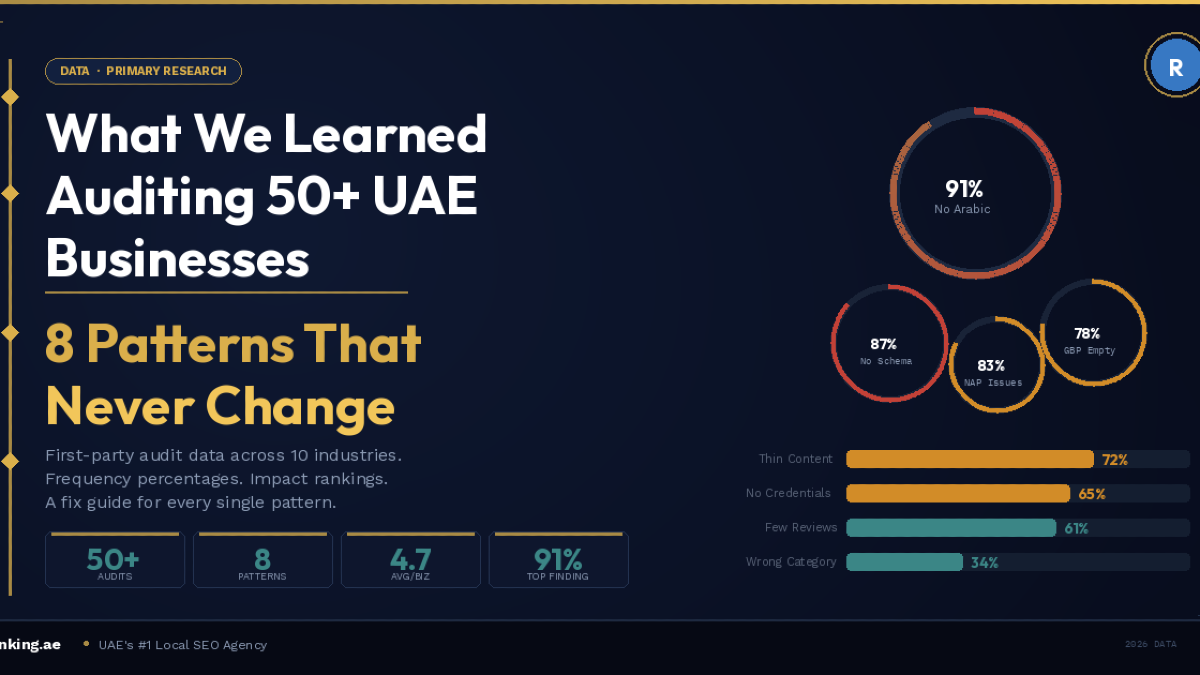
We started noticing it around audit number fifteen. The same problems. Different businesses, different industries, different budgets, different levels of sophistication. A Michelin-worthy restaurant in DIFC and a startup beauty salon in Deira. A 20-year-old law firm and a 6-month-old e-commerce brand. The specifics were different every time. The structural failures were identical.
By audit thirty, we could predict what we would find before opening the website. By fifty, it stopped being a discovery process and started feeling like an exercise in confirming a diagnosis. The patterns do not change. The frequency barely shifts from one quarter to the next. The businesses are different. The mistakes are the same.
We have now completed more than fifty comprehensive SEO audits for UAE businesses across ten industries, and we decided it was time to publish what we found. Not a generic "common SEO mistakes" list (we already wrote that one). This is primary data. Actual percentages from actual audits. Patterns we have observed first-hand, ranked by how often they appear, with the specific cost each one carries and the specific fix that resolves it.
If you run a business in the UAE and you have never had a professional SEO audit, you almost certainly have four or five of these eight patterns. At least one of them is quietly bleeding customers you will never know you lost.
A Note on How We Did This
Every audit follows the same 47-point framework. We scrape the live website, pull the Google Business Profile data, check the business name and phone number across 15 directories, test page speed on a real mobile device, verify schema markup in the source code, and benchmark the whole picture against whoever currently owns the top three Map Pack positions for the business's primary keyword.
The fifty-plus businesses span restaurants, medical clinics, dental practices, law firms, real estate agencies, hotels, salons, fitness centers, education providers, and e-commerce brands. Seventy percent are based in Dubai, fifteen percent in Abu Dhabi, the remainder in Sharjah and the northern emirates. The patterns below are ordered by frequency. Pattern 1 showed up the most. Pattern 8 showed up the least, but "least" still means more than one in three businesses.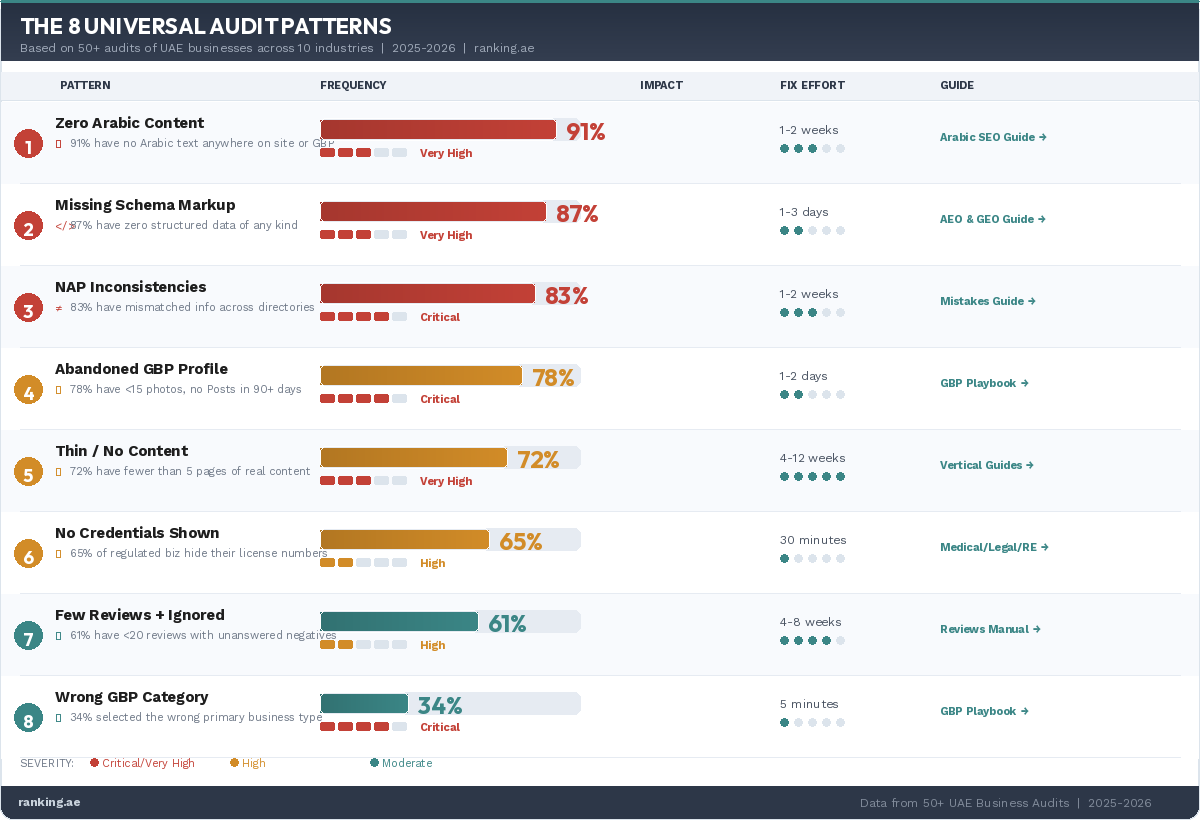
Pattern 1: Not a Single Word of Arabic Anywhere (91%)
This one shocks every business owner we tell. Ninety-one percent. Nine out of ten businesses we audited had zero Arabic content. Not on the website. Not in the Google Business Profile description. Not in a single meta tag, a single blog post, a single service page. The entire online presence was English-only, in a country where Arabic is the official language and a massive segment of the population searches exclusively in it.
Here is what makes this so expensive: the competition for Arabic keywords in the UAE is 40 to 50 percent lower than the equivalent English terms. That is not a guess. We have run the keyword research side by side. "Dentist Dubai" returns a full page of optimized competitors fighting for position. The Arabic equivalent returns a handful of half-finished pages and a lot of empty results. Same search intent. Same buyer readiness. A fraction of the competition. And 91 percent of UAE businesses are simply not there.
The cruelest part is that the fix starts small. An Arabic business description in your Google Business Profile takes thirty minutes. Translating your three most important service pages with proper hreflang tags takes a week. You are not rebuilding the internet in Arabic. You are opening a door that your competitors have not noticed exists.
One medical clinic we audited in Jumeirah added an Arabic GBP description and translated its top three procedure pages. Within 8 weeks, Arabic-language searches were generating 22 percent of their new patient inquiries. That entire audience segment had been invisible to them before. Not because the patients were not searching. Because the clinic was not showing up.
Pattern 2: Zero Schema Markup (87%)
Schema markup is the code that tells search engines (and, increasingly, AI assistants) exactly what your business is, where it operates, what services it offers, and how to verify its credentials. Without it, Google can guess. With it, Google knows.
Eighty-seven percent of the businesses we audited had no structured data of any kind. No LocalBusiness schema in the footer. No FAQPage markup on their FAQ sections. No BreadcrumbList on their inner pages. Nothing machine-readable beyond the raw HTML that search engines have been parsing since 1998.
In 2023, this was a missed optimization. In 2026, it is a competitive emergency. Here is why: AI search engines like ChatGPT, Google AI Overviews, and Perplexity rely on structured data to decide which businesses to cite when generating answers. AI-sourced traffic grew 527 percent between January and May 2025, and brands that AI engines do cite see 35 percent higher organic click-through rates than those they do not. Schema markup is the bridge between your website and that entire channel. Without it, you are not just missing fancy search result displays. You are invisible to the fastest-growing discovery channel in the market.
The implementation is not complicated. A developer can add LocalBusiness JSON-LD to your site template in under a day. FAQPage schema on existing FAQ content takes an afternoon. Our AEO and GEO guide maps the full implementation strategy, but the honest truth is that even basic LocalBusiness schema puts you ahead of 87 percent of your competitors immediately.
Pattern 3: The Business Name, Address, or Phone Number Does Not Match Across Directories (83%)
NAP inconsistency is the cockroach of local SEO problems: it survives everything, it is everywhere, and most people do not realize they have it until someone specifically checks.
When we check a business across Google, Bing, Apple Maps, UAE Yellow Pages, Foursquare, Facebook, Instagram, and the relevant industry directories, 83 percent have at least one meaningful discrepancy. Sometimes it is the business name: the legal entity on one directory, the trade name on another. Sometimes it is the address format: "Office 1601" here, "Suite 1601-1607" there, "Floor 16" somewhere else. Sometimes it is a phone number that was changed two years ago and updated on Google but not on the eight other directories that still list the old one.
Each mismatch is a small signal to Google that the business information is unreliable. Stack five or six of them together and you have a headwind that suppresses your Map Pack rankings regardless of how good your content or reviews are. Google reconciles these signals to determine legitimacy. Conflicting data says "we are not sure this business is real, or at least not sure where it actually is."
The fix is tedious but not technical. Audit every directory. Pick one canonical version of your name, address, and phone number. Update everything to match exactly. Then set a quarterly reminder to re-check, because directories auto-populate from data aggregators that can reintroduce old, incorrect information without warning.
"Businesses with complete and consistent Google Business Profiles are 2.7 times more likely to be considered reputable by consumers."
— Google, via SeoProfy industry analysis
Pattern 4: Google Business Profile Claimed But Abandoned (78%)
Here is the typical scenario. Someone at the business claimed the Google Business Profile in 2022 or 2023. They uploaded 6 photos (the building exterior, the logo, and four random interior shots). They wrote a one-sentence business description. They set the hours. And they never touched it again.
That profile is not optimized. It is a placeholder. And 78 percent of the businesses we audited had exactly this: a claimed profile with fewer than 15 photos, no Google Posts in the past 90 days, an incomplete or missing service menu, and at least one critical field that was blank or outdated.
Google's own data shows that complete profiles get approximately 200 interactions per month. Incomplete ones get a fraction of that. A verified, complete profile makes consumers 2.7 times more likely to consider the business reputable. And weekly Google Posts correlate with higher engagement and ranking signals. The profile is not a set-it-and-forget-it asset. It is the most important piece of digital real estate your local business owns, and 78 percent of UAE businesses are treating it like a storage closet.
Our GBP optimization playbook covers every single field, but the highest-return actions are: upload 50 or more photos with descriptive file names (not "IMG_4532.jpg" but "ranking-ae-office-burj-gate-dubai.jpg"), write a full English and Arabic business description with your primary keywords woven naturally into the text, complete the entire service or product menu, and publish at least one Google Post per week. In the LicensePlate.ae campaign, the GBP overhaul alone drove a 40 percent increase in profile impressions in month one.
Pattern 5: Almost No Content Beyond the Homepage (72%)
A real estate agency with 15 agents and coverage across 30 Dubai communities, and the entire website is a homepage, an about page, a contact page, and a listings feed. No page explaining what they do in Dubai Hills. No page explaining what they do in Palm Jumeirah. No blog. No guides. No FAQ. Three pages of original content to rank for thousands of potential searches.
Seventy-two percent of the businesses we audited had fewer than five pages of substantive, original content. The homepage carried all the weight, and everything else was either a placeholder, a thin template, or did not exist at all.
Google cannot rank what does not exist. A dentist with no page about teeth whitening in Dubai will never rank for that search. A law firm with nothing about commercial disputes in DIFC is invisible when a prospective client searches for exactly that expertise. You do not need 500 pages. But you need one good page for every core service you offer, each one written with the depth and specificity that demonstrates you actually know the subject rather than just listing it in a navigation menu.
The vertical guides we produce for our clients demonstrate what this depth looks like in practice: our restaurant SEO guide runs 5,000 words because that is what it takes to cover restaurant-specific search behavior in Dubai with real data. Our medical SEO guide runs 4,800 words because DHA regulatory requirements and YMYL content standards demand that depth. Your service pages do not need to be 5,000 words. But they need to be 600 to 1,500 words of genuinely useful content that a human being would actually read and find valuable. Not keyword stuffing. Not marketing fluff. Information.
Pattern 6: No Regulatory Credentials Displayed (65% of Regulated Businesses)
This one only applies to businesses in regulated industries, but those industries include some of the highest-value verticals in the UAE: healthcare, legal, real estate, financial services, and hospitality.
Of the regulated businesses we audited, 65 percent did not display their licensing credentials anywhere visible on their website or Google profile. DHA-licensed clinics without a DHA number on the site. RERA-registered agencies without RERA appearing anywhere. DIFC-licensed law firms that never mention their Courts registration. DTCM-classified hotels that do not reference their classification.
Google evaluates YMYL content (anything touching health, finances, safety, or legal rights) against higher quality standards than other categories. Part of that evaluation includes verifiable credentials. A medical website claiming expertise but displaying no license number is assessed differently from one that says "DHA License #12345" in the footer, on the about page, and in the schema markup. We have mapped this regulatory E-E-A-T pattern across medical (DHA), real estate (RERA), hotels (DTCM), and legal (SJD/DIFC/MOJ) in our vertical guides. Each license type functions as a trust signal that competitors who do not display theirs cannot match.
The fix takes thirty minutes. Put your license number in your website footer. Put it on your about page with the authority name. Add it to your schema markup using the hasCredential property. That is it. Thirty minutes for a permanent E-E-A-T advantage over the 65 percent of your regulated competitors who have not done this.
Pattern 7: Fewer Than 20 Reviews with Unanswered Negatives (61%)
Reviews are one of the three strongest signals Google uses to determine Map Pack ranking. Not just the number. The velocity (how quickly new ones arrive), the recency (how fresh the latest one is), the response rate (whether you reply to everything), and the sentiment trend (whether recent reviews are getting better or worse). Google watches all four dimensions.
Sixty-one percent of the businesses we audited had fewer than 20 reviews, and among those, at least one negative review had been sitting unanswered for a month or more. That unanswered negative is a double penalty. It hurts your ranking signal (Google sees unresponsive engagement). And it hurts your conversion (88 percent of consumers say they would use a business that replies to all reviews, but only 47 percent would consider one that does not respond at all). Every day that negative sits without a reply, it is silently turning away customers who found your listing, read the review, and moved on.
The system we built for generating and managing reviews uses WhatsApp as the delivery mechanism because in the UAE, WhatsApp review requests produce 15 to 25 percent response rates versus 5 to 10 percent for email. The timing matters too: request a review at the moment of peak satisfaction, not three days later when the experience has faded. For a restaurant, that is right after the meal. For a clinic, it is after the follow-up confirmation that the treatment went well. For a law firm, it is the day the case resolves favorably. In the LicensePlate.ae campaign, this system moved the review count from 11 to 156 in five months. That was not viral luck. It was systematic execution.
Pattern 8: Wrong Primary Category on Google Business Profile (34%)
The least frequent pattern on this list, and per instance, the most destructive.
Thirty-four percent of audited businesses had selected a Google Business Profile primary category that did not accurately represent their core service. A dental clinic categorized as "Medical clinic" instead of "Dentist." A hotel apartment listed as "Hotel" instead of "Apartment hotel." A legal consultancy that chose "Law firm" when they cannot represent clients in court. A salon offering Botox and fillers categorized as "Beauty salon" instead of "Medical spa."
Here is why this is so damaging: your primary category is the single strongest signal Google uses to decide which searches to show your business for. It is the first filter. Before Google evaluates your reviews, your content, your links, or anything else, it checks your category. A dentist categorized as "Medical clinic" will simply not appear for "dentist near me" searches. Period. That business can have 500 five-star reviews and a perfectly optimized website, and it will never show up for the keyword its patients actually search, because Google matched it to the wrong category at the gate.
The fix takes five minutes. Log into your Google Business Profile. Change the primary category. The ranking impact begins within days, not months. It is the single fastest ROI action in all of local SEO, and a third of UAE businesses are getting it wrong. Our GBP playbook covers category selection for every vertical, and our industry guides map the specific categories for restaurants, clinics, real estate, and hotels.
Why Fixing One Pattern Is Not Enough
These eight patterns are not independent problems sitting in separate boxes. They are interconnected in ways that make the combined damage worse than the sum of the parts.
Think about it this way. A business with no Arabic content (Pattern 1), no schema markup (Pattern 2), and an abandoned GBP (Pattern 4) does not have three problems. It has a compounding problem. The missing Arabic means zero visibility for Arabic searches. The missing schema means zero AI citations. The abandoned GBP means weak Map Pack presence even for English searches. Each gap reinforces the others. The business is invisible on three fronts simultaneously, and fixing just one of them produces only a fraction of the possible improvement because the other two are still dragging everything down.
This is why comprehensive SEO work takes 3 to 6 months to show compounding results) and why the businesses that see the most dramatic improvements are the ones that address all patterns at once rather than one at a time. In the LicensePlate.ae case study, we fixed all eight patterns simultaneously. The result was not eight small improvements. It was a compounding acceleration curve: 35 percent growth in month 2, 120 percent in month 3, 280 percent in month 4, 480 percent in month 5. Each fix amplified every other fix. That is what happens when the compound signals all fire together.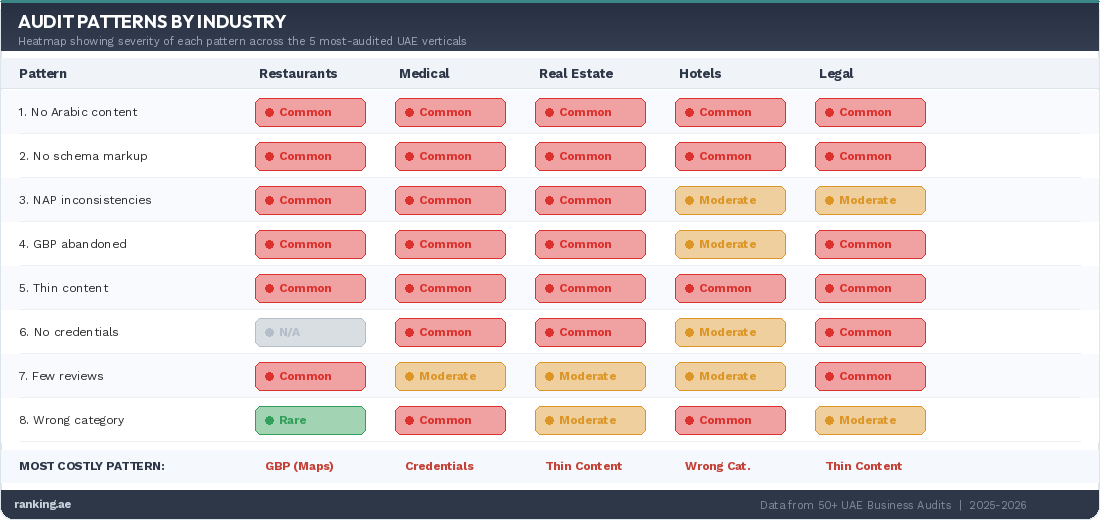
How Many Patterns Does the Average UAE Business Have?
Across all fifty-plus audits, the average business had 4.7 of the 8 patterns. Businesses that had never invested in SEO typically had 6 or 7. Businesses that had worked with an agency or freelancer previously typically had 2 to 4, with Arabic content and schema markup being the patterns most commonly left unaddressed even by providers who fixed the basics.
That last point is worth sitting with. Even businesses that had paid for professional SEO work still had unresolved patterns. Arabic content and schema implementation require specific skills that not every provider has. If your agency fixed your GBP and built some links but never touched Arabic optimization or structured data, you still have two of the highest-impact patterns suppressing your potential. The work was not wasted. It just was not finished.
Find Out Which Patterns Are Costing You
You have read the eight patterns. You have probably counted at least three in your own business. The question now is which specific ones, how severe each is relative to your competitive landscape, and which ones you should address first to get the fastest return.
Request a free SEO audit and we will run the same 47-point assessment we used to generate these findings against your specific business. You will receive a report that identifies exactly which patterns apply to you, benchmarks your profile against the businesses currently holding the top three Map Pack positions for your primary keywords, and lays out a prioritized action plan showing which fixes produce the fastest visibility improvement for your industry and area.
For the detailed fix methodology behind each pattern, our blog library covers every single one in depth. Start with the GBP playbook for Patterns 4 and 8, the review generation system for Pattern 7, and the Arabic SEO opportunity for Pattern 1. If you want to understand the pricing for professional help resolving these, our cost breakdown is transparent. If you want to see what all eight patterns look like resolved simultaneously, the LicensePlate.ae case study documents the month-by-month trajectory.
Frequently Asked Questions
Are these patterns unique to the UAE?
Some are universal. Abandoned GBPs, thin content, NAP inconsistencies, and review problems show up everywhere in the world. But two patterns are distinctly UAE-specific: the Arabic content gap (Pattern 1) and the regulatory credential gap (Pattern 6 covering DHA, RERA, DTCM, DIFC, and other UAE licensing authorities). These two patterns create outsized opportunity specifically because global SEO advice ignores them entirely. Businesses following international playbooks miss the two patterns that matter most in this market.
How many patterns does the average business have?
4.7 out of 8. Businesses with no prior SEO investment average 6 to 7. Businesses that have worked with a provider previously average 2 to 4, usually with Arabic content and schema still unresolved. The uncomfortable truth is that most "SEO work" in the UAE market addresses Patterns 3, 4, and 7 (citations, GBP basics, and reviews) and leaves the higher-impact Patterns 1, 2, and 5 untouched.
Which pattern should I fix first?
If your GBP primary category is wrong (Pattern 8), fix that before anything else. It takes five minutes and the impact starts within days. After that: complete the GBP (Pattern 4), correct NAP inconsistencies (Pattern 3), then address reviews (Pattern 7), Arabic content (Pattern 1), schema (Pattern 2), substantive content (Pattern 5), and regulatory credentials (Pattern 6). This priority order aligns with our local SEO checklist which ranks all 47 recommended actions by measured impact.
Can I fix these patterns myself?
Patterns 4, 7, and 8 (GBP completion, review responses, category correction) are accessible to anyone willing to spend the time. Our GBP playbook and reviews manual walk through every step. Patterns 1, 2, 3, and 5 (Arabic content, schema, citations, substantive content) require either technical skills or professional tools that most business owners do not have. Pattern 6 (credentials) is a 30-minute fix anyone can do. Our comparison of agency vs freelancer vs DIY helps you decide which model makes sense for your situation and budget.
How do I know if my current agency has already fixed these?
Ask them directly. "Is there Arabic content on my GBP?" "Which schema types are implemented on my site?" "How many NAP inconsistencies were there and have they all been corrected?" "What is my current review count and response rate?" If your agency cannot answer these with specific numbers, the patterns are likely still present. Our agency evaluation guide provides the complete list of diagnostic questions to ask.