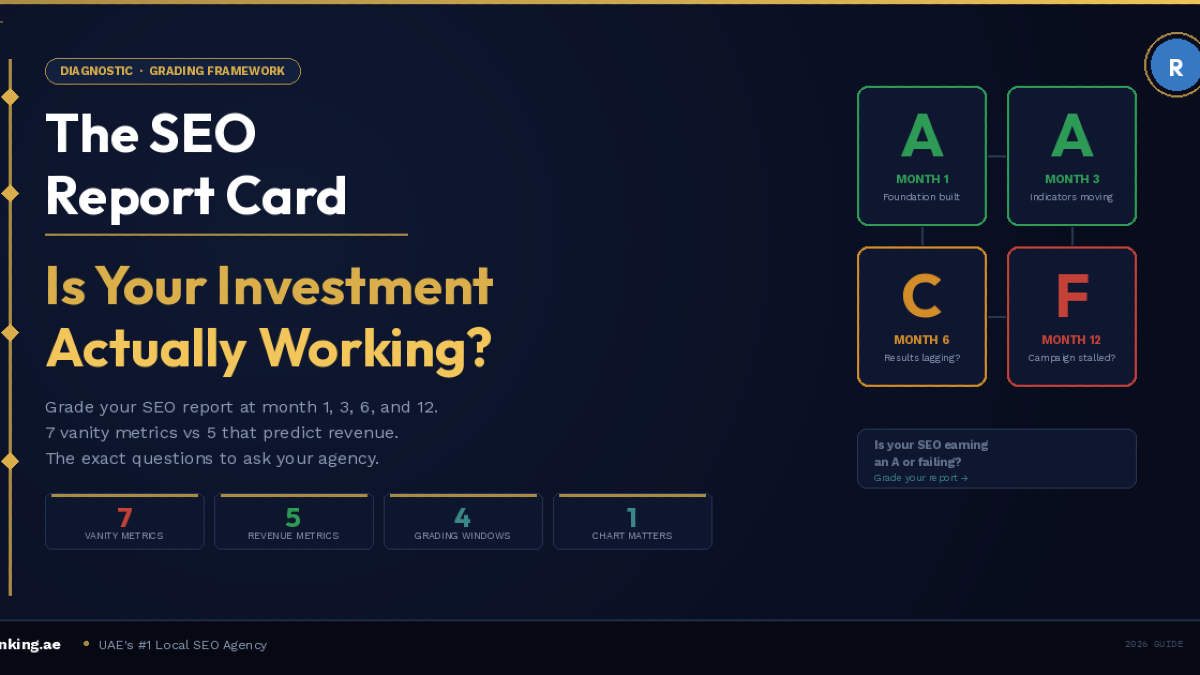
Go get your last SEO report. The one your agency or freelancer sent last month. Pull it up on your screen. I will wait.
Got it? Good. Now I am going to grade it.
Not grade the agency. Not grade the strategy. Grade the report itself, because the report is the only window you have into whether your money is producing results or producing paperwork. And after reviewing hundreds of SEO reports from agencies across the UAE, I can tell you that most of them are designed to look good regardless of whether anything meaningful is happening underneath.
That is not always malicious. Many agencies genuinely believe the metrics they report are useful. The problem is that the metrics most agencies default to are metrics that almost always trend upward even when results are flat. They are feel-good numbers. They pad the report. They make the monthly call comfortable. And they tell you absolutely nothing about whether your phone will ring more next month than it did this month.
This article is a grading rubric. It is organized by time: month 1, month 3, month 6, and month 12. At each stage, I will tell you exactly what a healthy SEO campaign should be showing, what the warning signs look like, and what the red flags are that something has gone genuinely wrong. If you are paying for SEO in Dubai and you are not sure whether it is working, this is how you find out.
First, the Numbers That Should Make You Suspicious
Before we look at the timeline, we need to talk about the seven metrics that show up on almost every SEO report and that Search Engine Land identified as needing retirement in 2026. These are not useless metrics. They measure something real. But they are consistently presented in ways that obscure whether anything meaningful is happening.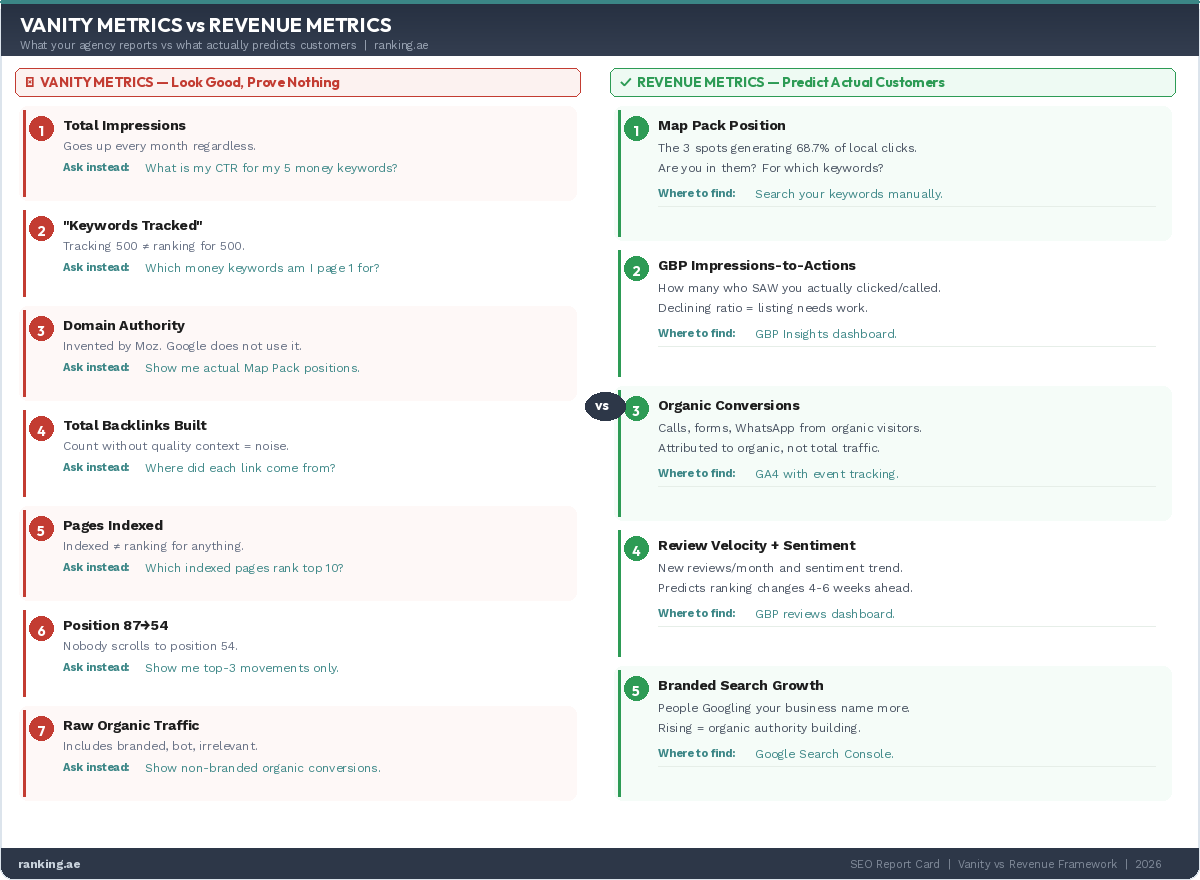
"Keywords tracked" is perhaps the most meaningless number in all of SEO reporting. An agency can "track" 500 keywords. That does not mean you rank for 500 keywords. It means they put 500 keywords into a tracking tool. Many of those keywords have zero volume. Many of them your site sits at position 87 for. The number that matters is how many of your top 5 money keywords you rank on page one for. Not 500 keywords. Five.
Domain Authority is a score invented by Moz. Google does not use it. Google has never used it. Google has publicly stated they do not use anything like it. Reportr's 2026 analysis calls it "one company's guess at ranking potential" that agencies should phase out of client reports. An agency reporting DA improvements as a primary metric is measuring their own scorecard, not Google's.
Total backlinks built conflates quantity with quality. Fifty directory links that any business can get carry less ranking weight than one contextual mention from a relevant local publication. Ask your agency where the links came from and what pages they pointed to. The total count tells you nothing about whether the links actually helped.
Position movements for irrelevant keywords are the most common padding technique. "We moved you from position 87 to position 54 for [keyword]." Great. Nobody has ever scrolled to position 54 in Google. And nobody searches for that keyword anyway. The only position changes that matter are changes for your money keywords (the 3-5 search terms your actual customers type when they are ready to buy) and specifically changes into or out of the top 3 for local searches and into or out of page one for broader terms.
"Traffic growth means nothing if conversion rates drop or you are ranking for low-intent queries. Revenue and pipeline are the metrics that matter. Reporting to boards, CEOs, or finance teams requires commercial framing, not SEO jargon."
— Buried Agency, SEO ROI Analysis 2026
Now, with the vanity metrics identified, let us grade your report based on what month you are in.
Month 1: The Foundation Grade
What you should be grading: Did the work start in the right place?
Month 1 is not about results. It is about preparation. A surgeon does not perform an operation in the first appointment. They run diagnostics, order tests, review history, and build a plan. Month 1 of SEO is the diagnostic phase. If your report shows results in month 1, something is wrong, because there has not been enough time for results to materialize. What you should see instead is evidence of thorough preparation.
A Grade (Healthy)
Your month-1 report should show: a completed technical audit with specific issues identified and prioritized (not "we ran an audit" but "we found 14 issues, here are the top 5 we are fixing first"). A GBP completeness assessment showing what was missing and what has been added (photos uploaded, description written, categories verified). A citation audit showing how many directories had incorrect information and what corrections were submitted. Baseline keyword positions documented for your 5 money keywords, so there is a clear before-and-after benchmark. And a strategic plan showing what months 2 through 6 will focus on and in what order.
C Grade (Concerning)
The report shows "domain authority increased 2 points" and "impressions grew" with no mention of GBP optimization, no citation audit, and no technical findings. This suggests the agency started with link building or content before diagnosing the foundation. It is like prescribing medication before running blood work. The work is not worthless, but the sequence is wrong, and the metrics being reported are not the ones that indicate whether month 1 was spent wisely.
F Grade (Failing)
The report is a generic template with your logo pasted on top. It shows "organic traffic" with a graph but no segmentation between branded and non-branded. It mentions no specific actions taken on your GBP, no citation corrections, no technical findings. It reads like it was written by someone who has not looked at your actual business. If your month-1 report could apply to any business in any industry in any city, it is not a report. It is a receipt.
The question to ask your agency: "What specific changes did you make to our Google Business Profile this month, and what technical issues did you find on our website?" If they cannot answer with specifics, they have not done the work.
Month 3: The Leading Indicators Grade
What you should be grading: Are the early signals moving?
Month 3 is where most SEO campaigns start showing their first measurable movement. Not rankings yet (those come later). Leading indicators. Think of them as the vital signs that predict whether the patient is recovering, even though they have not left the hospital yet.
A Grade (Healthy)
GBP impressions up 30 to 50 percent from the month-1 baseline. This is the single most reliable early indicator for local businesses. If more people are seeing your Google Business Profile in search results, the optimization is working. Review count growing (the review generation system should be producing 5 to 10 new reviews per month by now). First pieces of content published and indexed in Google (verify this in Search Console, not just on your website). New long-tail keywords beginning to appear in Search Console that were not there before. These are the sprouts. They are not fully grown rankings yet. But they confirm the soil is fertile.
C Grade (Concerning)
"We built 40 backlinks this month" with no GBP impression data, no review growth, and no content published. This is activity without outcomes. Backlinks are a tactic, not a result. The report should show what the backlinks produced, not just that they were built. Similarly, "we published 3 blog posts" is activity. "The blog post about [keyword] has been indexed and is appearing for 12 long-tail queries" is an outcome. If your month-3 report reads like a task list rather than a progress assessment, the agency is reporting effort instead of effect.
F Grade (Failing)
No mention of GBP impressions. No review growth. No Search Console data showing new keyword appearances. The report looks similar to month 1 but with different numbers plugged into the same template. The most damning version: "We are still building your foundation." If the foundation is not built after three months, either the scope was enormous (legitimate for very large or complex businesses) or the work is not being done at the pace your investment warrants.
The question to ask: "How have our GBP impressions changed since month 1, and how many new keywords are we appearing for in Search Console that we were not appearing for before?" These two questions directly measure whether the optimization is translating into visibility.
Month 6: The Results Grade
What you should be grading: Are rankings and customers actually arriving?
Month 6 is the checkpoint. The leading indicators from month 3 should have matured into actual results by now. If they have not, something is either legitimately difficult (extreme competition) or strategically wrong (fixable). This is the month where patience transitions from a virtue to a risk. Industry benchmarks confirm that most SEO campaigns should show meaningful ranking movement between months 4 and 6, with the strongest gains appearing in months 7 through 12.
A Grade (Healthy)
Map Pack position for at least one of your top 5 money keywords. Organic traffic up 50 to 100 percent from your month-1 baseline (not from a cherry-picked "best month" but from the actual starting point). Phone calls, form submissions, or WhatsApp inquiries from organic search growing measurably. The LicensePlate.ae case study showed 120 percent organic growth by month 3 and 480 percent by month 5, but that was an aggressive campaign in a relatively low-competition niche. For most Dubai service businesses in competitive verticals, 50 to 100 percent traffic growth by month 6 is a strong A.
C Grade (Concerning)
"Impressions are still growing" with no Map Pack position gained and no measurable increase in organic conversions. Growing impressions without growing clicks or conversions means you are being shown in search results but nobody is clicking. This could mean your meta descriptions are weak, your GBP photos are outdated, your star rating is below competitors, or you are ranking for queries that do not match your business. The agency should be diagnosing why visibility is not converting to traffic.
F Grade (Failing)
Month 6 looks like month 3. Same metrics, same ranges, same trajectory. No Map Pack movement. No conversion growth. The report is longer than it was at month 3, but the story it tells is the same: "things are improving." Six months of investment without a single Map Pack position or measurable lead increase for any of your money keywords means the strategy is not working, and continuing without a course correction is just paying rent on a process that is not producing returns.
The question to ask: "For which of our top 5 money keywords do we now appear in the Map Pack, and how many organic leads or calls did we generate this month compared to month 1?" If neither answer contains a number, you have a problem.
"Business outcomes matter more than SEO metrics. Practitioners who report on leads, revenue, and cost per acquisition earn more trust than those reporting rankings and traffic."
— WebFX, 2026 SEO Benchmarks Report
Month 12: The Compounding Grade
What you should be grading: Is the investment compounding or plateauing?
By month 12, the compounding effect should be unmistakable. Each month should be producing more organic traffic and more organic customers than the previous month, because content is accumulating, reviews are stacking, authority is building, and each new tactic amplifies every previous one. If month 12 looks approximately the same as month 6, the campaign has plateaued, and the agency is either maintaining instead of growing (which should be reflected in a lower maintenance fee) or coasting on your budget.
A Grade (Healthy)
Map Pack presence for 3 or more money keywords. Organic traffic compounding month over month (each month higher than the last). Cost per customer from organic dramatically lower than paid channels. Your business appears in AI-generated search results (Google AI Overviews, ChatGPT) for at least some relevant queries. Branded search volume (people Googling your business name) has increased, a leading indicator that organic authority is building downstream awareness. Our AEO guide maps how AI citation frequency becomes a measurable KPI at this stage.
C Grade (Concerning)
Results are real but have flattened. Map Pack position holds for 1-2 keywords but has not expanded. Traffic is up from month 1 but has not grown meaningfully since month 8. This could mean the agency has hit the ceiling of what the current strategy can produce and needs to expand scope (more content, new verticals, Arabic optimization, additional locations). A healthy C requires a conversation about what comes next, not just a continuation of what was already done.
F Grade (Failing)
Month 12 looks like month 6. The same Map Pack positions. The same traffic range. The same conversion numbers. The agency is doing maintenance-level work at growth-level pricing. You are paying for progress and receiving preservation. This is the most common failure mode in long-term SEO engagements: the agency achieves initial results, shifts to a maintenance routine, and continues billing at the same rate. Your agency evaluation guide provides the diagnostic framework for this specific situation.
The question to ask: "Show me a chart of our organic leads per month for the past 12 months. Is the line going up, flat, or down?" One chart. One question. The answer tells you everything.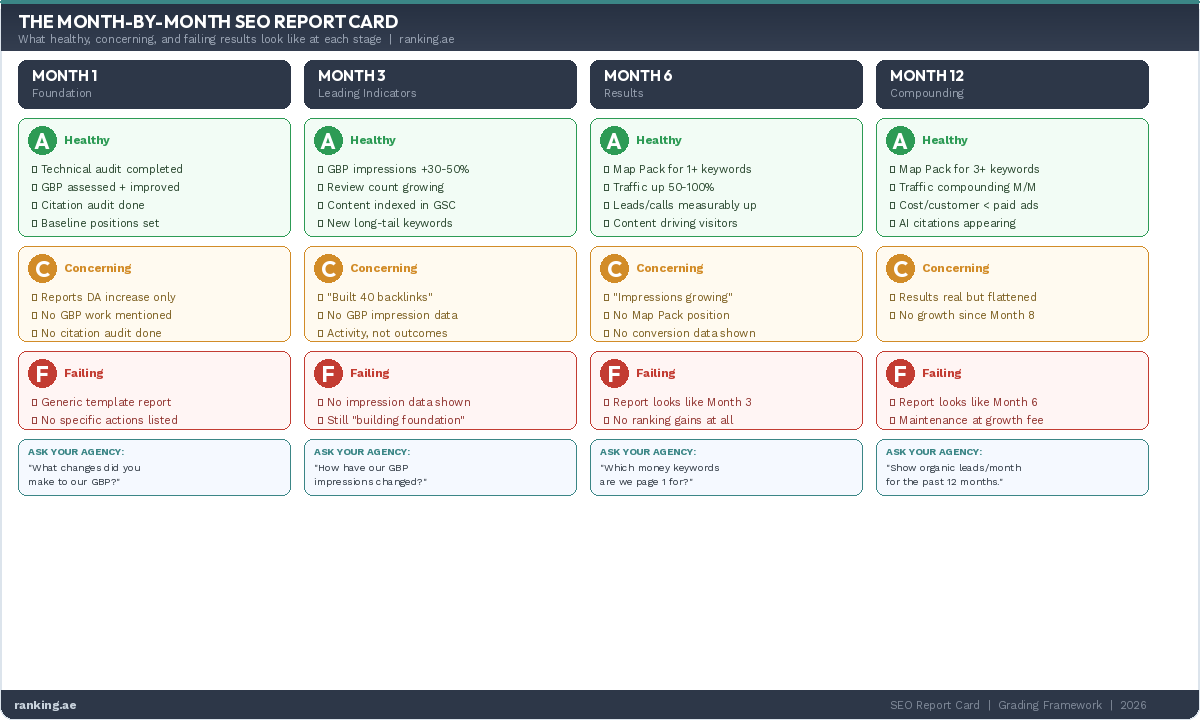
The One Chart That Replaces Every Vanity Metric
If your agency showed you one single chart every month, and nothing else, and that chart was organic leads (phone calls + form submissions + WhatsApp clicks from organic search) per month over time, you would know everything you need to know.
If the line goes up: SEO is working. Keep investing.
If the line is flat: SEO is maintaining. Either scale back to a maintenance fee or expand scope for growth.
If the line goes down: Something broke. Diagnose immediately using the 8 audit patterns framework or request a second-opinion audit.
Every other metric exists to explain why the line is moving in the direction it is moving. Impressions, rankings, backlinks, content published, technical fixes, all of these are explanatory variables. They answer "why?" The leads chart answers "is it working?" Start with the answer. Then, if the answer is confusing, dig into the why.
Our monthly reports at ranking.ae lead with this chart. Every report opens with organic leads over time. Then it explains what produced those leads: which Map Pack positions moved, which content drove traffic, which reviews were added, what technical work was completed. The leads chart is the grade. Everything else is the teacher's notes in the margin.
Get Your Report Graded
If you read through the four grading windows and your reports earned a C or below at your current stage, you have two options. You can take the diagnostic questions from each section to your next agency call and see how they respond. A good agency will appreciate the specificity. A bad agency will get defensive.
Or you can request a free second-opinion audit from us. We will review your current organic visibility independently, identify which of the 8 common audit patterns apply to your business, and give you an honest assessment of whether your current investment is on track, needs adjustment, or needs replacement. If your agency is doing good work that just needs time, we will tell you that. If the strategy has structural problems, we will show you exactly where they are.
For the full context on what SEO should cost in Dubai, what each tier covers, and what results to expect at each price point, our pricing breakdown provides complete transparency. For what a compounding trajectory actually looks like when all systems are working, the LicensePlate.ae case study documents month-by-month execution and results.
Frequently Asked Questions
My agency says domain authority is important. Are they wrong?
Domain authority measures something real (a rough estimate of your site's likelihood to rank), but it is a third-party metric that Google does not use. It is useful as an internal benchmark, not as a client-facing deliverable. If your agency reports DA alongside revenue metrics and Map Pack positions, that is fine. If DA is the headline metric while conversion data is buried or absent, the reporting priorities are inverted.
My SEO provider says my competition is extremely tough and that is why results are slow. How do I verify?
Search your top 3 money keywords on Google. Look at who holds the Map Pack positions. Check their review counts, content depth, and how long they have been established. If the Map Pack is held by businesses with 500+ reviews and years of content, your provider may be right that competition is fierce. If the Map Pack businesses have 30 reviews and thin websites, the "tough competition" explanation does not hold up. Our Maps ranking factors guide explains exactly what determines who holds those positions.
Is it normal to see no results at month 2?
Completely normal. Month 2 is still foundation phase for most campaigns. The concern is not absence of results at month 2. It is absence of results at month 6. Our SEO timeline guide maps exactly when each phase of results should appear for different industries and competition levels.
Should I ask my agency to share their actual work log, not just the report?
Yes. A transparent agency can show you a task-by-task log of what was done in the month: GBP posts published, citations corrected, pages optimized, links built (with source URLs), content written, technical issues resolved. The report summarizes outcomes. The work log proves the work happened. If an agency resists sharing the work log, ask yourself why.
How does AI search change what I should measure?
It adds a new metric: branded search growth. When AI assistants recommend your business, users often search your brand name afterward rather than clicking a link. If your branded search queries are rising in Google Search Console while your agency has not been running brand campaigns, that growth likely comes from AI citations. Our AEO and GEO guide covers how to measure and optimize for this channel.