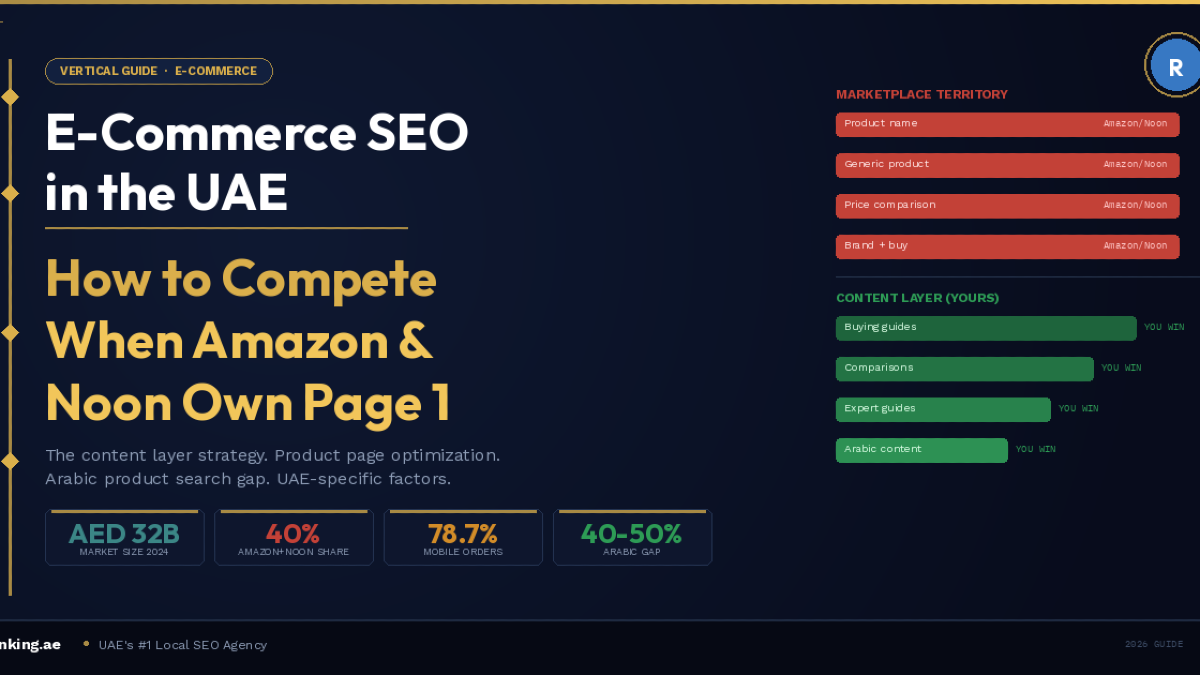
In January 2026, Noon activated 20 additional dark stores across Dubai and Abu Dhabi, shrinking its average delivery window to 12 minutes and raising real-time inventory coverage to 85% of urban households. The same month, Amazon.ae launched same-day export shipping to Riyadh and Manama from its Dubai South hub, cutting cross-border lead times by 60%.
Between them, these two platforms now control roughly 40% of the UAE's e-commerce market, according to multiple industry analyses. The top five online stores capture 49% of all net e-commerce sales in the country. Amazon.ae alone draws 21 million monthly visitors. An independent store selling the same products at the same price, with the same shipping speed, will not outrank either platform for a product keyword. That competition is over before it starts.
But there's a different competition happening. One that Amazon and Noon are structurally unable to win. And most independent UAE stores don't even know it exists.
The Platform Trap
A specialty home goods retailer in Al Quoz learned this the hard way. Ninety-two percent of revenue came through Noon marketplace listings. The store's own website generated eight orders a month. When Noon adjusted its seller commission structure in late 2025, the retailer's margins compressed overnight. Not because demand dropped. Not because the product got worse. Because the platform decided to take a larger cut, and the retailer had no leverage to push back. Noon had the customers. The retailer had the products. Without organic search traffic coming directly to its own domain, it had no alternative channel to absorb the hit.
This is the same structural dependency we've documented across three other verticals in the UAE. Hotels that depend on Booking.com face the same margin pressure. Real estate agents who depend on Bayut face the same data ownership problem. Restaurants that depend on Talabat face the same customer relationship gap. The platform captures the search visibility, the client relationship, and the transaction data. The business provides the service and pays a commission for the privilege.
The e-commerce version of this trap is the most financially dangerous of all, because e-commerce margins are already thin. A 15% marketplace commission on a product with 25% gross margin leaves 10% for everything else: rent, staff, logistics, returns, marketing. When that commission rises to 18% or 20%, the math stops working. The business that has built zero organic presence outside the marketplace has no escape route.
"The UAE e-commerce market reached AED 32.3 billion in 2024 and is projected to surpass AED 50.6 billion by 2029. Mobile shopping accounts for 78.67% of orders."
— EZDubai report via Emirates News Agency (WAM)
The Content Layer: What Amazon Cannot Publish and You Can
Search any product category on Google from a Dubai IP. "Best running shoes for Dubai heat." "Perfume for humid climate." "Organic baby food UAE delivery." Count how many of the first-page results are marketplace listings and how many are editorial content. In most categories, you'll find that Amazon and Noon dominate the transactional results ("buy running shoes"), but the informational and investigational results ("best running shoes for hot weather," "which brands last longest on outdoor tracks") are held by blogs, review sites, and the occasional independent store that publishes real content.
We call this the Content Layer. It's the search territory that marketplaces cannot occupy because their architecture doesn't support it. Amazon.ae is built to display product listings. It cannot publish "The 10 Best Running Shoes for Training Outdoors in Dubai Summer: A Runner's Guide for 40-Degree Heat." Noon cannot produce "Organic vs Non-Organic Baby Food in the UAE: What the Labels Actually Mean Under Emirates Authority for Standardization Rules." Their site structure, their content management systems, their entire business model is optimized for transactions, not editorial guidance.
That gap is your opportunity. And it's enormous.
The shopper who searches "best running shoes for Dubai" is 3 to 14 days away from purchasing. They're researching. They're comparing. They haven't decided which product to buy yet. If your store publishes the definitive guide to running shoes for UAE climate conditions, with real testing data, with humidity and heat performance comparisons, with specific recommendations linked to product pages on your own site, you capture that buyer before Amazon ever sees them. They arrive at your store educated, pre-decided, and loyal. They don't comparison-shop on Amazon because you already did the comparison for them.
The conversion rate from content-layer traffic is consistently higher than marketplace traffic. The customer who found your store through a buying guide they trusted converts at 3 to 5% versus the 1 to 2% typical of marketplace browsing, because they arrived with intent, not just impulse.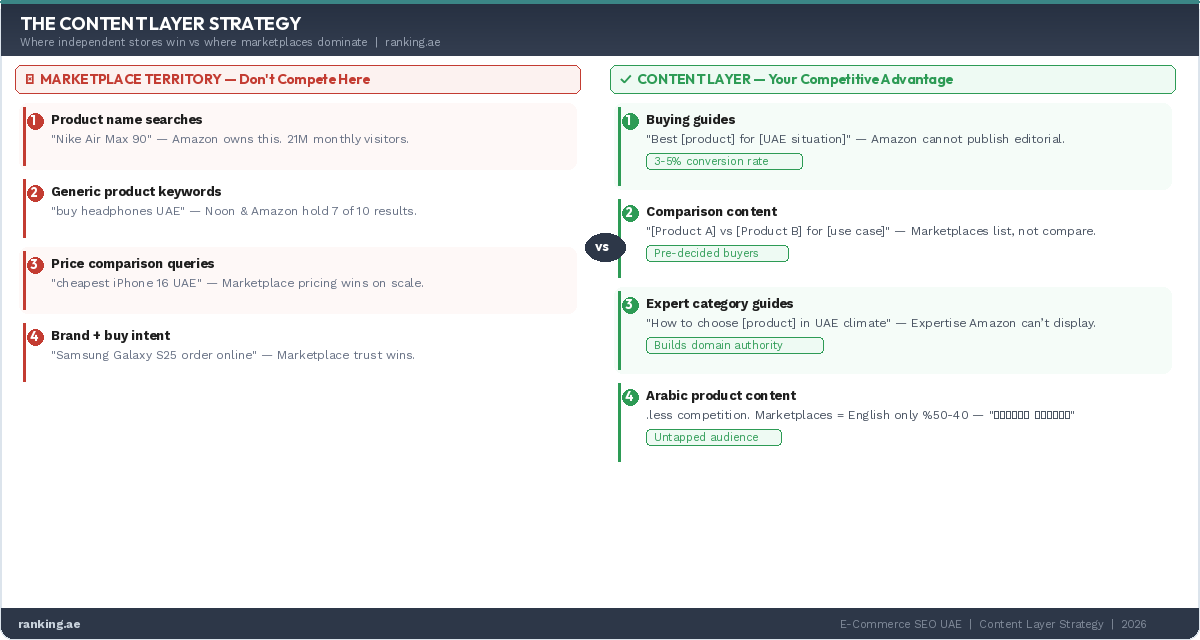
Product Page SEO That Actually Ranks
Most independent UAE e-commerce stores treat product pages as inventory displays. A photo, a price, a one-sentence description, an add-to-cart button. That page will never outrank Amazon's listing for the same product because Amazon has more authority, more reviews, and more backlinks than any independent store can accumulate.
But a product page with 400 to 800 words of genuine product expertise, with structured data that tells Google exactly what the product is, and with real customer reviews attached, that page can rank for the long-tail variations that Amazon's thin listings miss. "Bose QuietComfort headphones" belongs to Amazon. "Best noise-cancelling headphones for Dubai Metro commute" can belong to you, if your product page earns it.
Product Schema That Matters
Eighty-seven percent of the UAE businesses we've audited have zero structured data of any kind. For e-commerce, that means no Product schema, no Review schema, no BreadcrumbList, no FAQ markup on product pages. Without Product schema, Google cannot display your price, availability, and star rating in search results. Your listing looks like a plain blue link next to Amazon's rich result showing the price, 4.5 stars, and "In Stock." The click goes to Amazon. Not because the product is better but because the listing is.
Product schema implementation on a Shopify or WooCommerce store takes one to two days. Many themes include basic schema but miss critical properties: brand, SKU, availability, price currency (AED, not USD), and aggregateRating. Verify your implementation with Google's Rich Results Test. Every property you add is a signal that your listing deserves the rich display that captures clicks.
The Arabic Product Search Gap
Here is a data point that should change your entire content strategy: Arabic search competition in the UAE is 40 to 50% lower than English across every product category we've researched. Amazon.ae product listings are in English. Noon product listings are in English. The Arabic-speaking shopper searching "سماعات بلوتوث" (Bluetooth headphones) finds marketplace listings that were never optimized for Arabic queries.
An independent store that publishes Arabic product descriptions, Arabic buying guides, and an Arabic-language product category structure captures a market segment that the two biggest platforms in the country serve poorly. The work isn't trivial. It requires native Arabic content, not machine translation. It requires proper hreflang implementation. Our Arabic SEO guide maps the full strategy. But the competitive gap is so wide that even partial Arabic optimization produces measurable traffic from day one.
Category Pages vs Blog Content: Different Pages for Different Searches
This distinction matters more in e-commerce than in any other vertical, and most stores get it wrong.
A category page ("Women's Running Shoes") targets transactional intent. The searcher wants to browse and buy. The page should display products with filters, sort options, and pricing. It should have 200 to 400 words of introductory content that includes the category keyword and establishes the store's expertise, but the products are the main content.
A blog post ("Best Women's Running Shoes for Outdoor Training in Dubai: 2026 Guide") targets informational intent. The searcher wants to learn before buying. The post should compare options, recommend specific products with links to the relevant category or product pages, and demonstrate genuine expertise through testing, data, or experience. It drives traffic to the category pages through internal links.
When a store publishes a blog post and also has a category page targeting the same keyword, they cannibalize each other. Google doesn't know which page to rank. The solution is intentional separation: category pages own "[product type]" and "[product type] UAE." Blog posts own "best [product type] for [specific use case]" and "[product type A] vs [product type B]." The internal linking flows from blog (informational) to category (transactional) to product (conversion). Each page has a defined role in the funnel.
UAE-Specific E-Commerce Factors That Generic SEO Guides Miss
Every e-commerce SEO guide on the internet covers product schema, site speed, and content strategy. Those apply everywhere. Here's what applies specifically in the UAE.
Dubai Customs Threshold
A 2025 announcement from Dubai Customs raised the duty-free import threshold from AED 300 to AED 1,000 for online purchases. For stores importing products or competing with cross-border sellers, this changes the pricing landscape. Products under AED 1,000 from international sellers face lower landed costs. Domestic stores competing in this range need to emphasize advantages that price alone cannot communicate: same-day delivery, local warranty, Arabic customer service, easy local returns.
Cash on Delivery Is Declining But Not Dead
COD volumes fell 37% over four years, according to Checkout.com data cited in Mordor Intelligence's 2026 UAE e-commerce analysis. Digital wallets now handle 43.92% of payments. But COD still matters for customer segments that are uncomfortable entering card details online. Offering COD as an option, and mentioning it on product pages and in FAQ schema, can capture conversion from buyers who would otherwise abandon cart. For SEO, this means including "cash on delivery" in your delivery information page and FAQ markup, because shoppers search "[product category] cash on delivery UAE" at meaningful volume.
UAE Consumer Protection Law
Federal Law No. 15 of 2020 on Consumer Protection establishes return rights, warranty obligations, and product liability standards for online sales in the UAE. Displaying compliance with this law on your website, specifically in your returns policy, warranty page, and FAQ, serves dual purposes: it builds consumer trust (a ranking-relevant behavioral signal), and it provides content that Google can evaluate for E-E-A-T trustworthiness. Regulatory credential display is missing from 65% of regulated UAE businesses we audit. E-commerce is regulated. Displaying your trade license number and Consumer Protection compliance signals legitimacy that marketplace listings cannot replicate.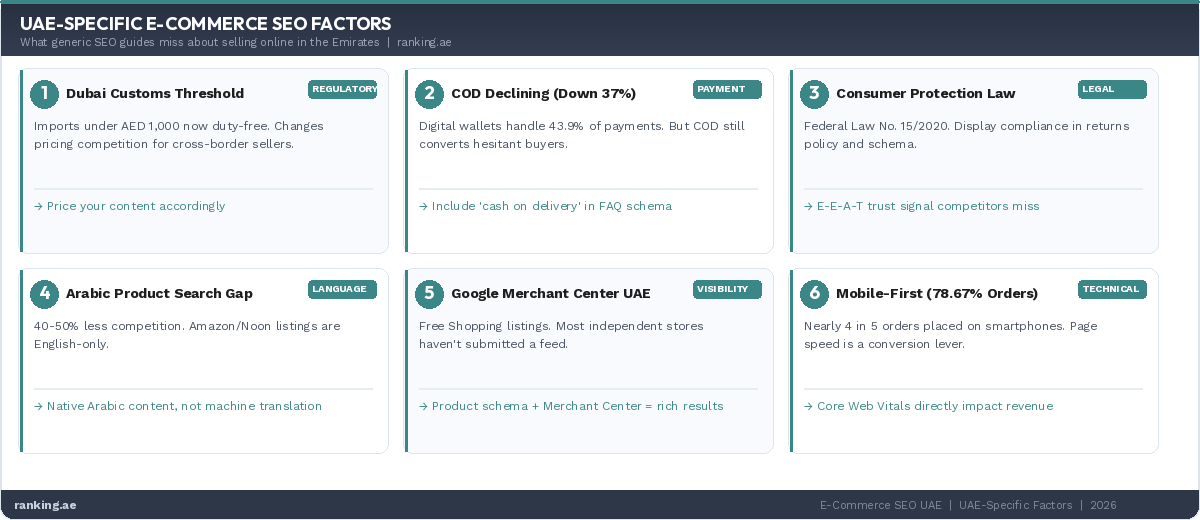
Google Merchant Center and Shopping: The Channel Most UAE Stores Ignore
Google Shopping results appear above organic listings for product searches. They display the product image, price, store name, and star rating. In the UAE, Google Merchant Center adoption among independent stores is remarkably low. Most stores rely on organic and marketplace listings without ever submitting a product feed to Google.
A properly configured Merchant Center feed does two things for SEO. First, free product listings (Google's unpaid Shopping tab) display your products alongside Amazon and Noon at zero per-click cost. Second, the structured product data you submit to Merchant Center reinforces the Product schema on your website, creating a consistency signal that improves organic ranking for product pages.
The feed requires: product title, description, price in AED, availability, product images, GTIN or MPN where available, brand, and a link to the product page on your site. Shopify and WooCommerce both have native Merchant Center integrations. The setup takes an afternoon. The visibility gain is permanent. And most of your independent competitors haven't done it.
The Platform Dependency Audit: How Exposed Are You?
Before investing in e-commerce SEO, measure how dependent your business currently is on marketplace channels. Pull your revenue data for the past 12 months and calculate what percentage comes from your own website versus marketplace platforms.
If more than 70% of revenue comes from marketplaces, your business has a structural vulnerability. You don't have customers. The platform has customers. You have products that the platform's customers sometimes buy. The distinction matters when the platform changes its terms, raises commissions, adjusts its algorithm to favor its own private-label products (Amazon has been doing this globally for years), or simply decides that your category is one it wants to compete in directly.
A healthy e-commerce business derives at least 30 to 40% of revenue from direct channels: its own website via organic search, email marketing, social media, and direct traffic. SEO is the largest and most sustainable of these direct channels because it compounds. Our timeline guide maps how organic traffic builds over 6 to 12 months. Our pricing breakdown shows what the investment looks like. The returns from direct organic traffic are structurally different from marketplace returns: zero commission per transaction, full customer data ownership, and a relationship that persists after the sale.
Where to Start: The First 90 Days of E-Commerce SEO
If you run an independent online store in the UAE and you've never invested in SEO, here's the priority order. It's not a comprehensive strategy. It's the minimum viable starting point that produces the fastest return.
Week 1 to 2: Implement Product schema on all product pages. If your platform (Shopify, WooCommerce, Magento) has a schema plugin, install it and verify every product page with Google's Rich Results Test. Ensure price currency is AED, availability is accurate, and brand is specified. This alone improves CTR from search results.
Week 3 to 4: Submit your product feed to Google Merchant Center. Claim your free product listings. This puts your products into Google Shopping results alongside Amazon and Noon at zero cost.
Month 2: Publish your first content-layer piece: a buying guide for your highest-traffic product category. Not a product description. A genuine guide that helps the shopper decide which product is right for their situation. Link every recommendation to the product page on your site. This is your first piece of traffic that no marketplace can intercept.
Month 3: Add Arabic content to your top three category pages. Write original Arabic descriptions, not machine translations. Implement hreflang tags. Our Arabic SEO guide covers the full process. The 40 to 50% reduction in competition for Arabic product searches means these pages can rank faster than any English equivalent.
By month 3, you've established the technical foundation (schema + Merchant Center), published your first content-layer asset (buying guide), and opened the Arabic search channel. From here, the work is expansion: more buying guides, more category content, more Arabic coverage, review generation, and continuous optimization based on Search Console data. Each month compounds on the previous one.
Frequently Asked Questions
Can a small online store actually outrank Amazon.ae?
For transactional product keywords ("buy Nike Air Max"), no. Amazon's domain authority, review volume, and product count make that competition unrealistic. For informational and investigational keywords ("best running shoes for Dubai weather," "Nike Air Max vs Adidas Ultraboost for gym"), yes. Amazon's architecture cannot produce editorial content. Yours can. And those informational searches are where buying decisions actually form.
I sell on Noon and Amazon. Should I stop?
No. Marketplaces provide immediate reach and transaction volume. The goal is not to replace them but to reduce dependency. A store that derives 30 to 40% of revenue from its own website via organic search has negotiating power with platforms and survivability if platform terms change. A store at 90% platform dependency has neither.
Which e-commerce platform is best for SEO in the UAE?
Shopify and WooCommerce both support the fundamentals: clean URLs, Product schema, sitemap generation, and Merchant Center integration. Shopify is simpler to manage. WooCommerce offers more customization. The platform matters less than what you do with it. A well-optimized Shopify store outranks a neglected WooCommerce store every time. The SEO work is the same regardless of platform.
How much does e-commerce SEO cost in the UAE?
Our pricing breakdown covers the full range. For most independent e-commerce stores, the Growth tier (AED 2,999/month) covers product page optimization, content strategy, link building, and technical monitoring. Stores with larger catalogs or multi-category strategies may need the Dominate tier (AED 4,999/month). The minimum viable investment for e-commerce SEO is higher than for local service businesses because the content layer requires ongoing editorial production.
Do Google Shopping listings help organic ranking?
Directly, no. Google Shopping and organic search are separate systems. Indirectly, yes. The structured product data you submit to Merchant Center reinforces the Product schema on your website. And free Shopping listings increase brand visibility, which leads to branded search increases, which is itself a ranking signal. Branded search growth is one of the five revenue metrics that predict organic success.
What about social commerce? Should I focus on Instagram Shop instead?
Instagram and TikTok commerce are growing in the UAE, but they are discovery channels, not search channels. Someone scrolling Instagram finds your product by accident. Someone searching Google finds your product by intent. Intent-driven traffic converts at 3 to 5x the rate of discovery-driven traffic. Social commerce supplements organic search. It does not replace it.
How long before I see results from e-commerce SEO?
Product schema and Merchant Center improvements show results in 2 to 4 weeks (richer search listings, Shopping tab visibility). Content-layer traffic from buying guides takes 3 to 6 months to build. Category page rankings in competitive niches take 6 to 12 months. The compounding timeline we've documented across other verticals applies equally to e-commerce: each month of investment produces more return than the previous one.
Is COD still important for e-commerce SEO?
COD volumes have fallen 37% over four years in the UAE, with digital wallets now handling 44% of payments. But COD remains important for specific customer segments. Including "cash on delivery available" in your product page content, FAQ schema, and delivery information captures search traffic from "[product] cash on delivery UAE" queries that competitors who've dropped COD no longer serve.
The Quiet Shift
The UAE's e-commerce market hit AED 32.3 billion in 2024. It's projected to pass AED 50 billion by 2029. Noon and Amazon will capture the largest share of that growth. That's not changing.
What is changing, quietly, is where buying decisions actually happen. The shopper who searches a product name and clicks the first Amazon listing has already decided what to buy. Someone influenced that decision. Someone published the comparison guide. Someone wrote the review. Someone answered the question that the shopper typed at 11pm when they couldn't sleep and started researching baby monitors or espresso machines or air purifiers for their new apartment in JLT.
The store that produced that answer owns something Amazon never will: the moment before the purchase decision was made. That's the content layer. That's where independent e-commerce lives in 2026. And the stores that understand this are building an asset that compounds every single month, while the ones that don't are renting shelf space on a platform that can change the rent at any time.
———
Request a free e-commerce SEO audit and we'll assess your current organic visibility, your marketplace dependency ratio, your product schema coverage, and the content-layer opportunities in your product categories. View our e-commerce SEO services or explore pricing for full transparency on what each tier includes.