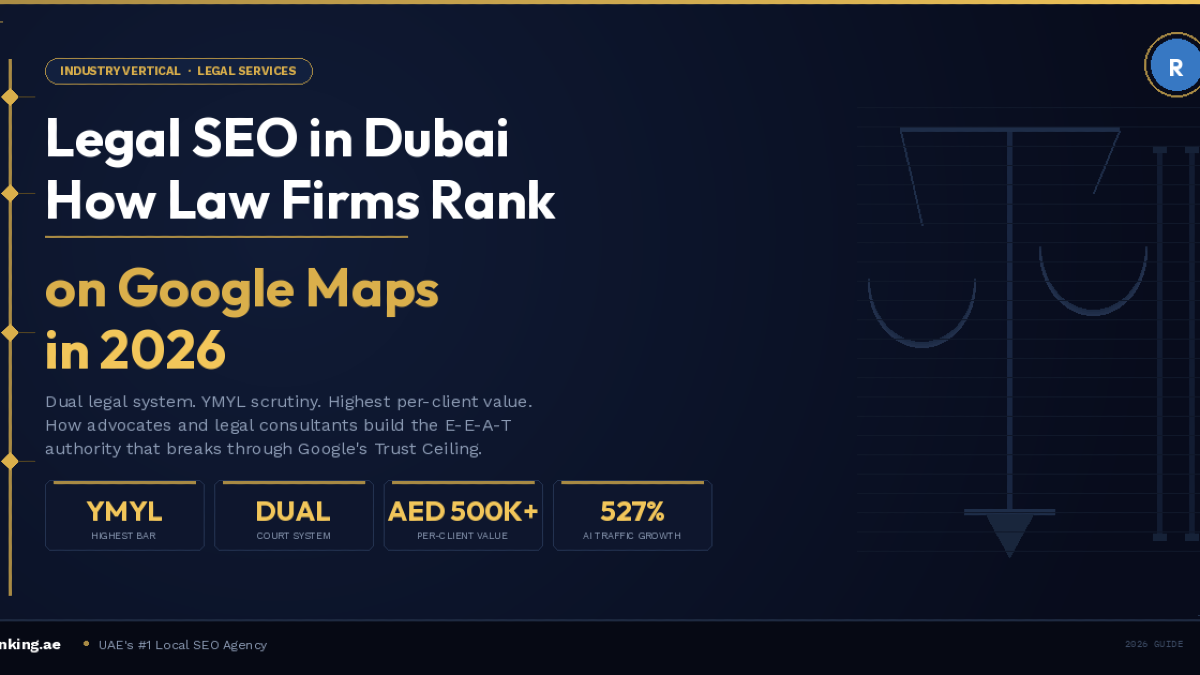
A single client retained through organic search can be worth AED 50,000 to AED 500,000 or more to a Dubai law firm. A commercial dispute involving a DIFC-registered entity, a real estate litigation case, or a complex family law matter with cross-border assets generates fees that dwarf what most service businesses earn from an entire month of clients. That makes legal services the highest per-client-value vertical in local SEO.
It is also the hardest vertical to rank in. Google classifies legal content as YMYL (Your Money or Your Life), meaning content that can affect a person's legal rights, financial stability, or personal safety receives the highest level of quality scrutiny. The bar for ranking is not just technical SEO competence. It is demonstrable expertise, verifiable credentials, and content depth that meets the standard Google applies to content that can materially impact someone's life.
Dubai adds a layer of complexity that no other legal market in the region matches: a dual legal system where civil law courts and common law DIFC/ADGM courts operate in parallel, each with different procedural rules, different language requirements, and different practitioner registration standards. This dual system creates different keyword targets, different trust signals, and different competitive dynamics depending on which jurisdiction a firm serves.
This guide explains how law firms and legal consultants in the UAE build Google Maps visibility, establish the E-E-A-T authority that YMYL content demands, and capture the highest-value clients searching for legal representation online. If you are new to local SEO fundamentals, start with our complete guide to local SEO in the UAE. This post builds on that foundation with strategy engineered specifically for the legal vertical.
The Trust Ceiling: Why Legal SEO Demands More Than Any Other Vertical
Across five industry verticals, we have documented a consistent pattern: regulatory licensing functions as an E-E-A-T trust signal that creates competitive advantage. DHA licensing for medical clinics, RERA registration for real estate agencies, DTCM classification for hotels, and Dubai Municipality licensing for restaurants. In every case, displaying verifiable credentials separates the licensed operator from the unverified competitor.
Legal services take this principle further than any other vertical. There is a ceiling above which no amount of link building, content volume, or review count will push rankings unless the E-E-A-T foundation is structurally in place. We call this the Trust Ceiling.
The Trust Ceiling exists because Google's quality raters evaluate legal content against the strictest YMYL criteria. A blog post about choosing a restaurant can contain minor inaccuracies without material harm. A blog post about UAE employment law, tenancy rights, or criminal defense that contains incorrect information can cause someone to make a decision that damages their legal position, their finances, or their freedom. Google knows this, and the algorithm reflects it.
"Pages on topics that could significantly impact the health, financial stability, or safety of people, or the welfare of society, need to meet very high Page Quality rating standards."
— Google Search Quality Rater Guidelines, Section 2.3 (YMYL)
To break through the Trust Ceiling, a law firm's website must demonstrate:
Verifiable practitioner credentials. Named lawyers with their registration status (advocate or legal consultant), the authority they are registered with (Ministry of Justice for onshore courts, DIFC Courts Register for DIFC, ADGM Courts for Abu Dhabi), their practice areas, and their professional history. Anonymous "our team of experts" language does not satisfy YMYL requirements.
Regulatory compliance signals. Trade license number, professional license authority, and office address that can be independently verified. For DIFC-registered firms, DIFC license number and Courts registration. For onshore firms, Dubai Legal Affairs Department (DLAD) registration.
Content authored by qualified practitioners. Every piece of legal content should identify its author, their qualifications, and their registration status. An article on UAE employment law written by a registered advocate carries weight. The same article without attribution carries none.
Topical depth, not breadth. A firm that publishes 50 thin articles across 20 practice areas signals generalism. A firm that publishes 15 deep guides across 3 core practice areas signals expertise. Google rewards depth in YMYL verticals.
Dubai's Dual Legal System: Two Jurisdictions, Two SEO Strategies
Most international cities have one court system. Dubai has two, and they operate under fundamentally different legal frameworks. This creates two distinct keyword universes that require separate content strategies.
Onshore Dubai Courts (Civil Law)
Dubai Courts operate under UAE civil law, rooted in codified statutes drawn from Egyptian civil law traditions and Sharia principles for personal status matters. Proceedings are conducted in Arabic. Only UAE-registered advocates can appear before these courts. Foreign-qualified lawyers operate as legal consultants who advise but cannot represent clients in court proceedings.
Keyword targets for onshore firms center on Arabic legal terminology, UAE federal law references, and practice areas under civil law jurisdiction: family law (divorce, custody, inheritance under Sharia and civil tracks), criminal defense, labor disputes, real estate litigation, commercial disputes, and debt recovery. The search pattern is "lawyer Dubai," "advocate Dubai," "محامي دبي" (lawyer Dubai in Arabic), and "[practice area] lawyer UAE."
DIFC Courts (Common Law)
The DIFC Courts operate as an independent common law judiciary within a defined geographic zone. Proceedings are in English. International judges from major common law jurisdictions (UK, Australia, Singapore) hear cases. The DIFC Courts handled cases worth over USD 1.8 billion according to their 2023 Annual Report, and Dubai Law No. 2 of 2025 reformed the DIFC Courts framework to expand jurisdiction.
The critical SEO insight: parties can "opt in" to DIFC jurisdiction with a single clause in any contract, even if the underlying business has nothing to do with the DIFC free zone. This means DIFC firms compete for clients across all of Dubai, not just within the financial center. Keyword targets shift to English common law terminology, international commercial law, and dispute resolution: "DIFC lawyer," "commercial arbitration Dubai," "contract dispute Dubai DIFC," "international law firm Dubai."
ADGM Courts (Abu Dhabi Common Law)
Abu Dhabi's equivalent is the ADGM Courts, operating under English common law within Abu Dhabi Global Market. With ADGM registering a 43% increase in financial institutions in Q1 2025, legal demand for ADGM-qualified practitioners is growing rapidly. Our Abu Dhabi SEO guide covers the broader Abu Dhabi market opportunity.
Why the Dual System Matters for SEO
A firm registered with the Ministry of Justice for onshore courts and also registered with the DIFC Courts Registry has two separate credential sets, two separate practitioner directories, and two separate content strategies. The onshore content targets Arabic-language civil law keywords. The DIFC content targets English-language common law keywords. Mixing them creates confusion for both Google and prospective clients. Separating them creates depth in two competitive spaces simultaneously.
Advocate vs. Legal Consultant: The GBP Category Decision That Changes Everything
Under Federal Law No. 34 of 2022 regulating advocacy and legal consultancy in the UAE, the legal profession is divided into two distinct categories:
Advocates have rights of audience before UAE courts. They can file cases, represent clients, cross-examine witnesses, and address judges directly. Only UAE-registered advocates (traditionally UAE nationals, though the path has expanded in recent years) can perform these courtroom functions.
Legal consultants provide advisory services, draft documents, prepare legal opinions, and assist with transactions. They cannot appear before onshore UAE courts. Most foreign-qualified lawyers in the UAE operate as legal consultants. However, legal consultants CAN register with DIFC Courts and ADGM Courts, where the common law framework allows broader practitioner participation.
This distinction directly affects GBP category selection, which is the strongest single signal for Map Pack inclusion:
Advocates and full-service firms: Primary category "Law firm" or "Lawyer." Secondary categories: "Legal services," "Immigration lawyer," "Family law attorney," "Criminal justice attorney" (as applicable to practice areas).
Legal consultancy firms: Primary category "Legal services" or "Consultant." Secondary categories matching advisory specialties: "Corporate lawyer," "Business lawyer," "Tax consultant."
DIFC-registered firms: Primary category "Law firm." Secondary categories reflecting common law specialties: "Business lawyer," "Contract lawyer." The DIFC registration legitimizes the "law firm" category even for foreign-qualified practitioners.
Selecting the wrong category suppresses visibility for the searches your actual clients make. An advocate firm that selects "Legal services" instead of "Law firm" loses Map Pack visibility for "lawyer near me" searches. A legal consultancy that selects "Law firm" when they cannot appear in court may attract inquiries they cannot serve, damaging review ratings and trust. Our GBP optimization playbook covers the mechanics of category selection in detail.
Google Business Profile Optimization for Law Firms
The principles from our GBP playbook apply universally. Here is what changes specifically for legal services.
Credentials in the Business Description
Your GBP description should include: firm registration authority (DLAD, DIFC, ADGM, Ministry of Justice), specific practice areas (not "all areas of law"), jurisdictions served (onshore UAE courts, DIFC Courts, ADGM Courts, or combination), and languages of service. A description like "Full-service law firm registered with the Dubai Legal Affairs Department, specializing in commercial litigation, real estate disputes, and employment law. Arabic and English representation before Dubai Courts. DIFC Courts-registered for international commercial arbitration." communicates jurisdiction, capability, and language in a format both Google and prospective clients can parse.
Practitioner Profiles
Google evaluates legal content against E-E-A-T standards that require identifiable expertise. Your GBP should feature photos of named lawyers (not stock images), and your website should have dedicated profile pages for each practitioner with their qualifications, bar admission or registration details, practice areas, published articles, and professional memberships. Link these profiles to LinkedIn for additional verification.
Reviews in the Legal Context
Legal services face a review timing challenge similar to what we documented for real estate: low transaction frequency but high transaction value. A firm closing 5-10 matters per month has a smaller review pool than a restaurant serving 500 covers. But legal reviews carry disproportionate weight because the stakes are high, and detailed reviews that describe outcomes (within ethical limits) are extremely persuasive to prospective clients.
Request reviews at case resolution, not at engagement. The moment the client receives a favorable judgment, completes a property transaction, or obtains their employment dispute settlement is when satisfaction peaks. Follow the systems in our Google Reviews manual with one critical legal-specific adaptation: never ask clients to disclose confidential case details in reviews. Guide them toward describing the experience ("responsive communication," "clear advice," "professional handling") rather than specific case facts.
Multilingual Legal Search
Legal search in the UAE spans multiple languages with distinct intent patterns. Arabic legal queries ("محامي دبي," "مستشار قانوني دبي") carry strong commercial intent from Emirati nationals and Arabic-speaking expatriates. Hindi and Urdu legal searches ("Dubai lawyer Hindi speaking," "दुबई में वकील") come from the large South Asian expatriate population navigating employment disputes, personal status matters, and immigration issues. Russian queries serve the CIS community for property disputes and commercial matters.
Our Arabic SEO guide documents the scale of this opportunity: Arabic search competition is 40-50% lower than English equivalents. For legal services, the gap is even wider because most international law firms in Dubai publish exclusively in English, leaving Arabic legal search almost entirely to local advocates who have not invested in SEO.
Content Strategy That Breaks Through the Trust Ceiling
Legal content must clear a higher bar than any other vertical. Here is the architecture that works.
Practice Area Pillar Pages
Build a dedicated, comprehensive page for each core practice area (employment law, family law, commercial litigation, real estate disputes, criminal defense, corporate advisory, etc.). Each page should be 1,500-3,000 words covering: the legal framework (which UAE law applies), the process (how cases are filed and heard), common client scenarios (without confidential specifics), typical timelines and cost structures, and which court handles these matters (onshore, DIFC, or both). Every pillar page is authored by a named practitioner with visible credentials.
Legal Guides That Capture Research Intent
Prospective legal clients research extensively before contacting a firm. The queries are specific and high-intent: "UAE employment law termination notice period," "DIFC vs Dubai Courts which is better for commercial dispute," "how to file for divorce in Dubai as an expatriate," "golden visa UAE requirements 2026." Each of these queries represents someone who will need a lawyer. The firm that provides the definitive answer becomes the first contact.
These guides must be legally accurate (reviewed by a qualified practitioner before publication), clearly attributed (author name, qualifications, date of publication, last update date), and updated when laws change. UAE law evolves frequently: Federal Decree-Law No. 34 of 2022 reformed advocacy profession regulations, Dubai Law No. 2 of 2025 reformed DIFC Courts, and family law underwent substantial reform in recent years. Outdated legal content is worse than no content because it can mislead readers and trigger YMYL quality downgrades.
The Jurisdiction Comparison Content Gap
The most underserved content category in UAE legal search is jurisdiction comparison. "DIFC Courts vs Dubai Courts," "which court should I file in," "can I choose DIFC for a mainland Dubai dispute." These are the highest-intent queries for commercial clients who are actively preparing to litigate. They are choosing between two systems that will determine the language, procedure, timeline, and cost of their dispute. The firm that publishes the definitive comparison guide captures the client at the decision point.
Schema Markup for Law Firms
Implement LegalService schema on your homepage and about page with: name, address, telephone, areaServed, and the critical knowsAbout property listing your practice areas. For individual lawyer profile pages, use Person schema with jobTitle, worksFor, knowsAbout (practice areas), and hasCredential (registrations). For legal guide content, use Article schema with identifiable author (linking to the Person schema). For FAQ content, implement FAQPage schema. Schema does not directly boost rankings but earns rich snippets and improves AI citation eligibility, as detailed in our AEO and GEO guide.
Link Building for Legal Services
Legal directories. Chambers & Partners, Legal 500, IFLR1000, and Martindale-Hubbell list UAE firms with editorial profiles. Ranking in these directories provides authoritative backlinks AND direct client referrals. Submitting to these directories is a priority.
Court registries. Your listing in the DIFC Courts Register of Practitioners is a government-equivalent backlink. DLAD registration provides similar authority for onshore firms.
Legal publications. Lexology, Mondaq, Legal 500 Thought Leadership, and regional publications like Gulf News legal supplements accept contributed articles from UAE practitioners. Each published article with a firm attribution link builds domain authority.
Industry association memberships. Dubai Chamber of Commerce legal advisory panel, Emirates Law Business & Practice journal contributors, and Abu Dhabi Commercial Conciliation and Arbitration Centre membership pages provide contextually relevant backlinks.
Client industry partnerships. Law firms serving specific industries (real estate, hospitality, healthcare) can secure backlinks from client industry associations and publications. A firm specializing in hotel law appearing on a hospitality industry body's recommended legal partners page provides a contextually perfect link.
AI Search Optimization for Legal Services
When someone asks ChatGPT "what are my rights if my UAE employer terminates me without notice?" or Google AI Overview generates an answer for "how to file a case in DIFC Courts," the answer pulls from structured, authoritative, law-specific content. Legal services are one of the highest-traffic YMYL categories for AI search. AI traffic from LLMs grew 527% between January and May 2025 across industries, with legal as one of the top-performing verticals.
Our AEO and GEO guide covers the full framework. For legal specifically: structure FAQ content with clear question-answer pairs citing specific UAE laws by number. Publish procedural guides with step-by-step formats AI models can extract. Attribute all content to named, credentialed practitioners. Cite official sources (DLD, DIFC Courts, Ministry of Justice) that AI models trust.
"Legal, Health, and Finance see the highest AI-sourced traffic growth. LLMs are becoming a legitimate discovery channel for trust-heavy, consultative questions."
— Previsible AI Data Study 2025, via Search Engine Land
Mistakes Law Firms Make with SEO in Dubai
Publishing without author attribution. Unsigned legal content on a YMYL topic is the single fastest way to fail Google's quality evaluation. Every article, guide, and blog post must identify its author by name, qualification, and registration authority. "Written by our legal team" is not attribution.
Mixing jurisdiction signals. A firm that publishes content about DIFC commercial arbitration and onshore criminal defense on the same website without clear structural separation confuses both Google and prospective clients about what the firm actually does and where it can represent you.
Neglecting Arabic legal content. Onshore UAE courts operate in Arabic. Clients searching in Arabic for legal representation are high-intent. Yet most international law firms in Dubai publish exclusively in English. Our Arabic SEO guide documents why this gap represents the largest untapped opportunity in UAE legal search.
Generic "areas of practice" pages. A 200-word page listing 15 practice areas with a sentence each will not rank for any of them. YMYL verticals require depth. Five deep practice area pages outperform fifteen thin ones every time.
Ignoring the GBP entirely. Many law firms view Google Business Profile as something for retail businesses. In reality, when someone searches "lawyer near me" or "law firm DIFC," the Map Pack appears first. Law firms without an optimized GBP are invisible for these searches. Our GBP playbook and Maps ranking factors guide detail why this matters.
For the broader pattern of local SEO errors, read our 10 Local SEO Mistakes guide.
What Legal SEO Costs and Why the ROI Is Unmatched
Our full pricing breakdown covers the market-wide range. For legal specifically, the ROI calculation is the strongest of any vertical we serve.
A single retained commercial dispute client can generate AED 50,000 to AED 500,000+ in fees. A family law retainer produces AED 15,000 to AED 100,000. An employment case generates AED 10,000 to AED 50,000. One organic client acquisition per month at even the lower end of these ranges exceeds the full annual cost of our Dominate tier (AED 4,999/month) several times over.
At our Growth tier (AED 2,999/month), this covers GBP optimization, citation management, review strategy, monthly content production, and technical monitoring. The Dominate tier adds multilingual content (Arabic and English), practice area pillar page development, jurisdiction-specific content, advanced link building targeting legal directories, and competitive analysis against other firms in your practice areas.
The 90-Day Execution Plan for Law Firm SEO
Month 1: Trust Foundation
GBP overhaul. Correct category (Law firm vs Legal services per advocate/consultant status). Add registration numbers (DLAD, DIFC, MOJ). Upload professional team photos. Write description with jurisdictions, practice areas, and languages. Establish weekly Google Post cadence.
Practitioner profile pages. Build dedicated pages for each lawyer with name, photo, registration details, practice areas, LinkedIn link, and published content. This is the E-E-A-T foundation.
Technical audit. Core Web Vitals, schema markup implementation (LegalService, Person, FAQPage, BreadcrumbList), meta descriptions, and OG tags.
Citation audit. Verify NAP consistency across Google, Bing, Legal 500, Chambers, Martindale-Hubbell, and UAE directories.
Month 2: Content Foundation
Publish 3 practice area pillar pages. Start with your highest-revenue practice areas. 1,500-3,000 words each, authored by named practitioners, covering legal framework, process, scenarios, timelines, and court jurisdiction.
Publish 2 legal guides. Target the highest-volume research queries in your practice areas. "How to [legal process] in UAE" format.
Arabic GBP and core pages. Add Arabic business description. Translate top practice area pages into Arabic. Implement hreflang tags.
Month 3: Authority Building
Submit to legal directories. Chambers & Partners, Legal 500, IFLR1000. Request verified reviews from clients on Google.
Publish jurisdiction comparison content. "DIFC Courts vs Dubai Courts: Complete Guide" targeting the highest-intent commercial keyword gap.
Review generation. Implement post-resolution review request system. Target multilingual reviews.
Link building. Contribute articles to Lexology, Mondaq, or Legal 500 Thought Leadership with firm attribution links.
Start Ranking Where Your Next Client Is Searching
Legal services generate the highest per-client revenue of any local search vertical. The firms that appear in Google Maps when prospective clients search for representation capture inquiries that translate directly into retained matters worth tens or hundreds of thousands of dirhams.
We build local SEO strategies specifically for law firms, advocates, and legal consultancies in the UAE. From GBP optimization and practitioner profile development to multilingual content production, jurisdiction-specific legal guides, and legal directory submissions, every tactic in this guide is part of our legal services SEO offering.
Request a free SEO audit for your law firm and we will assess your GBP status, E-E-A-T foundation, competitive position, and specific opportunities in your practice areas. Or review our pricing to see which tier matches your firm's growth goals.
Frequently Asked Questions
Is legal SEO really different from regular local SEO?
Yes, fundamentally. Google applies YMYL (Your Money or Your Life) scrutiny to legal content, which means the E-E-A-T bar is higher than for a restaurant, salon, or fitness center. Practitioner credentials, author attribution, regulatory compliance signals, and content accuracy all carry more weight in rankings. Our local vs regular SEO comparison explains the foundational distinction, and this guide layers the legal-specific requirements on top.
Should a DIFC-registered firm optimize differently than an onshore firm?
Yes. DIFC firms should target English-language common law keywords, reference DIFC Courts registration in their GBP and schema, and build content around international commercial law topics. Onshore firms should include Arabic content targeting civil law keywords and reference Ministry of Justice or DLAD registration. Firms registered in both jurisdictions need separate content tracks for each.
How important is Arabic content for legal SEO in the UAE?
Critical for onshore practice. Dubai Courts operate in Arabic. Clients searching for representation in family law, criminal defense, and employment matters often search in Arabic. Competition for Arabic legal keywords is dramatically lower than English. Read our Arabic SEO guide for the full analysis.
How long does legal SEO take to show results?
Legal SEO moves at a pace similar to medical SEO (the other YMYL vertical we serve). Expect GBP improvements in 8-12 weeks, practice area page rankings for long-tail keywords in 4-6 months, and competitive broad term visibility in 6-12 months. The higher YMYL bar means Google takes longer to evaluate and trust legal content. But the per-client value means even modest organic lead generation produces exceptional ROI.
Can a small firm compete with Al Tamimi or Baker McKenzie in organic search?
Not on brand-name searches, and not on broad head terms like "law firm Dubai." Yes, on practice-area-specific and location-specific long-tail queries. "Employment lawyer DIFC," "divorce lawyer Dubai Hindi speaking," "real estate dispute lawyer JLT" are searches where a specialized firm with deep content and strong GBP optimization outperforms a large firm with a generic profile. This is the same long-tail strategy we apply in hotel SEO (competing with OTAs) and real estate SEO (competing with portals).
Do client reviews matter for law firms?
Enormously. Reviews are one of the top three Google Maps ranking factors. For law firms, reviews carry additional weight because the decision to hire a lawyer involves high personal and financial stakes. Clients read reviews carefully. A firm with 40 detailed reviews describing "clear communication," "favorable outcome," and "transparent fees" generates more trust than a firm with 200 reviews for a restaurant. Quality over quantity matters more in legal than in any other vertical.