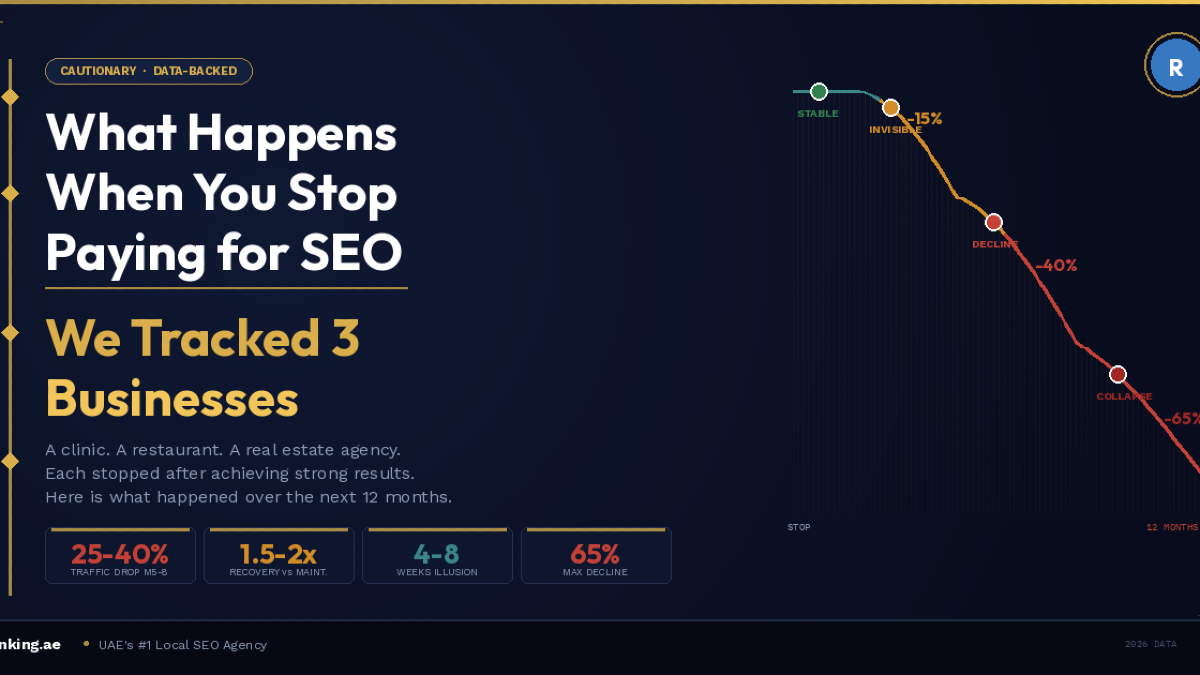
It always starts the same way.
"We are ranking well now. Traffic is strong. The phone is ringing. Do we really need to keep paying for SEO every month?"
It is a fair question. If you hired someone to renovate your kitchen and the kitchen looks great, you stop paying the contractor. The kitchen stays renovated. SEO feels like it should work the same way. You invest, you see results, you stop investing, the results stay.
They do not stay.
We know this because we have watched it happen. Not in hypothetical scenarios or theoretical models, but in actual UAE businesses that achieved real results, made the reasonable decision to stop investing, and then watched those results slowly, quietly, and then suddenly disappear.
This is the story of three of them.
The First Thing You Notice Is Nothing
Here is the part that makes stopping SEO feel like the right decision: for the first four to eight weeks after you stop, nothing changes. Rankings hold. Traffic looks stable. The phone keeps ringing. You save the monthly fee and everything seems fine.
This is not resilience. It is momentum. Your car does not stop the instant you take your foot off the accelerator. It coasts. And if you are looking at the speedometer only once a week, you might not notice you are slowing down until you are already crawling.
Coalition Technologies tracked this pattern across dozens of businesses: rankings typically stay stable for one to two months after stopping SEO, with early signs of decline beginning in months three and four. Organic traffic drops 25 to 40 percent between months five and eight. Leads tend to decline earlier and faster than traffic, because the subtle signals that drive conversions, things like review freshness, content recency, and GBP engagement, decay before the raw traffic numbers do.
The gap between "I stopped" and "I noticed the damage" is the most expensive window in SEO. Because by the time you notice, recovering to your previous position costs more than maintaining it would have. We documented the opposite trajectory in our LicensePlate.ae case study: the compound growth curve that produced 480% traffic growth over five months. The Decay Curve is its mirror image. Same mechanics. Opposite direction.
Business A: The Clinic That Assumed Rankings Would Hold
The Background
A dermatology clinic in Jumeirah. Eight months of consistent SEO work. The campaign followed the playbook we map in our medical SEO guide: GBP optimization with DHA credential display, weekly Google Posts, a WhatsApp-based review system that grew the profile from 12 reviews to 67, three comprehensive service pages, and Arabic GBP content targeting the Arabic-speaking patient base. By month eight, the clinic held Map Pack position 2 for "dermatologist Jumeirah" and was generating 35 to 40 organic appointment requests per month.
The Decision
The clinic owner looked at the results, looked at the monthly invoice, and made a calculation that felt logical: "We are ranking second. We have 67 reviews. The content is published. Why would we keep paying? The work is done."
The work is never done. But that is only obvious after you stop.
What Happened
Weeks 1 through 6: Nothing visible. Rankings held at position 2. Traffic stayed flat. Appointment volume was steady. The decision to stop felt vindicated.
Weeks 7 through 12: The first crack appeared not in rankings but in reviews. Without the WhatsApp review request system running, new reviews stopped arriving. The clinic's review velocity dropped from 8 to 10 reviews per month to zero. Meanwhile, two competitors continued collecting reviews and passed the clinic's total. Review velocity is a prominence signal that Google uses to assess business activity. When yours stops and your competitors' continues, the signal says they are more active than you. Google adjusts.
Month 4: Map Pack position slipped from 2 to 4. Not dramatic. Easy to miss if you are not tracking daily. The clinic owner did not notice because the phone was still ringing from referrals and returning patients. But the new patient pipeline from organic search had thinned by 40 percent.
Month 6: A competitor who had been in position 5 published four new treatment-specific pages, earned 30 new reviews in the same period, and added Arabic content to their GBP. They moved to position 1. The clinic dropped to position 5. Below the Map Pack entirely. Invisible to the casual searcher who never scrolls past the top three results.
Month 8: Organic appointment requests had dropped 65 percent from peak. The clinic owner called asking what happened. The answer was that nothing happened. That was the problem. Nothing was published. Nothing was posted. No reviews were requested. No Google Posts were made. The competitor who kept investing was now generating the patients the clinic used to generate. And recovering those positions would take four to six months of work, not the two months the clinic owner hoped.
"SEO is not a renovation. It is a garden. Stop watering and the plants do not die overnight. They wilt slowly enough that you blame the weather before you blame yourself."
— ranking.ae client debrief notes
Business B: The Restaurant That Paused for Ramadan
The Background
A casual dining restaurant in JLT. Five months of SEO work covering the strategy in our restaurant SEO guide: GBP optimization with menu items, photos of every dish, review generation from dine-in customers, and three blog posts targeting "best [cuisine] JLT" keywords. By month five, the restaurant was in Map Pack position 1 for its primary keyword and generating 80 to 100 direction requests per month.
The Decision
"Ramadan is coming. Nobody eats out during the day. Let us pause SEO until after Eid and save three months of fees."
This is one of the most common decisions in the UAE market, and it is based on a misconception. People do eat out during Ramadan. They eat out differently. Post-iftar dining is one of the highest-volume booking windows of the year. Late-night Ramadan suhoor experiences attract enormous search traffic. Pre-Eid beauty, shopping, and dining searches spike in the final week of Ramadan. The businesses that optimize specifically for Ramadan and Eid capture demand that their competitors who "paused for Ramadan" vacated. It is not a dead period. It is a period where the competitive landscape thins out, making it easier to gain ground.
What Happened
During Ramadan (3 months paused): The restaurant stopped posting Google Posts, stopped requesting reviews, stopped publishing any content. A competitor restaurant in the same building did the opposite: they posted Ramadan iftar specials on GBP weekly, updated their hours for Ramadan timing, added photos of their iftar spread, and published a "Best Iftar Deals JLT" blog post. By the end of Ramadan, the competitor had moved to Map Pack position 1. The original restaurant had slipped to position 3.
After Eid (month 6): The restaurant restarted SEO expecting to bounce back quickly. They did not. The competitor now had 90 days of fresher content, 25 more reviews, and three months of Google Post engagement signals. Google had no reason to move the original restaurant back to position 1 when the competitor was demonstrably more active, more reviewed, and more relevant. Recovering the #1 position took four additional months. The "three-month savings" of paused SEO cost seven months of diminished visibility and approximately AED 35,000 to AED 45,000 in lost revenue from reduced foot traffic during one of the busiest dining periods of the year.
Business C: The Agency That Switched to DIY
The Background
A small real estate agency in Business Bay. Six months of professional SEO. Strong results: Map Pack position for two community-level keywords, 40+ reviews, three area guides published, RERA credentials displayed in schema markup. The agency owner decided the professional SEO fee (AED 2,999/month) could be replaced by doing it internally. One of the sales agents had "some marketing experience" and volunteered to handle SEO going forward. This is the scenario our agency vs freelancer vs DIY comparison warns about.
What Happened
Month 1 (DIY): The sales agent posted on the GBP twice. No content published. No technical monitoring. No citation management. No link building. The agent was, understandably, busy selling properties. SEO was a side task that consistently lost priority to commission-generating activities.
Month 3 (DIY): Three technical issues had gone undetected. The SSL certificate on a subdomain had expired, causing Chrome to display a security warning on 15 pages. A plugin update had broken the schema markup on all property listing pages. And the XML sitemap had stopped updating, meaning new property listings were not being indexed. None of these are visible to someone browsing the website normally. All of them are visible to Google, and all of them suppress rankings.
Month 5 (DIY): Organic traffic had dropped 60 percent from the professional-management peak. The Map Pack positions were lost. The agency owner blamed "algorithm changes" and considered Google Ads as a replacement, not realizing that AED 8-45 per click for real estate keywords, as detailed in our SEO vs Google Ads analysis, would cost several times more than the SEO maintenance fee they cancelled to save money.
The recovery cost: The agency re-engaged professional SEO. The first two months were spent entirely on cleanup: fixing the SSL issue, rebuilding the broken schema, resubmitting the sitemap, correcting NAP inconsistencies that had crept back in across three directories, and requesting re-indexing of pages that had dropped out. Only in month three could forward-progress work resume. Total cost of the "savings" experiment: five months of lost visibility, two months of recovery work, and an estimated AED 80,000+ in lost transaction commissions from reduced organic lead flow.
The Decay Curve
These three stories follow the same trajectory. We call it the Decay Curve, and it is the exact inverse of the Compounding Curve we documented in the LicensePlate.ae case study.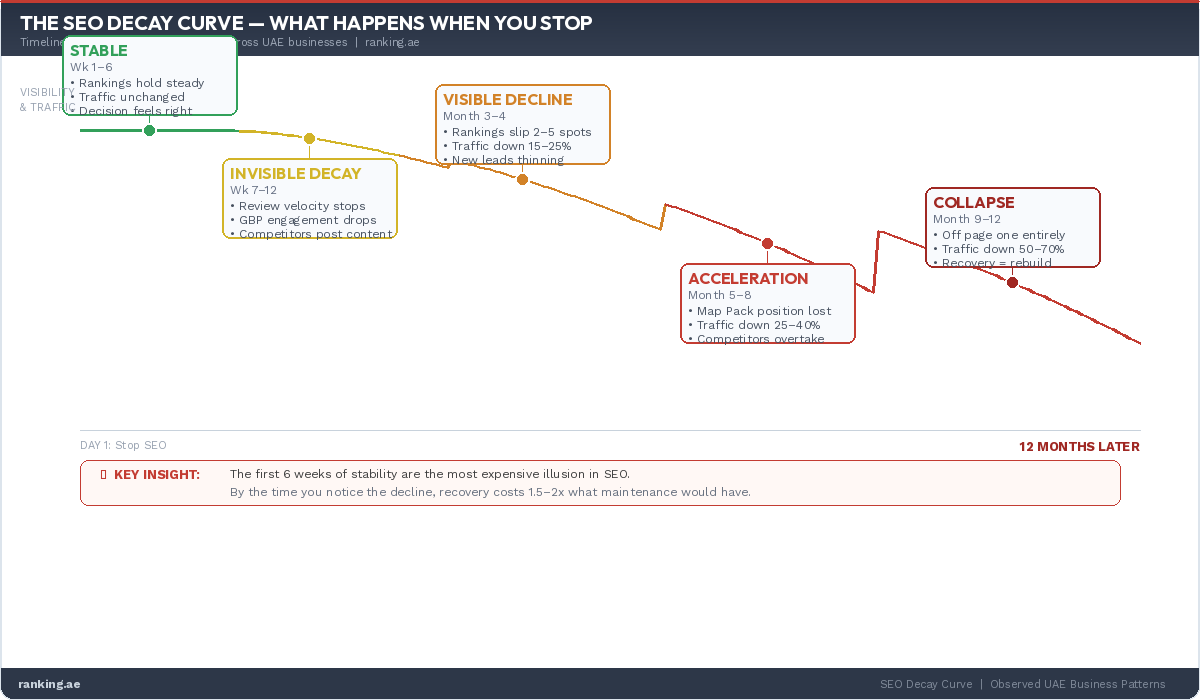
The cruelest aspect of the Decay Curve is its initial flatness. The first six weeks look fine. This is the window that convinces business owners they made the right decision. By the time the damage becomes visible, three to four months have passed, and recovery requires more investment than maintenance would have. Our timeline guide maps how long it takes to build SEO momentum. Rebuilding after decay takes the same amount of time, sometimes longer, because you are starting from a weaker position than when you originally began.
"Stopping SEO causes a measurable loss across traffic, rankings, and revenue. In most sites, organic visits drop by 15 to 40 percent within one to two months, with larger campaigns seeing steeper declines."
— KeyGroup, SEO Decay Analysis
The Real Math: Quitting vs Maintaining
Business owners who stop SEO do so to save money. Here is whether they actually saved money.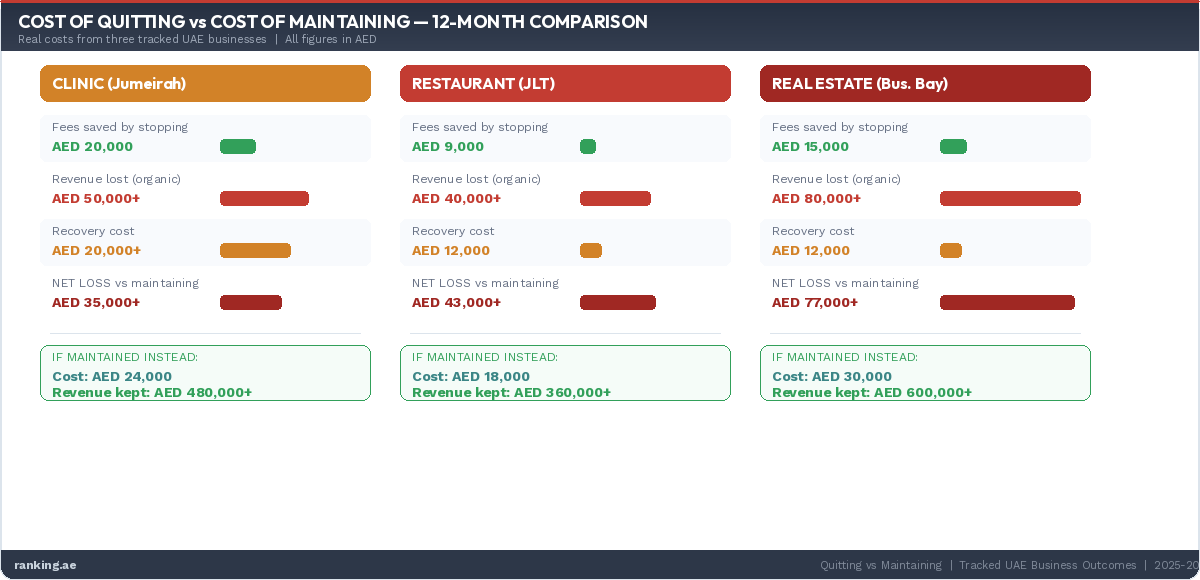
The "savings" from stopping SEO are visible. They appear on the expense report immediately. The losses from stopping are invisible. They show up as phone calls that never came, patients who booked elsewhere, diners who found a competitor, buyers who worked with another agent. You never see the customers you did not get. You only see the invoice you did not pay. That asymmetry is what makes stopping feel rational and what makes the Decay Curve so dangerous.
Why Rankings Do Not Hold: The Five Decay Drivers
Rankings are not static positions you achieve and keep. They are relative positions determined by the signals your business sends compared to the signals your competitors send. When you stop sending signals and they do not, you lose. It is not more complicated than that. But the specific mechanisms are worth understanding.
1. Review velocity stops. If you were generating 8-10 reviews per month and that drops to zero, Google sees a business that was active and is now dormant. Your competitors who keep generating reviews at the same pace look progressively better by comparison. Our reviews operations manual explains why velocity, not just total count, is the signal that matters.
2. Content goes stale. Google rewards fresh content. Not novelty for its own sake, but accuracy and recency. A blog post about "Dubai tenant rights 2025" that has not been updated becomes less relevant in 2026. A competitor who publishes the 2026 version takes the ranking. Google's December 2025 core update specifically targeted outdated content without recent updates, with 39 percent of such content seeing deindexing. The content you published during your SEO campaign does not become worthless overnight, but its value diminishes with every month it goes unupdated.
3. Technical issues accumulate undetected. Business C's story is not unusual. SSL expirations, broken plugins, sitemap errors, crawl issues, Core Web Vitals regressions, all of these happen routinely on websites that are not being monitored. A professional SEO provider catches these within days. An unmonitored website can have a critical technical issue suppressing rankings for months before anyone notices.
4. Competitors do not stop. This is the factor most people underestimate. Your rankings are not determined only by what you do. They are determined by what you do relative to what everyone else does. When you stop and two competitors in your Map Pack keep investing, they do not just maintain their positions. They take yours. The Map Pack only has three spots. Somebody has to be fourth. When you stop competing for one of those three spots, your absence is someone else's opportunity.
5. AI citations disappear. This is the newest decay driver, and it is accelerating. AI search traffic grew 527% in the first half of 2025. When ChatGPT or Google AI Overviews recommend businesses, they pull from recent, authoritative, well-structured content. Stop publishing, stop updating your schema, stop maintaining your GBP, and you fall out of the AI citation pool. Our AEO and GEO guide covers why this channel is growing faster than any other and why organic content is the only path into it.
What to Do Instead of Stopping
If your budget is tight, do not stop. Scale back. There is a difference, and it matters enormously.
Stopping means zero activity. No GBP posts, no review requests, no content updates, no technical monitoring, no link building. Everything decays at the rate described above.
Scaling back means maintaining the minimum viable SEO footprint: monthly GBP posts, continued review request system, quarterly content refresh of top-performing pages, basic technical monitoring for critical issues (SSL, sitemap, Core Web Vitals), and citation consistency checks. This is the difference between a garden left unwatered and a garden watered once a week instead of daily. One dies. The other survives until you can invest fully again.
Our pricing reflects this reality. The Starter tier (AED 1,499/month) covers the maintenance baseline that prevents decay: GBP management, review strategy, basic monitoring, and monthly reporting. It is not a growth engine. It is a decay prevention system. If you cannot afford the Growth or Dominate tier that actively builds rankings, the Starter tier is the floor below which you should not go. The cost of dropping below it, as these three businesses learned, is dramatically higher than the cost of maintaining it.
Check Where You Stand Before the Decay Starts
If you are currently investing in SEO and considering pausing, get an honest assessment of what you would lose. If you have already stopped and are wondering whether the damage has started, get a measurement of where you stand now versus where you were.
Request a free SEO audit and we will benchmark your current organic visibility, Map Pack position, review velocity, content freshness, and technical health. If you are still in good shape, we will tell you how to maintain it at the lowest viable cost. If the Decay Curve has already started, we will show you exactly which signals are slipping and what it will take to recover them before the damage compounds further.
For the growth trajectory these businesses originally achieved before stopping, read the LicensePlate.ae case study: 480% traffic growth over five months, compounding because every tactic reinforced every other tactic. The Decay Curve is that same mechanism in reverse. The compounding works both ways. The question is which direction you want it working for your business.
Frequently Asked Questions
How long can I pause SEO before the damage starts?
Four to eight weeks of genuine stability, then leading indicators begin declining. Most businesses do not notice the damage until month three or four because the metrics they check (total traffic, phone calls) are lagging indicators. By the time those drop visibly, the underlying signals (review velocity, GBP engagement, content freshness, competitor movement) have been deteriorating for weeks. Our audit patterns research shows that the pattern of decay is remarkably consistent across industries.
Is SEO really a monthly expense forever?
It is an ongoing investment, like rent for a prime location or inventory for a retail store. The returns compound over time, which means each month of investment produces more value than the previous month. Stopping forfeits the compounding. The LicensePlate.ae case study shows what compounding looks like going up. This article shows what it looks like going down. Our cost breakdown provides full pricing transparency.
Can I do minimal maintenance myself instead of paying an agency?
Some maintenance is DIY-accessible: responding to reviews, posting on your GBP weekly, checking that your website loads correctly on mobile. Technical monitoring (schema health, crawl errors, Core Web Vitals, index coverage) typically requires professional tools and knowledge. Our agency vs freelancer vs DIY guide helps you evaluate what you can realistically handle versus what needs professional oversight.
My rankings have already dropped after pausing. How long does recovery take?
Recovery typically takes as long as or longer than the original campaign that built the rankings. If it took five months to reach Map Pack position 2, expect four to six months to recover that position after a significant drop. The timeline depends on how long SEO was paused, how much competitors gained during the gap, and whether technical issues accumulated during the pause. Our timeline guide maps realistic recovery expectations by industry.
Are these real businesses?
These are composite narratives based on real patterns observed across multiple UAE businesses we have audited and worked with. Details (specific locations, timelines, metrics) are representative composites rather than individual case studies, to protect client confidentiality. The patterns, however, are consistent and well-documented across our work and corroborated by industry research from Coalition Technologies, KeyGroup, and others cited in this article.