A Dubai dental clinic in Jumeirah ran Google's Rich Results Test in February 2026 and discovered three findings that explained eighteen months of frustrating SEO results.
First, the clinic had no LocalBusiness schema at all on its homepage despite the agency having charged AED 4,500 per month for "comprehensive SEO" since 2024. Second, the clinic's three location pages each had partial Organization schema with conflicting business names: "Dr. Smith Dental Clinic" on one page, "Dr Smith Dental" on another, "Smith Family Dentistry" on the third. Same business, three different entity declarations. Third, the clinic's symptom-and-treatment pages, which received approximately 70 percent of the site's organic traffic, had zero schema of any kind. Not LocalBusiness. Not FAQPage. Not Service. Not Person for the practitioners. Nothing.
When a user opened ChatGPT and asked "best dentist Jumeirah," the response named two competitors. Both competitors had complete LocalBusiness schema, FAQPage markup on their treatment pages, and Person schema identifying their lead practitioners with verifiable DHA credentials. The dental clinic asking "why are we invisible to AI search?" was not invisible because of content quality. The clinic's blog had detailed treatment explanations, patient testimonials, and case studies. The content was good. The trust layer was missing. AI search reads trust signals, not keywords.
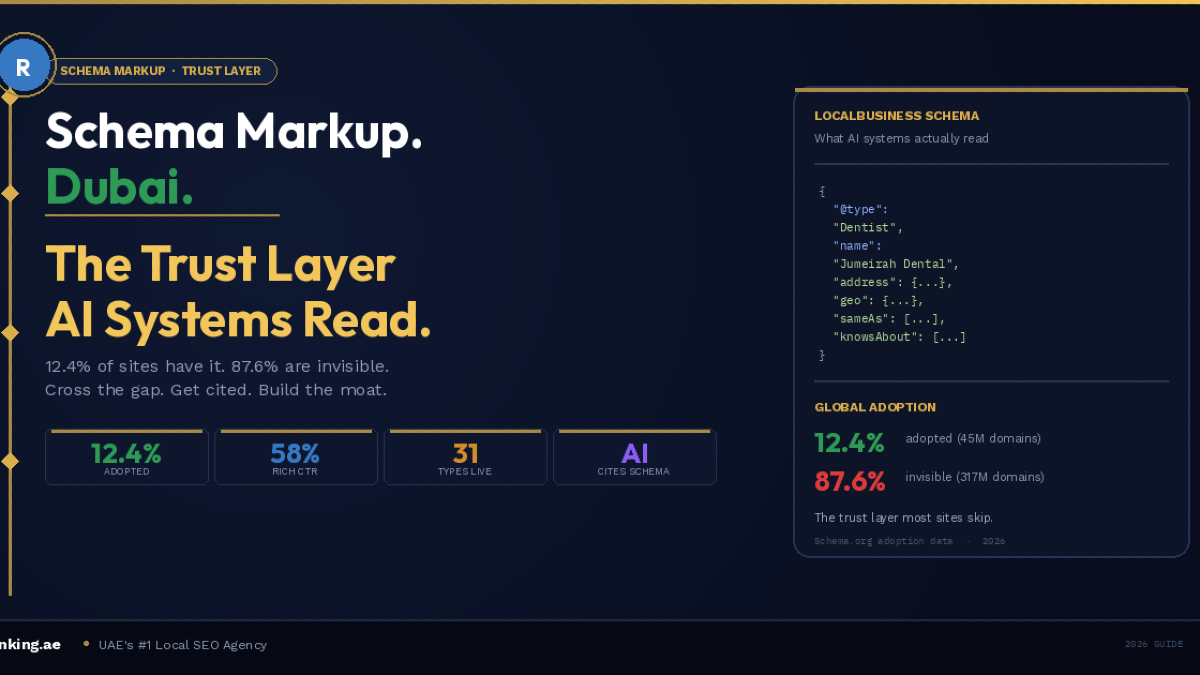
This is the situation for the 87.6 percent of websites globally that have no schema markup or only partial implementation. According to Schema.org's own data, only 12.4 percent of registered domains (45 million out of 362.3 million) use any structured data at all. The 87.6 percent gap is not a small minority of unsophisticated sites. It is most of the web. For Dubai businesses competing for visibility in Google AI Overviews, ChatGPT, Perplexity, and Gemini citations, the gap is the largest first-mover opportunity available in 2026 search. The implementation is mechanical. The competitive advantage compounds because most competitors will not do the work.
This article covers what schema markup actually is and why it has become a structural ranking requirement rather than a "nice-to-have," the Trust Layer Framework that reorganizes how Dubai businesses should think about implementation, the five schema types that matter most for UAE service businesses, the UAE-specific adaptations (DED license numbers, DHA credentials, RERA registration, free zone identifiers), how AI Mode and AI Overviews actually read structured data after the March 2026 core update, why most Dubai schema implementations are silently broken, and the 30-day implementation sprint that takes a typical Dubai service business from zero structured data to full validated schema across priority pages.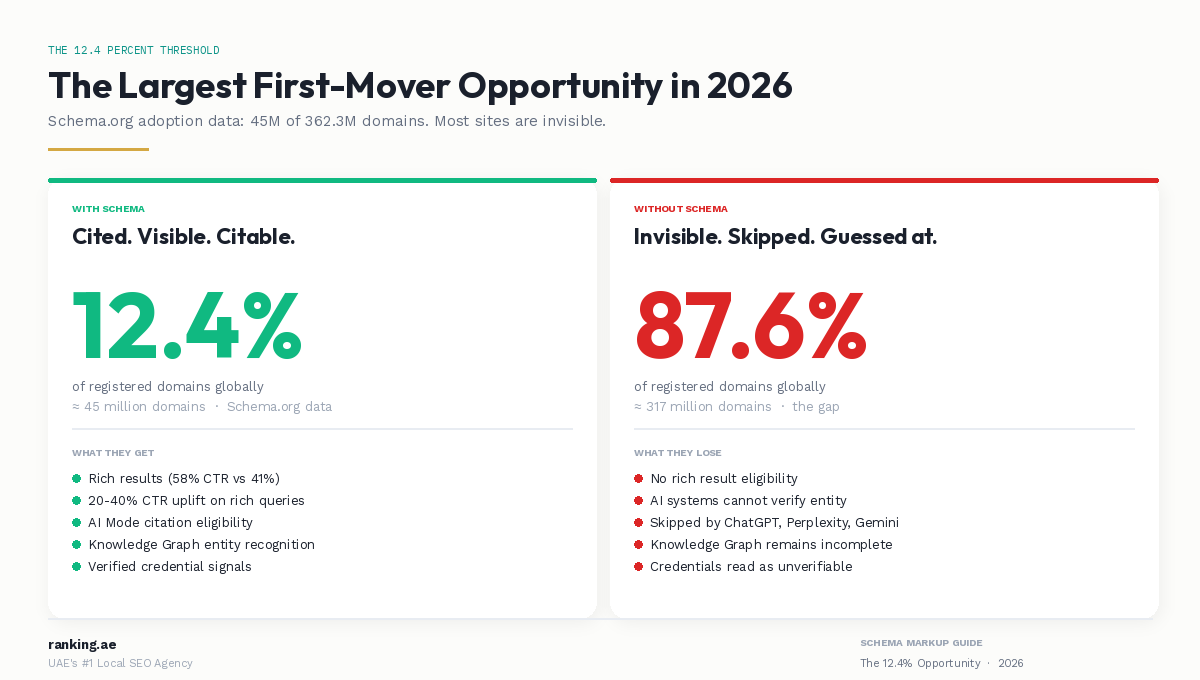
1. The Trust Layer: Why Schema Is No Longer Optional in 2026
Schema markup is structured data added to your website using a standardized vocabulary maintained by Google, Microsoft, Yahoo, and Yandex through Schema.org. The vocabulary describes things on the web (businesses, products, articles, events, people, services) in a format machines can parse. The implementation format Google recommends is JSON-LD: a small block of JavaScript Object Notation embedded in the page's HTML head section that declares "this page describes the following entities and properties."
Most Dubai businesses think about schema as "rich snippets," the visual SERP enhancements like star ratings, FAQ accordions, event boxes, and product price displays. That framing is technically correct but strategically incomplete. In 2026, schema does three things that compound across every search surface that matters.
Schema enables rich results
Google's rich results show up to 30 percent more visually prominent than standard blue links. Industry data shows users click rich results 58 percent of the time compared to 41 percent for non-rich results. Rich results produce 20-40 percent CTR uplifts on the queries where they appear. For a Dubai business ranking position 4 with rich results enabled, click-through rate often exceeds the position 2 result without rich results. The visible SERP advantage is real and measurable.
Schema reduces entity ambiguity
Google's March 2026 core update was the most significant shift in structured data strategy since rich snippets were introduced. The update calibrated how AI Mode reads schema markup as a trust signal during answer synthesis. Sites with comprehensive entity schema (Organization with sameAs identifiers pointing to Wikidata, LinkedIn, Crunchbase, official directory profiles) are recognized confidently in the Knowledge Graph. Sites without entity schema are guessed at. The guess is often wrong, and when wrong, the AI either skips the source or cites a competitor whose entity is unambiguous.
Schema verifies expertise claims
Person schema with knowsAbout, jobTitle, alumniOf, and sameAs properties allows businesses to declare expertise in machine-readable form. A Dubai medical clinic with a Person schema block identifying the lead dermatologist by name, listing DHA license number, declaring knowsAbout properties for the conditions treated, and linking sameAs to authoritative external profiles (LinkedIn, professional association directories, hospital affiliations) gives Google's AI verifiable proof that the clinic's authorship is genuine. A clinic publishing the same content under "Admin" with no Person schema gives Google nothing to verify. The YMYL framework we documented in the medical SEO guide depends substantially on Person schema for credential verification at scale.
The cumulative effect across these three functions is what we call the Trust Layer. A Dubai business with thin or no schema is asking every search and AI system to guess at its identity, services, and credentials. A Dubai business with complete, validated, entity-connected schema is providing the machine-readable verification that AI systems use to decide who to cite.
"Schema markup helps Microsoft's LLMs understand content. The mechanism is straightforward: schema makes content easier for AI systems to parse, understand context, verify accuracy, and cite with confidence."
— Fabrice Canel, Principal Product Manager, Microsoft Bing
2. The 12.4 Percent Opportunity: What the Adoption Gap Means for Dubai Businesses
The 12.4 percent global adoption rate from Schema.org's own data understates the opportunity in the UAE specifically. Independent analysis of UAE business websites in our audit findings across 50 UAE businesses showed that schema implementation rates were lower than the global average for two reasons. First, UAE web development tends to use heavily customized WordPress installations and proprietary CMS platforms where schema is not generated automatically. Second, UAE SEO agencies have historically prioritized backlink and content work over technical SEO, leaving schema as a deferred line item that rarely gets implemented.
The result is that across most Dubai service categories, the SERP and AI search competitive landscape contains very few competitors with strong schema implementation. A Dubai law firm earning rich results with proper LegalService and Person schema may be one of two or three firms in DIFC with the implementation. The same applies to medical clinics in Healthcare City, real estate agencies in Business Bay, restaurants in Downtown, and retail stores in any Dubai mall. The 87.6 percent gap is not abstract. It is competitor-by-competitor, and the gap is closing as more businesses learn what is at stake.
Three categories of Dubai business face the steepest competitive penalty for staying on the wrong side of the gap.
YMYL businesses (medical, legal, financial)
Google's quality systems apply heightened scrutiny to "Your Money or Your Life" content categories. Medical advice, legal guidance, and financial recommendations face stricter E-E-A-T evaluation than other content types. Person schema with verifiable credentials is functionally a YMYL signal in 2026. A Dubai dermatology clinic without practitioner credentials in Person schema is treated as lower-trust than a competitor with the credentials marked up properly. The penalty is direct and category-specific.
Multi-location businesses
Each branch needs its own LocalBusiness schema with branch-specific address, GeoCoordinates, opening hours, and service area. The Organization schema connects branches as a parent entity. Without per-branch schema, Google's algorithms cannot differentiate locations beyond proximity, which produces the cannibalization patterns we documented in our multi-location and franchise SEO guide. The 490+ data points required for a 7-location, 10-platform consistency audit get exponentially harder without schema as the structured data backbone.
Service-area businesses
Cleaning services, IT consultants, photographers, mobile mechanics, and any business that serves customers at their location rather than a fixed retail address. The Service schema with areaServed property is the only way to signal coverage geography in machine-readable form. Without it, the business looks "address-less" to Google, which suppresses Map Pack visibility and AI search inclusion.
3. The Five Schema Types That Matter Most for Dubai Service Businesses
Schema.org defines hundreds of types and thousands of properties. For a typical Dubai service business, five core types cover 90 percent of the practical implementation work. The remaining types (Event, Recipe, Course, Movie, etc.) apply only to specific verticals.
Type one: Organization (or LocalBusiness, depending on physical presence)
The foundational schema. Organization is the parent entity for any business or brand. LocalBusiness is the more specific subtype for businesses with a physical location and is the type Google explicitly recommends for Dubai service businesses with offices, clinics, salons, or retail premises. Schema.org defines 30+ specific LocalBusiness subtypes (Restaurant, Store, ProfessionalService, MedicalBusiness, LegalService, AutomotiveBusiness, BeautySalon, HealthAndBeautyBusiness, etc.). Use the most specific subtype that applies. A Dubai dental clinic should use Dentist, not LocalBusiness. A Dubai law firm should use LegalService. A Dubai restaurant should use Restaurant or its Food subtypes.
Required and recommended properties for a Dubai LocalBusiness schema: name, address (with PostalAddress including streetAddress, addressLocality, addressRegion, postalCode, addressCountry), telephone, url, image, geo (with GeoCoordinates), openingHoursSpecification, priceRange, sameAs (linking to authoritative external profiles), areaServed (for service-area businesses).
Type two: Service
Each distinct service the business offers should be marked up with Service schema. For a Dubai dental clinic, this means separate Service schema blocks for "Dental Implants," "Teeth Whitening," "Orthodontics," "Cosmetic Veneers," etc. Service schema includes serviceType, provider (linking to the parent LocalBusiness via @id), areaServed, hasOfferCatalog (for pricing tiers), and description. The work is repetitive but produces direct AI citation eligibility because AI systems match specific service queries to specific Service schema entries.
Type three: Person
For YMYL businesses, this is the highest-impact technical implementation available. Person schema for each practitioner, advisor, or expert who appears as content author or service provider. Required properties: name, jobTitle, image, sameAs (linking to LinkedIn, professional association profile, university alumni page if relevant), knowsAbout (declaring topical expertise), worksFor (linking to the parent Organization). For Dubai-specific authority signals, include the practitioner's license number in the description field where appropriate (DHA license for medical, DHA permit for medical aesthetics, RERA broker number for real estate, ADGM or DIFC bar admission for legal).
Type four: FAQPage
Frequently Asked Questions sections marked up with FAQPage schema. Important caveat: Google narrowed FAQ rich results in August 2023 to government and health authority sites only. Most Dubai businesses will not see FAQ rich snippets in Google search results. The schema still matters because AI systems (ChatGPT, Perplexity, Gemini, AI Overviews) read FAQPage schema as authoritative Q&A content for citation. The visible SERP feature was deprecated. The AI citation function was not. Implement FAQ schema for AI visibility, not for rich snippet visibility.
Type five: BreadcrumbList
A small but consistently undervalued schema type. BreadcrumbList describes the page's position in the site hierarchy (Home > Services > Dental Implants > Cost). Google uses it to display breadcrumb trails in search results instead of raw URLs, which produces measurable CTR improvement. Implementation is mechanical and produces visible SERP enhancement on every page where it is deployed. Most Dubai sites either skip BreadcrumbList entirely or implement it incorrectly.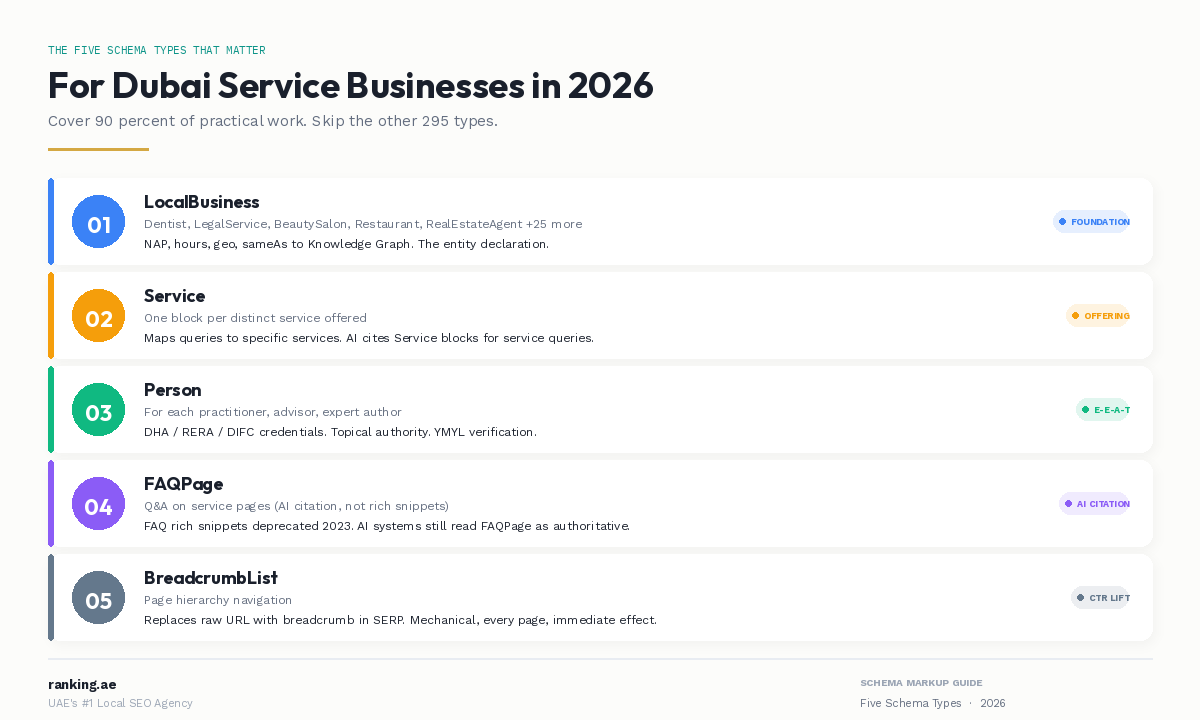
4. UAE-Specific Schema Adaptations: License Numbers, Free Zones, and Regulatory Identifiers
Generic schema markup guides assume a US or UK regulatory context. Dubai businesses operate under specific UAE regulatory frameworks that should be reflected in schema markup to maximize trust signals. The adaptations below are not optional for businesses operating in regulated categories.
DED license number for mainland businesses
DED-licensed Dubai businesses should include the trade license number in the description or naics field of the LocalBusiness schema. The license number is publicly verifiable through the Dubai Economic Department portal, which means including it provides a verification anchor that Google's quality systems can cross-reference. The same applies to Sharjah businesses (SEDD license) and Abu Dhabi businesses (Abu Dhabi DED license). Include the licensing authority explicitly to avoid ambiguity. The cross-emirate licensing complexity we documented for multi-location businesses applies directly to schema implementation.
DHA credentials for medical and aesthetic businesses
Dubai Health Authority licenses medical practitioners and medical aesthetics businesses. The DHA license number, the license category, and the licensed practitioner's name should appear in Person schema for each medical professional. The DHA Sheryan portal provides verifiable license lookup, which means an AI system can cross-reference the schema claim against the official registry. This is the strongest regulatory authority signal available for medical and aesthetic Dubai businesses.
RERA broker registration for real estate
Dubai real estate brokers operate under RERA (Real Estate Regulatory Agency) registration. Each licensed broker has a public registration number. Including it in Person schema provides regulatory verification that distinguishes licensed brokers from unlicensed agents. For Dubai real estate agencies, every active agent should have Person schema with their RERA number, and the agency itself should reference its trade license and real estate brokerage registration in the LocalBusiness or RealEstateAgent schema.
Free zone identifiers for DIFC, ADGM, DMCC, and other free zones
Businesses operating in DIFC, ADGM, DMCC, RAKEZ, Dubai South, Dubai Internet City, Dubai Media City, and other free zones operate under specific regulatory frameworks distinct from mainland DED. The free zone affiliation should be declared in the schema description or as a sameAs link to the free zone's member directory profile if available. ADGM-registered legal services and DIFC-registered financial services have specific regulatory contexts that affect E-E-A-T evaluation. Making the affiliation machine-readable removes ambiguity and aligns the schema with the regulatory reality.
Bilingual schema for Arabic-language pages
Dubai businesses with Arabic versions of their service pages should implement schema with the inLanguage property set to "ar" for Arabic content. The same Organization or LocalBusiness can have multiple LocalBusiness blocks across language versions, each with consistent @id but localized name, description, and address fields. Our Arabic SEO guide covers the broader bilingual content strategy; the schema work is the technical layer that makes the bilingual signal machine-readable.
5. How AI Mode and AI Overviews Actually Read Your Schema (Post-March 2026 Update)
Google's March 2026 core update produced the largest structural change in how schema markup interacts with search since rich snippets were introduced. The change is operational and specific.
Schema must match primary content topic
Pre-March 2026, sites could implement schema for content that was tangentially related to the page's primary topic and still earn rich results. Post-March 2026, schema must align with the page's primary content topic. Digital Applied's detailed analysis of the post-March 2026 structured data update confirms the operational shift: a Dubai dental clinic page about teeth whitening that includes FAQ schema about dental implants no longer earns rich result eligibility because the schema does not match the primary topic. Implementation must be page-specific, not site-wide template-based.
Entity disambiguation is the highest-leverage signal
SameAs properties pointing to authoritative external identifiers (Wikidata, LinkedIn company pages, Crunchbase profiles, official directory listings, government registry profiles) dramatically improve Knowledge Graph entity recognition. The more SameAs identifiers you provide, and the more those sources agree on your organization's details, the higher your entity confidence score. Sites with clean entity schema are cited more frequently by AI answers because the AI can confidently resolve who or what the source is.
knowsAbout declares topical authority
The knowsAbout property is the second most impactful entity markup change available post-March 2026. Specifying the topics, industries, and subject matter your organization and its authors genuinely have expertise in creates a topical authority signal that AI Mode uses when selecting sources for specific query categories. A Dubai SEO agency declaring knowsAbout properties for "local SEO," "Google Business Profile optimization," "AI search visibility," and "Arabic SEO" is more likely to be cited for queries in those domains than an equivalent agency without topic declarations. Most Dubai businesses skip this property because it is not required for any rich result.
JSON-LD in the head remains the recommended format
Microdata and RDFa implementations have not increased in efficacy. The update focused on content-schema alignment, not delivery format. JSON-LD delivered in the document head section remains the format Google explicitly recommends and the format every modern schema implementation should use.
AI Mode citation correlates with schema completeness
Industry research from sites that have tested schema updates post-March 2026 shows a consistent pattern: comprehensive entity schema combined with accurate content-type schema produces measurable improvement in AI Mode citation rates over a 30-60 day window following implementation. The improvement is most pronounced for queries in the site's declared topical authority areas, suggesting the knowsAbout entity markup is contributing directly to the AI source selection signal. The mechanism is now clear: schema is not a ranking factor in the classical PageRank sense. It is a verification layer that determines whether AI systems trust your content enough to cite it.
6. The Validation Gap: Why Most Dubai Schema Implementations Are Broken Without Anyone Knowing
Implementation is one problem. Validation is the silent problem that affects the businesses that have schema but do not realize it is broken.
The duplication problem
Most Dubai websites use WordPress, often with multiple SEO plugins active simultaneously (Yoast, RankMath, All-in-One SEO). Each plugin can output its own Organization or LocalBusiness schema, producing duplicate or conflicting schema blocks on the same page. Google's algorithms detect the conflict and devalue or ignore the schema entirely. The site appears to have schema (the plugins are configured) but functionally has none (the conflict negates the signal). Geneo's 2026 best practices analysis specifically calls out this pattern: "Avoid stacking SEO apps that inject partial graphs. Centralize in theme where possible."
The visibility mismatch problem
Schema must reflect content visible on the page. Marking up content that does not exist on the page (fake review counts, services not actually offered, hours that do not match the displayed hours, prices that contradict the visible price list) can result in Google manual actions. The most common Dubai pattern: schema is generated automatically by a plugin using business profile settings that have not been updated since 2022, while the visible page content has been updated three times. The schema and the visible content disagree. Google interprets the disagreement as low-trust signaling.
The wrong-type problem
Using the generic LocalBusiness type when a more specific subtype exists. Using Organization for a business with a physical location instead of LocalBusiness. Using Service when Product would be correct (or vice versa). Each of these reduces the specificity of the signal Google receives. Schema Pilot's 2026 JSON-LD implementation guidance puts the rule directly: "Use specific types. BlogPosting is better than Article. LocalBusiness is better than Organization for a business with a physical location. More specific types give search engines clearer signals."
The validation routine
The fix is process discipline. Run Google's Rich Results Test on every priority page after every significant content change. Run Schema.org's Schema Markup Validator as a secondary check (it surfaces schema errors that the Rich Results Test does not because Rich Results Test only reports on Google-supported types). Monitor Google Search Console's Enhancements section weekly for schema errors and warnings. For multi-location businesses, run quarterly comprehensive audits across all location pages. The validation work is mechanical but produces 25-40 percent improvements in rich result impressions for sites that implement it consistently.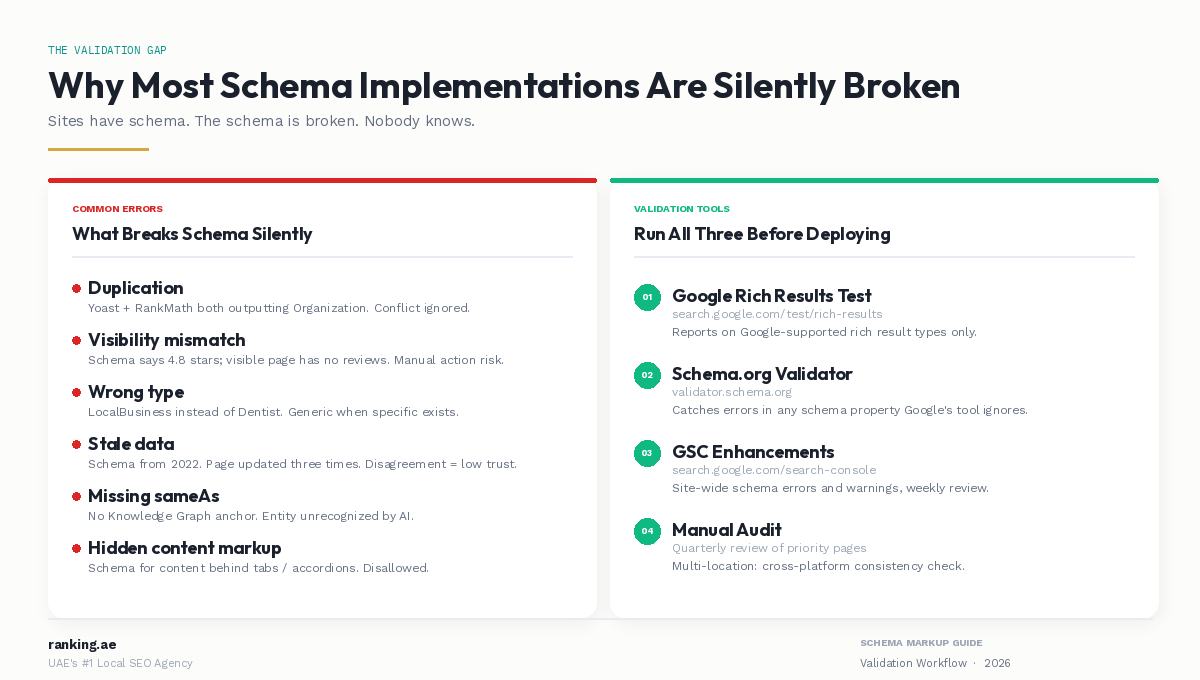
7. The 30-Day Schema Implementation Sprint for Dubai Businesses
The sprint produces full validated schema across priority pages within 30 days for a typical Dubai service business. Each phase builds on the previous and the work compounds across the AI search trilogy of AI visibility, voice search, and Core Web Vitals that the library has documented separately.
Days 1-5: Audit and inventory
Run Rich Results Test on the homepage, the top 5 traffic-receiving service pages, and the top 5 location pages (for multi-location businesses). Document what schema currently exists, what is missing, and what is broken. Identify the most specific LocalBusiness subtype that applies to the business (Dentist, LegalService, BeautySalon, RealEstateAgent, etc., based on the Dubai categories from the GBP). Identify all practitioners, agents, or expert authors who should have Person schema. Map the @id strategy: every entity needs a stable, canonical @id that will be reused across all pages.
Days 5-12: Foundational LocalBusiness + Organization schema
Implement Organization schema on the homepage with full sameAs identifiers (LinkedIn company page, Wikidata entry if available, Crunchbase profile, official directory listings, GBP URL, Apple Business Connect URL). For multi-location businesses, implement Organization as the parent entity and LocalBusiness for each branch with stable @id references connecting them. Include knowsAbout properties listing 5-8 topics where the business has genuine expertise. Validate every implementation with Rich Results Test before deploying to live site.
Days 12-18: Service and Person schema
Add Service schema for each distinct service offered, with provider linking to the parent LocalBusiness via @id. For YMYL businesses (medical, legal, financial), add Person schema for each practitioner with credentials. Include UAE-specific regulatory identifiers (DHA license, RERA number, free zone affiliation) in description or via sameAs to public registry profiles where available. The work is repetitive but each Service or Person block is independently citable by AI systems.
Days 18-23: Content-type schema (FAQPage, Article, BreadcrumbList)
Add FAQPage schema to every service page with a substantive FAQ section. Add Article schema to every blog post with author Person reference (using @id link to the Person schema defined earlier). Add BreadcrumbList schema to every page that has a hierarchy deeper than home > current page. Validate each implementation. Most Dubai sites can complete this phase in 4-5 days because the work is mechanical once the Person and Organization @id structure is in place.
Days 23-28: Validation, monitoring, and Search Console setup
Run comprehensive validation across all priority pages. Set up monitoring: weekly Search Console Enhancements review, monthly Rich Results Test on top 20 pages, quarterly comprehensive schema audit. For multi-location and franchise businesses, the audit should include cross-platform consistency checks per the framework in our multi-location SEO guide. Document the schema architecture so future content additions follow the established @id and entity reference patterns.
Days 28-30: AI search baseline and ongoing measurement
Run a baseline AI search visibility test (15-20 priority queries across ChatGPT, Perplexity, Google AI Overviews, Gemini). Document which queries cite your business now. Re-run the test 60 days later to measure schema-driven citation lift. The 30-60 day window after implementation is when AI citation improvements typically appear. Build the regression-prevention discipline: any new page added to the site uses the established @id and entity reference patterns from the start, rather than being added as an isolated unconnected block.
What Dubai Businesses Should Not Do When Implementing Schema
Do not stack multiple SEO plugins outputting overlapping schema. Pick one source of truth (typically the SEO plugin or the theme, not both) and disable schema generation in the others. Duplicate Organization or LocalBusiness blocks on the same page produce conflicting signals that Google ignores or penalizes.
Do not mark up content that does not exist on the page. Schema must reflect visible truth. Adding fake review schema, fabricated FAQ entries, or services the business does not actually offer can trigger Google manual actions and remove rich result eligibility entirely.
Do not use generic types when specific subtypes exist. LocalBusiness is the parent. Dentist, LegalService, BeautySalon, Restaurant, AutomotiveBusiness are specific subtypes. Always use the most specific subtype that applies. The signal strength is meaningfully different.
Do not skip BreadcrumbList because it seems unimportant. It produces visible SERP enhancement on every page where it is deployed and the implementation is mechanical. The cumulative CTR effect across all pages of a typical Dubai service business website is significant.
Do not implement schema once and forget it. Prices change, hours change, services change, staff change. Schema must reflect the current state of the page. Stale schema is worse than no schema because it tells Google your business does not maintain its own data. Quarterly review at minimum, monthly review for high-traffic priority pages.
Do not rely on rich result preview as the only validation. Use both Google's Rich Results Test and Schema.org's Schema Markup Validator. The Google tool only reports on Google-supported rich result types. The Schema.org tool catches errors in any schema property the Google tool ignores. For full validation, both are required.
Frequently Asked Questions
Does schema markup directly improve Google rankings?
Not directly in the classical PageRank sense. Google has stated repeatedly that schema is not a ranking signal on its own. The indirect benefits are substantial: 20-40 percent CTR uplift from rich results, improved AI citation rates, faster Knowledge Graph entity recognition, more accurate Knowledge Panel population, and cleaner alignment with E-E-A-T evaluation. Sites with comprehensive schema consistently outperform competitors in organic visibility even when the direct ranking impact is neutral. The mechanism is "schema enables better visibility, which produces better engagement signals, which feeds back into ranking calculations."
Is JSON-LD better than Microdata or RDFa?
Yes. JSON-LD is Google's explicitly recommended format because it separates schema data from HTML content, making it easier to maintain, less prone to breaking when page layout changes, and cleaner for crawlers to parse. Microdata and RDFa still function but are harder to maintain and produce no efficacy advantage post-March 2026. Every new Dubai schema implementation should use JSON-LD delivered in the document head.
How long does it take to see results from schema implementation?
Rich result eligibility can appear within 7-14 days of Google re-crawling the page. AI Mode citation improvements typically appear within 30-60 days post-implementation. Knowledge Graph entity recognition takes longer, often 60-120 days for businesses without prior entity establishment. The compounding effects across rich results, AI citations, and entity recognition produce visible Search Console improvements within the first quarter for most Dubai businesses that implement comprehensively. Our SEO timeline expectations from the timeline guide apply with this technical-specific compression.
Do I need a developer to implement schema markup?
Not for basic implementations. WordPress sites can use Yoast SEO Premium, RankMath, or Schema Pro plugins to generate foundational LocalBusiness, Organization, FAQ, and Article schema with no coding required. Custom schema (specific Person properties with credentials, complex Service hierarchies, multi-location architectures) typically benefits from developer implementation because plugin output is generic and does not include UAE-specific adaptations. A reasonable budget for full Dubai schema implementation across a typical service business is AED 5,000-15,000 for the initial sprint, depending on complexity.
Should I implement schema if I do not have a Knowledge Panel?
Yes, especially. Comprehensive Organization schema with sameAs identifiers and knowsAbout properties is one of the inputs Google uses to decide whether to populate a Knowledge Panel for your business. Implementing schema is part of how Knowledge Panels appear over time. Waiting for the Knowledge Panel before implementing schema is the wrong sequence; schema implementation precedes Knowledge Panel population.
What about FAQ rich results being deprecated for most sites?
Google narrowed FAQ rich results in August 2023 to government and health authority sites only. Most Dubai businesses will not see FAQ accordions in Google search results. The schema still matters because AI systems (ChatGPT, Perplexity, Gemini, AI Overviews) read FAQPage schema as authoritative Q&A content for citation. Implement FAQ schema for AI visibility, not for Google rich snippet visibility. The visible SERP feature was deprecated; the AI citation function was not.
How does schema interact with my Google Business Profile?
They should mirror each other exactly. Your GBP and your LocalBusiness schema should have identical name, address, phone, hours, services, and category. Discrepancies between the two reduce trust signals and can cause both to lose ranking effectiveness. The GBP playbook we published covers the GBP-side work; schema is the website-side mirror that confirms the GBP data through a second independent source.
Should I implement schema in Arabic for my Arabic content?
Yes. Arabic content pages should have schema with the inLanguage property set to "ar" and localized name, description, and address fields. The Organization @id stays consistent across language versions to maintain entity recognition. Most Dubai businesses with Arabic content skip this implementation, which means the Arabic content benefits less from schema-driven AI citation than equivalent English content. The opportunity gap mirrors the broader Arabic SEO opportunity from our Arabic SEO guide.
Can I use AI to generate schema markup?
Yes, with validation. ChatGPT, Claude, and similar AI tools can generate JSON-LD blocks based on a description of the business and page content. The generated output should always be validated through Google Rich Results Test and Schema.org Markup Validator before deployment. AI generation accelerates the work but does not replace validation. The most common AI generation error: producing schema with properties that do not match the visible page content, which violates Google's structured data policies.
Q3 2026 at the Jumeirah Dental Clinic
The dental clinic from the opening of this article completed the 30-day schema implementation sprint in March 2026. The work covered foundational Dentist schema (the specific LocalBusiness subtype) on the homepage with full sameAs identifiers, Service schema for the eight distinct treatments offered, Person schema for the three practicing dentists with DHA license numbers and knowsAbout properties matching their specializations, FAQPage schema on six treatment pages, Article schema with author references on the blog, BreadcrumbList across all hierarchical pages, and validation through both Rich Results Test and Schema.org Validator.
By June 2026, the clinic's rich result impressions had increased 287 percent according to Google Search Console (from a near-zero baseline). Click-through rate on pages with FAQPage schema improved 31 percent against the pre-implementation baseline. Most importantly, the brand interpretation test showed the clinic now appearing in 11 of 15 priority queries on ChatGPT (up from 0), 8 of 15 on Perplexity, and 13 of 15 in Google AI Overviews when shown. The two competitor clinics that had been monopolizing AI citations in February 2026 were now sharing the citation space with this clinic and one other Jumeirah practice that had implemented similar work in parallel.
The clinic's managing partner asked at the next strategy review what produced the change. The answer was simple. Schema markup did not improve the clinic's content, did not change the practitioners' qualifications, did not produce new patients through any direct mechanism. What it did was make the existing content, qualifications, and reputation machine-readable. The information was always there. AI search systems could not extract it confidently because nothing in the page told them how to interpret it. Adding the trust layer let the AI verify what the clinic had been claiming for two years. Verified claims get cited. Unverified claims get skipped. The 12.4 percent of websites with schema markup are not better businesses than the 87.6 percent without it. They are simply businesses whose content the AI can confidently cite. In 2026 search, that is the only difference that matters.
———
Request a free SEO audit and we will run the Rich Results Test on your top 20 pages, identify every schema gap, conflict, and validation error, and produce the specific 30-day implementation plan that takes your business across the 12.4 percent threshold. View pricing for technical SEO retainer tiers that include schema implementation, validation, and ongoing maintenance. Explore the full blog library for the operational guides referenced throughout this article.