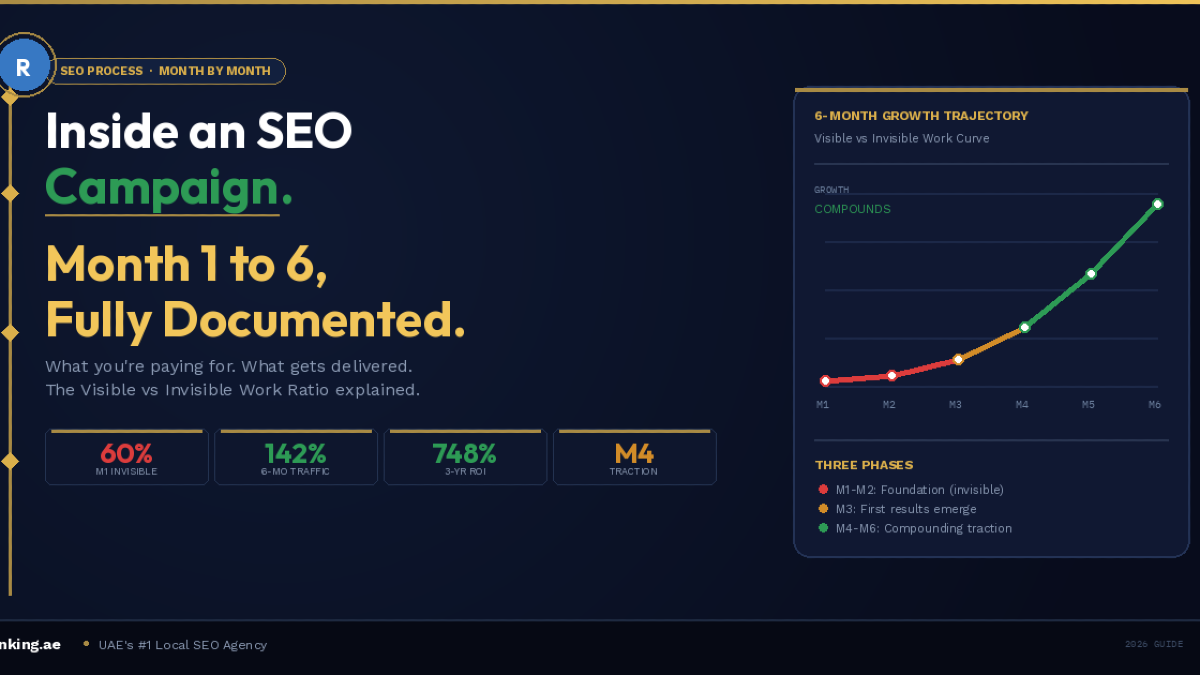
A client sat across the table at 11am on a Thursday in November 2024, looked at the contract, and asked: "I'm paying AED 2,999 per month for six months. What exactly am I getting for that?"
The answer took forty-seven minutes. He left the meeting with a printed schedule of the work that would happen each month, the specific deliverables he would receive at each cycle, and the framework for understanding why the first three months would feel like nothing was happening even though the work behind the scenes was the most important part of the entire campaign. Six months later, organic traffic had increased 142 percent, the firm's priority service pages were ranking in the top 5 for thirteen target queries, and the managing partner asked one question at the renewal meeting: "Why does no agency explain it this way at the start?"
They do not explain it because the explanation is uncomfortable. The first month of an SEO campaign produces no rankings, no traffic, and no leads. That is not a warning sign. It is the correct outcome of correctly executed work. Independent SEO research confirms the pattern: "Month 1 produces no rankings. That is not a warning sign — it is the correct outcome." Most Dubai businesses do not know this because most agencies do not tell them. The agencies that lose clients in months 2 and 3 are the agencies that did not pre-set expectations correctly. The clients who cancel in month 3 then describe SEO as "a scam" to anyone who will listen, which makes the next agency's job harder, which makes the cancellation cycle perpetuate.
This article covers what an SEO campaign actually does in months 1, 2, 3, 4, 5, and 6. Not in marketing language. In specific deliverables, specific work hours, specific reasons each step matters, and specific milestones that should appear at each cycle. The framework is the Visible vs Invisible Work Ratio, and once a Dubai business owner understands it, the first three months stop feeling like silence and start looking like exactly what they should look like: foundation work that determines whether months 4 through 12 produce strong results or mediocre ones.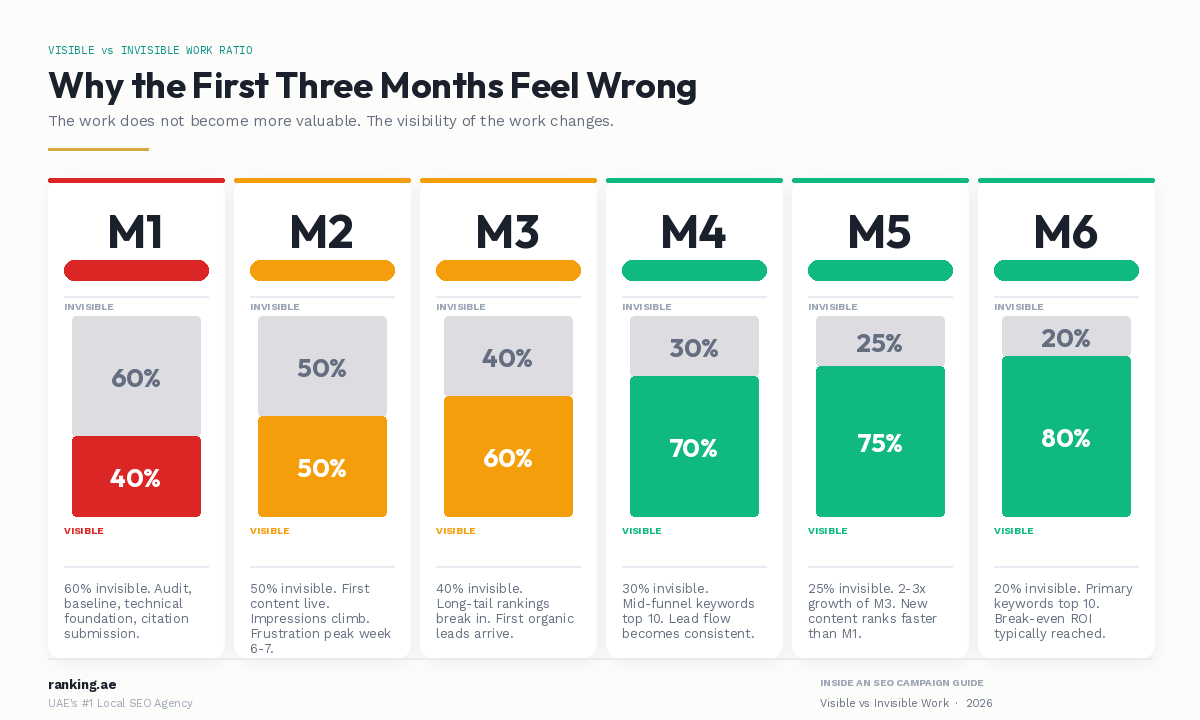
1. The Visible vs Invisible Work Ratio: Why the First Three Months Feel Wrong
Most agency-client tension in SEO comes from a measurement mismatch. The client measures progress through what they can see: rankings, traffic, leads, revenue. The agency in the early months produces work that the client cannot see: technical fixes that affect crawl efficiency, schema implementations that make pages eligible for rich results, internal link restructures that redistribute authority, baseline conversion tracking that becomes the comparison point for every later report, citation foundation work that establishes entity verification across UAE directories. None of this work appears in the metrics the client is watching. All of it is necessary for the metrics the client wants to see in months 4 through 12.
The Visible vs Invisible Work Ratio describes how this balance shifts predictably across a six-month campaign. The work itself does not become more valuable in later months. The visibility of the work changes. Industry analysis from Upgrowth's case study work across companies including MarketSmith, Scripbox, Qikink, and Fi.Money confirms the pattern: "Month 1 builds the foundation. Month 2 accelerates execution. Month 3 reveals early signals of success."
Month 1: Approximately 60 percent invisible
Audit, baseline measurement, technical foundation, keyword mapping, conversion tracking setup, GBP optimization, citation submission, schema deployment. The client sees a strategy document, an audit report, and the first content brief. Almost no metrics move. The work is real and substantial. The visibility is low because nothing the work produces has yet hit Google's index in a measurable way.
Month 2: Approximately 50 percent invisible
First content publications go live. Optimized service pages deploy. Internal linking restructure begins. Google starts crawling the changes. Impressions in Search Console begin to rise even though clicks have not. The client can now see the published content but cannot yet see ranking movement on it. The frustration peak typically occurs at week 6-7, when the client has paid two months of fees and seen no traffic increase.
Month 3: Approximately 40 percent invisible
First visible movement. Long-tail keywords (lower-competition queries) begin entering positions 11-30. The first organic leads from new content start arriving. Search Console impressions are now meaningfully above baseline. The visible/invisible ratio has flipped to roughly half visible. The client begins to feel that something is happening but the metrics are not yet impressive enough to feel like success.
Month 4: Ratio flips to 70 percent visible
Traction phase begins. Mid-funnel keywords enter top 10. Organic traffic shows clear week-over-week growth. Lead flow from organic search becomes consistent rather than sporadic. The work being done in month 4 (continued content production, link earning, technical refinement) is similar to month 3 in nature, but the cumulative effect of months 1-3 now produces visible results from the new month's work almost immediately. This is the inflection point where the campaign starts to feel "worth it" to most clients.
Months 5 and 6: 75-80 percent visible
Compounding effects accelerate. Pages published in month 2 are now matured, ranking in top 5 for their primary queries. Pages published in month 4 reach top 10. Domain authority signals from accumulated backlinks improve baseline ranking eligibility for all new content. The work is no longer about "starting" the campaign. It is about scaling what is working and replacing what is not. Reporting becomes outcome-focused (revenue from organic, leads per query, conversions per page) rather than process-focused (pages published, technical fixes completed).
The Visible vs Invisible Ratio is the single most important framework for evaluating SEO progress month-by-month. A client who knows that month 1 will look like nothing is the client who does not cancel in month 3. A client who expects rankings by month 2 is the client whose campaign gets cut short before the foundation work has been allowed to compound.
"Month 1 produces no rankings. That is not a warning sign — it is the correct outcome. During this phase, an SEO team conducts a full site audit, maps priority keywords to URL targets, identifies and queues technical fixes, and sets up Google Analytics 4 and Google Search Console with proper conversion tracking."
— Metrics Rule, Realistic SEO Timeline Analysis 2026
2. Month 1: Foundation, Audit, and Baseline (The Month That Looks Like Nothing)
Month 1 is the most consequential month of an SEO campaign, and almost no client realizes this until month 6 looking back. The work done in month 1 determines whether months 2 through 12 produce strong results or mediocre ones. Cutting corners in month 1 is the single most common reason for SEO underperformance, and it usually happens because the agency feels pressure to produce visible work rather than to do the foundation correctly.
Week 1: Diagnostic and baseline measurement
A comprehensive technical audit covering crawlability, indexation, Core Web Vitals, mobile usability, security flags, and structured data validity. The audit produces a documented list of issues categorized by impact (critical, high, medium, low) and effort. The baseline measurement captures current rankings on 30-50 priority queries, current organic traffic by page, current conversion rates, and current Google Business Profile performance metrics. Without this baseline, no later report can credibly claim the campaign produced anything. The audit framework we documented across 50 UAE businesses covers the specific findings patterns this work surfaces.
Week 2: Keyword and competitor research
Comprehensive keyword research producing a tiered priority list: branded queries (already winning), low-hanging fruit (positions 8-20 where small content improvements produce big ranking gains), primary commercial queries (the main targets for the campaign), supporting informational queries (top-of-funnel content), and long-tail queries (specific high-intent variations). Competitor analysis covers the top 5-10 competitors' content gaps, backlink profiles, technical performance, and content strategy. The output is a keyword-to-URL mapping document that determines what content gets optimized, created, or pruned in the following months.
Week 3: Technical foundation deployment
Critical technical fixes from the week 1 audit get implemented. Typical work includes Core Web Vitals optimization (covered in detail in our page speed and Core Web Vitals guide), schema markup implementation across priority pages, internal linking restructure to redistribute authority, broken link cleanup, redirect chain elimination, sitemap optimization, and robots.txt review. The work is operational and produces no immediate visible effect, but every later content piece performs better because the foundation is solid.
Week 4: GBP optimization and citation submission
For local Dubai businesses, Google Business Profile optimization is the highest-leverage week 4 work. Profile completion, category refinement, services and products updates, photos refresh, Q&A population, attributes verification. Citation submission across 30-50 UAE directories begins (Yellow Pages UAE, Dubai Yellow Pages Online, EmiratesBD, Yello UAE, GetListedAE, Hi Dubai, Bayut, Dubizzle, Zawya, Dubai Chamber directory, sector-specific platforms). The work is mechanical but produces both citation foundation and the first measurable Map Pack ranking improvements within 60-90 days.
Month 1 deliverables the client should receive
The audit report (typically 30-60 pages with prioritized issues), the keyword-to-URL mapping document, the competitor analysis, the technical fixes log (with before/after screenshots where applicable), the citation submission tracker, and the month 1 baseline metrics dashboard. The client should also have direct access to Google Search Console, Google Analytics 4, Google Business Profile, and the Looker Studio reporting dashboard set up by the agency.
What month 1 should NOT show
Significant ranking changes. Significant traffic increases. Significant lead flow improvements. Anyone promising these in month 1 is either using black-hat tactics that will produce penalties later or is misrepresenting the work. The leading indicators that should improve in month 1 are: cleaner Search Console index coverage, fewer crawl errors, an updated XML sitemap, and rising impressions even if clicks have not moved. SEO consultant Luca Tagliaferro's timeline analysis captures the diagnostic precisely: "If you cannot show improved indexing and impressions by the end of month 1, you have a discovery problem — and no amount of content will solve it until the technical foundation is repaired." Our SEO timeline guide covers the broader expectation framework.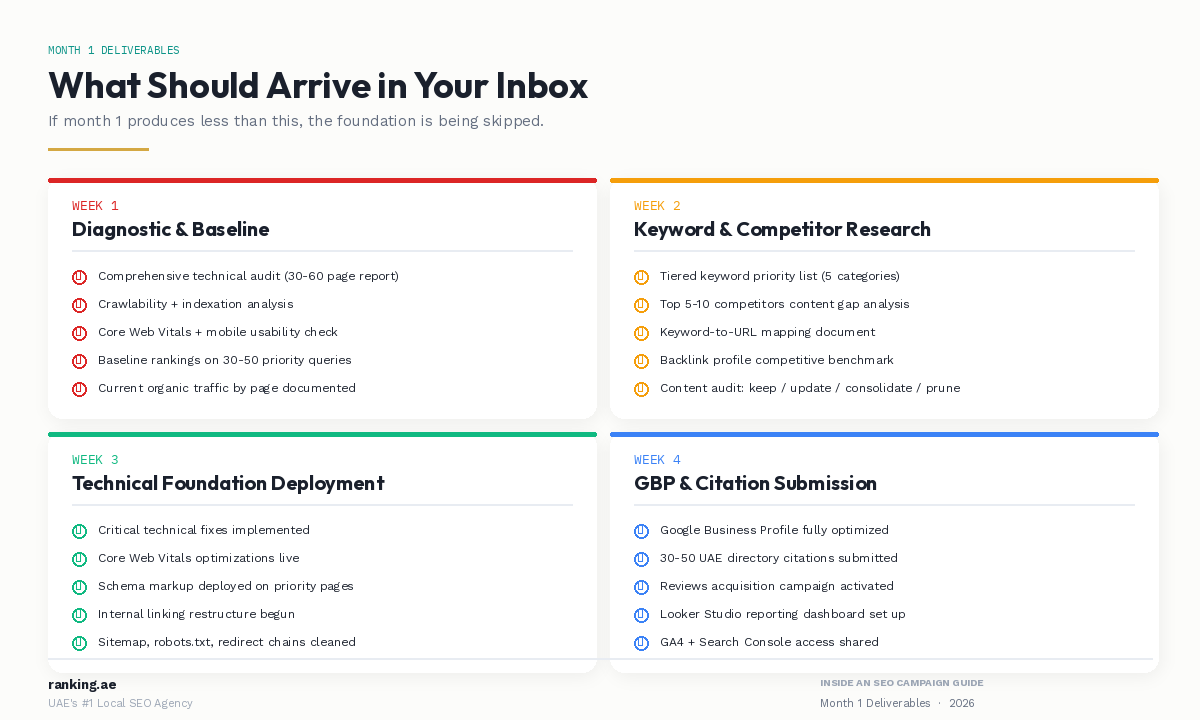
3. Month 2: Content Production, On-Page Optimization, and the Frustration Peak
Month 2 is the toughest month of any SEO campaign for client psychology. Foundation work continues but most of it is invisible. Content production begins but the new pages are not yet ranked. Search Console impressions begin climbing but clicks have not followed. The client has now paid two months of fees and seen no measurable business outcome. The frustration peak typically occurs at week 6-7, and this is where most cancellations happen.
Week 5: First content wave deployment
Based on the keyword-to-URL mapping from month 1, the first wave of optimized service pages and pillar content goes live. For a Dubai service business, this typically means rewriting 5-10 priority service pages and publishing 2-4 new pillar articles targeting top-of-funnel queries. Each piece follows the answer-first content structure: H2 phrased as a question, 40-60 word direct answer immediately below, supporting context after. The structure is essential for
voice search, AI Overview citation, and featured snippet eligibility, all of which we documented across separate posts. Internal links connect new content to existing high-authority pages.
Week 6: On-page optimization at scale
Title tags, meta descriptions, header hierarchy, image alt text, and URL structure get optimized across the priority page set. The work is mechanical but high-leverage: a service page with a poorly written title tag can lose 30-50 percent of available CTR even when ranking well. Meta description optimization specifically targets the click-through behavior that feeds back into ranking signal through Google's NavBoost system. Image compression and WebP conversion address the LCP component of Core Web Vitals.
Week 7: Initial link earning and outreach
PR outreach begins for the first wave of original content assets. The work targets Tier 4 lifestyle blogs and Tier 5 directories first because acceptance rates are higher and the wins compound trust signals before the higher-tier outreach. The citation-to-backlink bridge framework from our backlinks guide covers the sequencing in detail. By end of week 7, expect 3-8 directory citations confirmed and 1-2 lifestyle blog mentions in progress.
Week 8: Schema deployment continues, GBP Posts begin
Schema implementation extends to the newly published content. FAQPage, Article, and BreadcrumbList schema deploy on every new page following our schema markup framework. GBP Posts (event posts, offer posts, update posts) begin a regular cadence. Reviews acquisition campaigns activate per the reviews operations manual. The cumulative effect is a substantial increase in trust signals across the local SEO ecosystem.
Month 2 deliverables the client should receive
A list of every page optimized or created with before/after element comparisons (title tag changes, meta description changes, content additions). The Search Console impressions trend chart showing the week-over-week climb. The citation submission progress tracker. The first PR outreach pipeline status. The GBP Posts publication log. The technical fixes completed log. Total deliverable volume in month 2 is meaningfully higher than month 1, even though business outcomes have not yet moved. Programming Insider's monthly SEO deliverables checklist captures the expectation framework: "Vague statements like 'on-page SEO completed' are not sufficient deliverables." Page-by-page documentation with specific element changes is the minimum standard.
The week 6-7 conversation the client should have with their agency
"I am not seeing rankings move yet. Walk me through what is happening." A good agency response includes the impressions trend (showing Google has crawled the new content and is testing it in SERP), the indexation report (showing all priority pages are indexed), the technical fixes log (showing the foundation has been improved), and the projected ranking timeline based on competitor analysis. A bad agency response is "trust the process." Trust is earned by transparency about what is happening, not by reassurance about what will eventually happen.
4. Month 3: First Visible Results and the Long-Tail Breakthrough
Month 3 is the inflection point. The first long-tail keywords break into rankings. Organic traffic from new content starts arriving. The first leads attributable to organic search appear. The numbers are still modest, but for the first time the campaign has visible business outcomes.
Week 9: Long-tail rankings begin
Pages published in week 5 are now 4-5 weeks old. Google has crawled them, indexed them, and begun ranking them on long-tail queries (specific phrases with lower competition). Expect 5-15 long-tail keywords entering positions 11-30 by week 9, with another 5-10 in the 30-50 range. None are at top 3 yet, but all are now within striking distance for content refinement and link building. The CTR curve from independent industry data shows position 1 generates 27 percent CTR, position 3 generates 10 percent, position 5 generates 5 percent, position 10 generates 2-3 percent. Moving from position 20 to position 8 may double or triple traffic from a single keyword even before reaching the first page.
Week 10: Content refinement on emerging rankings
The pages now ranking on long-tail queries get analyzed and refined. Common improvements: deeper answer capsules for queries where Google selected a competitor's page as featured snippet, additional FAQ sections matching specific People Also Ask questions, internal links from higher-authority pages to push the ranking pages further up. The work is targeted (specific to the queries showing movement) rather than general (improving the whole site). The targeted work produces 2-5x faster ranking gains than general optimization.
Week 11: First Tier 2 PR placement attempts
With foundation citations established and content depth proven, the agency now pitches the first Tier 2 industry publications (Construction Week Online, Hospitality News Middle East, MEED, Time Out Dubai, depending on sector). The pitches use original data from the keyword and competitor research as the news angle. Expected response rate at this stage: 15-25 percent positive from Tier 2, 5-10 percent from Tier 1. One placement secured this month is a strong outcome. Two placements is excellent.
Week 12: First reporting milestone and strategic review
End-of-quarter review. The client should receive a comprehensive report covering: rankings movement (with specific keywords showing position changes), Search Console impressions and clicks trend, organic traffic by page, lead attribution from organic, citation and backlink progress, and a strategic adjustment plan for months 4-6 based on what worked in months 1-3. Our SEO Report Card framework covers what a credible quarterly review actually looks like.
Month 3 deliverables the client should receive
The first measurable business outcomes report (specific keywords now ranking, specific pages receiving traffic, specific leads attributable to organic). The strategic review document. The 90-day comprehensive performance dashboard. The plan for months 4-6 with specific keyword targets and content priorities. By end of month 3, a client should be able to explain the campaign's direction and progress in their own words. If they cannot, the reporting has failed.
5. Months 4-5: The Traction Phase (Where the Work Starts to Pay)
Months 4 and 5 are when the campaign starts producing the results that justify the investment. The work being done in months 4-5 is not fundamentally different from months 2-3. What changed is that the foundation work has now compounded enough that new work produces visible results faster.
What month 4 looks like
Mid-funnel keywords (queries with commercial intent but moderate competition) start entering top 10. Organic traffic shows clear month-over-month growth, typically 30-60 percent above month 3. Lead flow from organic becomes consistent: not sporadic spikes but predictable weekly inquiries. The agency continues content production at the established cadence (typically 4-8 new pieces per month for a service business), continues PR outreach for the next tier of publications, continues technical refinement based on Search Console insights, and begins the first round of content audits on existing pages to identify which to update, consolidate, or prune.
Independent SEO timeline research describes month 4 as the traction phase: "Mid-funnel keywords begin ranking, monthly lead volume from organic becomes measurable and consistent." This matches our experience across Dubai service business clients. The traction is not random. It is the predictable outcome of months 1-3 foundation work.
What month 5 looks like
Month 5 typically shows 2-3x the growth of month 3. Pages published in month 2 are now matured and ranking in top 5 for their primary queries. Pages published in month 4 reach top 10. New content published in month 5 begins ranking for long-tail queries within 2-3 weeks rather than 4-5 weeks (because the domain authority and topical signals have strengthened). Backlink earning accelerates because the site's content depth makes it more pitchable to higher-tier publications.
The compound effect
A specific pattern emerges in month 5 that explains why SEO is described as "compound" rather than "linear" growth. New content published in month 5 ranks faster than equivalent content published in month 1 would have ranked. The reason is that the site's domain authority, topical relevance, and entity recognition have all strengthened cumulatively. The same keyword research process, the same content production, the same technical execution, produces 2-3x the results in month 5 versus month 1 because the foundation underneath has been built up. This is why cancelling a campaign at month 3 destroys the value of months 1-3, not just stops month 4 from happening.
Months 4-5 deliverables the client should receive
Month-over-month performance reports showing the acceleration. Lead attribution reports showing which content and queries are driving conversions. Backlink earned report showing the editorial coverage accumulated. Strategic content calendar adjustments based on what is working. By end of month 5, the campaign's ROI calculation should be visible: revenue attributable to organic compared to total SEO investment to date. For most Dubai service businesses, this number turns positive in months 5-6.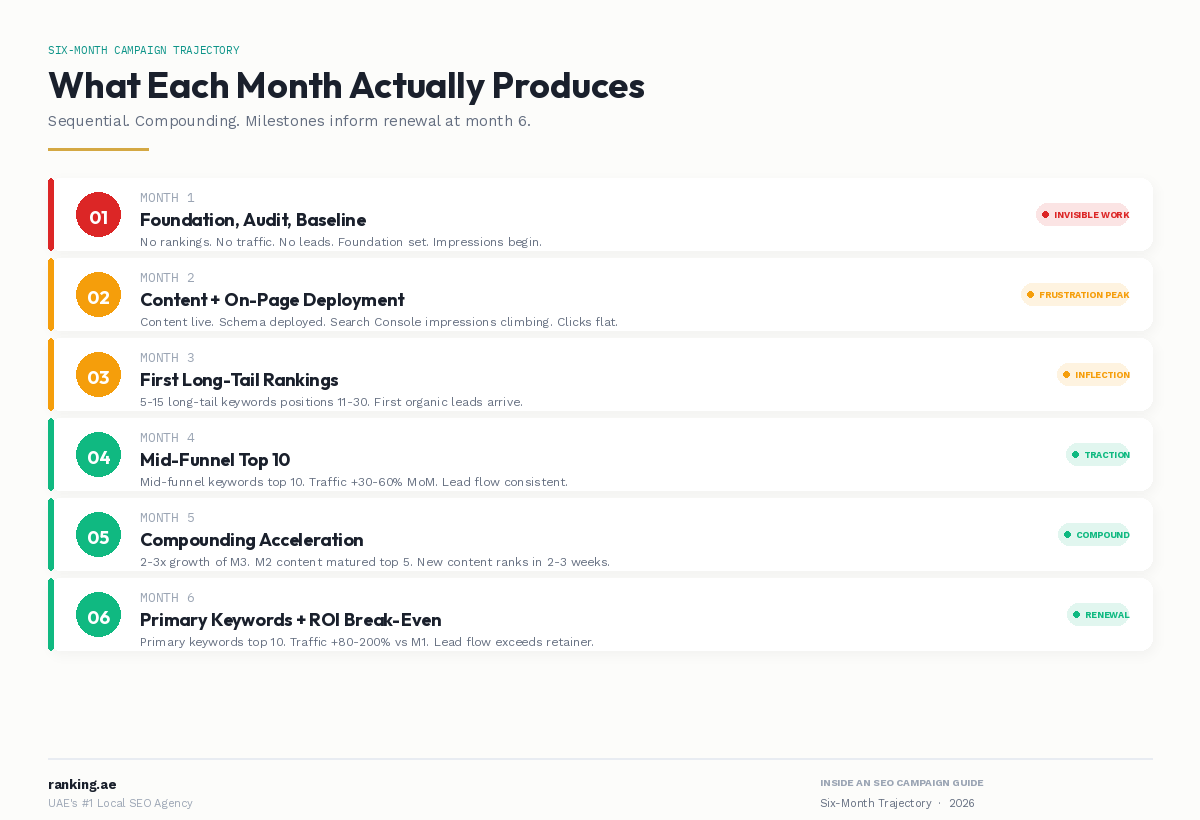
6. Month 6: Compounding, ROI, and Strategic Renewal
Month 6 is the renewal point for most SEO contracts. By this point, the campaign has produced enough data to make an informed decision about continuation versus discontinuation, scope expansion versus scope reduction, and strategic adjustment versus continuation of the current approach.
What month 6 should produce
Primary commercial keywords (the main targets identified in month 1) entering top 10. Organic traffic 80-200 percent above the month 1 baseline depending on starting point and competitive intensity. Monthly lead flow from organic that exceeds the cost of the SEO retainer (the break-even ROI point). Brand SERP density that supports AI search visibility. The first cited mentions in Google AI Overviews and ChatGPT for some priority queries. Break The Web's campaign trajectory analysis aligns with this expectation: "Notable results — or increases in organic positioning, visibility, and traffic — are often achieved after 6-8 months of consistent SEO implementation."
The renewal conversation
A credible agency presents the month 6 review with three explicit components. First, the documented results to date with specific numbers (rankings, traffic, leads, attributed revenue where measurable). Second, the projected results for months 7-12 with specific milestones (which keywords are likely to reach top 3, what additional traffic that produces, what lead flow that generates). Third, the strategic adjustments for the next phase (which content categories to scale, which to reduce, what new content to add, what technical work remains). The renewal decision is informed rather than emotional.
The mathematical reality of month 6
Industry research establishes that the typical top-10 ranking page is around two years old, and pages ranking in position 1 average nearly three years old. This means a six-month campaign has not yet reached the duration where most competitive primary keywords reach position 1. Top 10 entries are realistic at month 6. Top 5 entries on long-tail and lower-competition queries are realistic. Top 3 on highly competitive primary keywords typically requires 9-18 months of sustained work. The expectation framework matters: a campaign producing top-10 entries by month 6 is performing well, even if some primary targets are still at positions 11-15.
The compounding ROI calculation
The most important number at month 6 is not "how much traffic do we have now" but "what is the trajectory of compounding value." A campaign producing 142 percent organic traffic growth in 6 months is also building domain authority, topical relevance, citation foundation, and entity recognition that will continue producing returns for 18-36 months even with reduced ongoing investment. Industry ROI research shows median SEO ROI of 748 percent calculated over a three-year window. Real estate businesses see 1,389 percent. Financial services 1,031 percent. B2B SaaS 702 percent. The investment evaluated at month 6 is being measured at one of the worst possible measurement points; the same investment at month 18 looks dramatically better, and at month 36 better still.
7. What "Bad SEO" Looks Like Month-by-Month (And How to Spot It Early)
The patterns above describe a properly executed SEO campaign. Most Dubai businesses have no reference point for what proper execution looks like, which means they cannot identify improper execution until they have already paid 6-9 months and gotten nothing useful. The diagnostic patterns below allow earlier detection.
Month 1 red flags
No comprehensive audit document. No keyword-to-URL mapping. Vague monthly deliverables described as "SEO work" without specific page-by-page or task-by-task breakdowns. Generic strategy that could apply to any client (the same recommendations a competing Dubai law firm would receive as a Dubai dental clinic). Promises of rankings or traffic improvements within month 1. Refusal to share access to GA4, Search Console, or GBP. Absence of baseline metrics documentation.
Month 2 red flags
No record of pages optimized with specific element-by-element changes. No content production cadence visible. Search Console impressions not improving (suggests either the technical foundation work was not completed correctly or new content has not been indexed). No PR or outreach work documented. Generic "rankings report" without context for which queries are priority and why. The agency hard-selling additional services rather than executing on the original scope.
Month 3 red flags
No visible long-tail ranking movement. No leads attributable to organic search. No strategic review document for the upcoming quarter. Month-over-month performance reports that look identical to month 1 (suggests no progression). Excuses about Google updates rather than data about what was learned and adjusted. The agency suggests "more content" or "more backlinks" without explaining the specific gap that more would address.
Months 4-6 red flags
Traffic growth flatlining when it should be accelerating. Lead flow not consistent enough to project ROI. Backlink profile dominated by low-quality directory submissions rather than editorial mentions. Content production reduced from the original cadence (suggests the agency is over-extended or has lost focus on this account). The renewal conversation focuses on price negotiation rather than results review (suggests the agency knows the results are not strong enough to justify the original investment level).
What to do if you spot the red flags
First, document specifically what is missing or not happening. Vague dissatisfaction is hard to act on; specific gaps are easy. Second, request a meeting where the agency walks through their work and addresses the specific gaps. Third, if the meeting does not produce a credible plan to close the gaps, evaluate whether to continue. Our guide to choosing an SEO agency in Dubai and the agency vs freelancer vs DIY analysis both cover the evaluation framework in more detail.
What Dubai Businesses Should Not Do During an SEO Campaign
Do not cancel in month 2 or 3 because rankings have not moved. The foundation work in months 1-3 is what makes months 4-12 produce results. Cancelling at month 3 destroys the value of months 1-3 entirely. The decision point is month 6 with the strategic review document, not month 3 with vague impatience.
Do not change agencies every six months hoping to find one that "actually works." Each new agency restarts the foundation work that the previous agency had completed. The result is permanent month 1-3 with no compounding effect. Dubai businesses that have hired and fired four agencies in two years typically have less SEO progress than businesses that hired one agency and stayed with it for the full 18 months even if that agency was only mediocre.
Do not expect linear progress. SEO is compound. Month 5 produces 2-3x the growth of month 3 because the foundation has matured. Month 12 produces 2-3x the growth of month 6 for the same reason. Plotting progress as a linear chart and panicking at the slow start ignores the underlying mathematics.
Do not measure success only by rankings. Rankings are leading indicators. Lagging indicators (lead flow, revenue, customer acquisition cost) are what actually determines business outcomes. The
SEO Report Card framework covers the multi-metric evaluation that captures real progress.
Do not pay for "guaranteed rankings" or "first-page guarantees." Any agency offering these is either lying or planning to use methods that will produce penalties later. Ranking is a function of dozens of factors no agency controls. The SEO myths post we published covers the broader pattern of misleading sales claims.
Frequently Asked Questions
What is the minimum monthly budget that produces results in Dubai?
Below AED 2,500 per month, an agency cannot produce the work volume required for measurable results. The minimum viable SEO retainer for a Dubai service business is AED 3,000-5,000 per month for 6-12 months, with budget increases as the campaign matures. Below that range, the agency is delivering surface-level work that rarely produces compounding results. Our SEO pricing breakdown for Dubai covers the underlying economics in detail.
How do I know if I should renew at month 6?
Three diagnostic questions. First: did the agency deliver the work documented in the original scope? (Check the monthly deliverables against the original contract.) Second: did the leading indicators improve? (Search Console impressions, indexation, technical health, citation foundation, content depth.) Third: are the lagging indicators starting to move? (Long-tail rankings, mid-funnel rankings, organic traffic above baseline, first attributable leads.) If yes to all three, renew. If yes to the first two but no to the third, ask for a specific plan for months 7-12 before renewing. If no to the first or second, the issue is execution, not timeline.
What if my industry is highly competitive in Dubai?
Highly competitive Dubai categories (legal services in DIFC, real estate in Marina/Downtown, medical clinics in Healthcare City, beauty salons in Jumeirah/Marina) typically require 9-12 months for primary commercial keywords to reach top 5 rather than 6 months. The month-by-month progression is the same; the absolute results at each milestone are smaller. A 6-month campaign in a competitive category should still show top-10 entries on primary keywords, but top-3 entries may not appear until months 9-12. The expectation calibration matters at the campaign start, not at the month 6 review.
Can SEO produce results faster than 6 months?
In specific cases, yes. New websites with no existing content debt can show traction by month 4. Local businesses with strong existing GBP and reviews can rank in Map Pack within 2-3 months. Long-tail and very-low-competition queries can rank within 2-3 weeks. The 6-month timeline applies to primary commercial keywords with competitive landscapes, which is what most Dubai businesses care about. If your priority queries are all low-competition long-tail variations, the timeline compresses. If they are high-competition primary commercial queries, the timeline extends.
What happens to results if I stop SEO after month 6?
The compounding work done in months 1-6 continues producing returns for 12-24 months even with no further investment, because the content, backlinks, and entity signals are durable. Rankings on existing content typically hold for 12-18 months before competitors catch up and overtake. Our detailed analysis of what happens when you stop paying for SEO covers the decay curve in detail. The right framing is not "stop or continue" but "scale ongoing investment to match the maintenance and growth requirements of the asset built."
How do I measure SEO ROI in months 4-6?
Three components. First, organic traffic value (multiply monthly organic clicks by the equivalent paid CPC for those keywords; this is the cost of replacing organic traffic with paid traffic). Second, attributable revenue (track conversions from organic in GA4, multiply by average order value or customer LTV). Third, brand equity accumulation (citation foundation, backlink profile, content library that continues producing returns for 18-36 months). The third component is hard to value precisely but is often the largest of the three over time. Industry research shows median SEO ROI of 748 percent calculated over a three-year window.
Should I hire a freelancer instead of an agency for the first 6 months?
Depends on the freelancer's specific capabilities. A skilled SEO freelancer can execute months 1-3 foundation work effectively, but the volume of work in months 4-6 (content production at scale, PR outreach, technical refinement, reporting) typically exceeds single-person capacity. Many Dubai businesses get good results from a hybrid approach: a freelancer for strategy and audit work, paired with content production and technical execution from a small team or agency. The agency vs freelancer vs DIY analysis covers the evaluation framework.
What if my agency only sends a "ranking report" each month?
That is insufficient. A monthly SEO report should cover: pages optimized this month with specific changes, content published this month with topic and target keywords, technical fixes completed, citations and backlinks earned, Search Console performance trends, organic traffic by page, lead attribution from organic, and the plan for next month. A pure rankings report tells you nothing about the work being done; it shows only the outcome of work that may or may not be happening. Request the full deliverables list before renewing.
How does SEO interact with AI search visibility?
Directly. The same content and technical foundation that produces traditional SEO rankings produces AI search citations. Our analysis of the 1.2 percent problem in AI visibility documented that ChatGPT recommends only 1.2 percent of locations, and the businesses that win that 1.2 percent are the ones with strong traditional SEO foundations plus schema markup implemented correctly. AI visibility is not a separate workstream from SEO; it is a layer that builds on SEO. The 6-month campaign described in this article also produces measurable AI search citation gains by months 4-6.
Six Months Later, the Same Conversation
The client from the opening of this article sat across the table at 11am on a Thursday in May 2025, looked at the renewal contract, and asked a different question. "What does month 7 through 12 look like?"
The answer that time took eighteen minutes, not forty-seven, because the framework was now familiar. Months 7-9 would scale the content production cadence and shift the work mix toward link earning and brand SERP optimization. Months 10-12 would consolidate gains, run a full content audit on the now-mature content library, and pursue Tier 1 PR placements with the original data the firm had accumulated across the first six months. The metrics targets were specific: primary commercial keywords moving from top-10 to top-3, organic traffic doubling from the month 6 baseline, AI search citations appearing on 8-12 priority queries, brand SERP density supporting Knowledge Panel population.
What had changed between November 2024 and May 2025 was not the work. The work in months 1-6 was the same kind of work that would happen in months 7-12. What had changed was the client's ability to evaluate it. He no longer needed forty-seven minutes of explanation because he understood the Visible vs Invisible Work Ratio, knew which deliverables to expect each month, and knew how to spot the early warning signs that would tell him whether the campaign was on track. The single biggest deliverable an SEO agency can provide in months 1-6 is not the rankings, the traffic, or the leads. It is the literacy that lets the client become a competent evaluator of the work. Once a client can look at month 2's impressions trend in Search Console and explain what it means without an agency interpreter, the relationship becomes a partnership rather than a service. The clients who renew at month 6 are not the clients who saw the most rankings. They are the clients who learned the most about what was actually happening. The agencies that lose clients in months 2 and 3 are the agencies that withheld this education to keep the client dependent. The agencies that build long-term relationships are the agencies that taught the client to read the data themselves. The forty-seven-minute explanation in November 2024 was an investment, not a cost. The eighteen-minute renewal conversation in May 2025 was the return on that investment.
———
Request a free SEO audit and we will run the diagnostic that month 1 of any properly executed campaign produces, identify the specific opportunities for your business, and walk through what the next six months of work would look like with documented monthly deliverables. View pricing for transparent retainer tiers, or explore the full blog library for the operational guides that feed every section of this article.